Maren visits Frank and reads his notes
Bones & AllMaren’s visit to Frank Yearly at Bridewell Hospital turns an almost wordless encounter into a belated meeting between father and daughter: Frank cannot tell her his history aloud, so she discovers it in the notebook he wrote for the child he did not know existed. The visit gives Maren evidence that she was wanted and that her father once imagined becoming a good parent, while also revealing the childhood violence at the origin of his cannibalism. Its central exchange is therefore divided between a silent present and a written past.
The Visit to Bridewell
Before Maren is admitted, a doctor tells her that Frank is doing fairly well, is alert, and has eaten most of his breakfast. Permission to see him is limited to ten minutes, and Travis must remain with her for her safety. The restriction makes the visit feel less like an ordinary family reunion than a controlled encounter, although the reason for the safety precaution is not explained in this scene.
Travis leads Maren through swinging doors and a long corridor, unlocks the room with keys from his belt, and enters with her. Frank is seated at a padded table with his back to the door. His bed is visible nearby, with leather restraints hanging from its sides. When he turns toward Maren, she recognizes how much time has changed him: the boy in the yearbook photograph is gone, and the man before her has watery eyes, gray stubble, and strained neck and jaw muscles. He does not smile or speak.
Maren greets him as her father. Frank’s eyes widen and tears run down his cheeks; his lips move, but she cannot understand him. The scene leaves his intended words inaccessible, making his physical response the only immediate sign of recognition or feeling. Maren’s thought of the father who will never again sing while cooking breakfast places this impaired encounter against an imagined domestic life that can no longer be recovered.
The Notebook as a Meeting
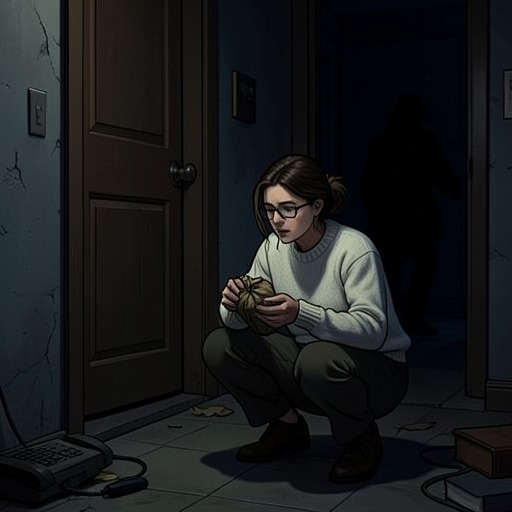
Frank has been at the institution for nearly fourteen years. Travis places an old, marbled black-and-white composition notebook on the table. Its yellowed cover and pages crinkled by old spills make it feel both long kept and materially vulnerable. At first, Maren mistakes it for her own journal; the resemblance unsettles her before Travis explains that Frank wants her to read it and wrote it for her.
The notebook offers what Frank cannot provide in conversation. His handwriting is difficult to decipher, and his eyes remain wet as Maren begins. The opening addresses an unknown child by the family name Yearly. Frank says he does not know the child’s name or even whether the child is a boy or a girl, and fears that the child may hate him. He has written in case the child comes to visit, because he is afraid that by then he will no longer be able to answer questions. His words establish the notebook as an attempted conversation prepared for a future he could not be sure would arrive.
That intended recipient changes the meaning of the encounter. Frank has not been waiting with knowledge of Maren herself: she realizes that he did not know about her. Yet he had imagined a child who might one day find him, and had left that child an account in place of the answers his failing memory might prevent him from giving. The visit joins the daughter who has arrived to the child Frank once addressed without knowing her identity.
Memory of Janelle and the Unborn Child
Frank writes that he cannot remember his biological parents or even the name they gave him. By contrast, his time with Janelle remains clear. He recalls waking in the institution and feeling, for a moment, as if she had been beside him, with the remembered scent of her shampoo and the image of bacon frying nearby. He knows that his memory is full of blanks and expects it to diminish further the longer he remains there. The domestic details persist where other parts of his past have disappeared.
The notebook recounts their meeting when Frank was twenty-two and working as a forest ranger at Laskin National Park. Janelle sat at the entrance gate collecting fees. Their first conversation, prompted by an inflatable woman in a red wig in a visitor’s car, became the beginning of a love Frank describes as immediate and enduring. He remembers their jobs as leaving time for swimming and hiking, and admits that neither worked as hard as they could have. In the notebook’s account, shared leisure and laughter form the texture of the summer he later calls perfect.
Frank also tells the child that Janelle was happy during the pregnancy and sang lullabies as if the baby were already born. He had promised himself that he would be a real father and give the child a childhood unlike his own. Reading this, Maren understands that her mother had wanted her and that, for at least a time, Maren had made Janelle happy. The revelation does not erase the later rupture between mother and daughter; it gives Maren a specific, written memory that complicates what she thought she knew about her beginning.
That remembered happiness was already vulnerable to interruption. Frank describes Robby arriving while Janelle was working at a hotel on Whippoorwill Lake, drunk and making degrading remarks about her. Frank says he knew the claims were lies, but could not thereafter remember their summer without hearing them. The notebook thus records not only love but the intrusion of words that altered how Frank could remember it. Maren’s reading moves between tenderness and damage, without reducing either to the other.
Frank’s Confession and the Limits of Speech
After several blank pages, Frank announces that he wants to be good for the child but can only be honest. He then describes the earliest event he remembers: as a very small boy, he was led by a man to a restroom behind a gas station, where the man locked them in and tried to make him do something bad. Frank says that he ate the man. He recalls having milk teeth, grinding the bones down, and becoming hungrier the more he ate.
Frank distinguishes his experience from people who eat human flesh as an ordinary person might eat steak or a hamburger. He presents his act not as a conventional appetite or a deliberate choice but as something that happened in childhood during an attempted assault. The account exposes the origin of his condition while preserving the horror of the act; it does not make the event harmless or simple. Frank apologizes for the pain and shock the disclosure may cause his child, writing the confession because he wants the child to know the truth.
He also explains that Janelle could make him forget he was a monster, even after learning what he had done. In Frank’s account, her love allowed him to imagine living honestly and well. The statement links his hope of becoming a father to the acceptance he experienced with Janelle, while the notebook’s confession shows how difficult that hope was to sustain. Maren’s visit ends not with a spoken reconciliation but with this written testimony: Frank cannot make himself understood in the room, yet the notebook lets his love, fear, and history reach her across years of silence.