Maren's birth certificate
Bones & AllMaren's birth certificate is both an official record and a turning point: its faded entries identify Francis Yearly as Maren's father, giving her a name to follow after Janelle leaves her, while later encounters reveal how little the document can explain about the family it records. Blue, crinkly, and unfolded with care, it makes Maren's parentage legible without resolving the secrets, absences, and obligations attached to it.
The Document and Its Entries
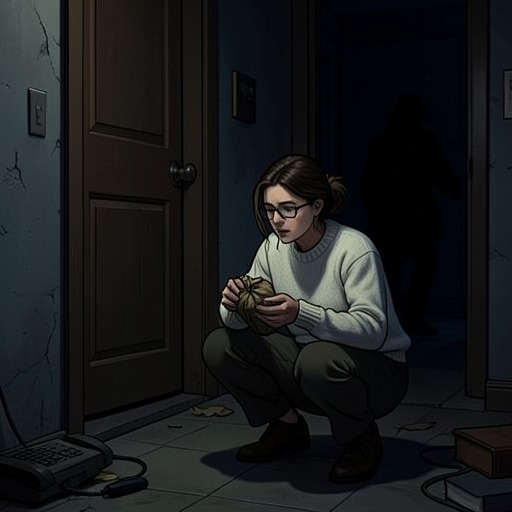
The certificate first appears among the things Janelle leaves behind. The day after Janelle leaves, Maren goes into the kitchen, throws a dish to the floor, then steps over the pieces and picks up a fat white envelope. She finds money inside, but also the certificate. Its material condition matters to the scene: the paper is blue and crinkly, and Maren takes her time unfolding it. She treats the record as something close to sacred, even while describing herself as a monster. It is not merely a paper that identifies her; it is a rare object carrying information about the person she is and the family she has not been allowed to know.
The entries give that information a precise, bureaucratic form. The certificate names the General Hospital of Friendship, Wisconsin; records Maren's birthday, sex, length of 20½ inches, and weight of 7 pounds 12½ ounces; and lists her mother's maiden name, Janelle Shields, with Edgartown, Pennsylvania, as her place of birth. In the space for her father, it names Francis Yearly. The contrast between exact measurements and the emotional force of that last entry is central to the discovery: among the facts printed in faded type, the name changes Maren's sense of what is possible. She had known she had a father in the abstract; seeing his name makes him a person she can seek.
A Name to Follow
Before reading the certificate, Maren has asked Janelle about her father only once. Janelle says he is gone, and does not answer when Maren asks his name. Maren imagines that her parents were married because Janelle still wears a ring, has no boyfriends, and shares her surname with Maren. These are a child's inferences, not knowledge. The record confirms that her parents were married, as Barbara Yearly later acknowledges, but its entry does not explain why the father disappeared from Maren's life or what happened between her parents.
The name on the certificate gives Maren a destination as well as an identity. She understands Sandhorn, Minnesota, as the place Janelle expects her to go with the money, and interprets the arrangement as a demand to find her father and forget her mother. She resists that implication: she wants to make things right with Janelle. Yet she has also kept the address of her grandparents from a Christmas card on the inside cover of her notebook, and, after Janelle leaves, decides to go there. The document therefore does not simply settle a question. By naming Francis Yearly, it sharpens Maren's conflict between trying to return to her mother and pursuing the family history her mother has withheld.
Proof in Encounters
When Maren reaches Barbara Yearly, the certificate becomes a means of introduction. Barbara asks how Maren found her; Maren unfolds the paper and holds it out. Seeing the name, Barbara recognizes the family connection and notes that Maren has been given their name. Maren answers that her parents were married, and Barbara confirms it before inviting her inside. In this exchange, the document does more than announce a fact: it allows Maren to approach a relative who can respond to what it records. Barbara's recognition validates the name, but it does not make the family history simple. She later says that she and her husband adopted Francis after Tom and that they knew the boy had been found under mysterious circumstances. The official record identifies Francis as Maren's father; it cannot disclose the circumstances surrounding his own beginnings.
The same paper is offered as proof when Maren seeks to visit Francis at Bridewell Hospital. She slides the folded blue certificate across the director's desk, ready to establish that she is his daughter. Dr. Worth does not examine it; instead, she opens a manila folder and warns that Francis is very sick and that a visit after all these years could upset both him and Maren. The document's evidentiary force is thus limited by the institution's separate knowledge of Francis's condition and history. Its claim is not disproved, but neither does it grant Maren immediate access to the father it names.
What the Record Cannot Settle
Francis's notes eventually reveal that he did not know about Maren. She understands that her father had never known she existed, a discovery that changes the meaning of his absence: the certificate had named a relationship, but it could not show whether that relationship was known or lived. His account also describes his childhood first act of eating another person and the circumstances of his adoption by the Yearlys. Together with Barbara's account of a boy found under mysterious circumstances, these disclosures expose a family history that the certificate's orderly fields cannot contain.
The document's importance consequently rests in both its authority and its limits. It gives Maren an origin point—her recorded birth, her mother's name, and Francis Yearly's name—and enables her to make contact with the paternal family. But it cannot supply the story behind those entries, guarantee welcome, or undo the years of separation. Later, Sully tells Maren that Francis is his son, bringing the named father into a further family connection that the certificate itself does not explain. Across these encounters, the paper remains a durable piece of evidence, while kinship emerges through a more unsettling mix of recorded identity, concealed history, and what people know or choose to do for one another.