Sully and Maren Yearly
Bones & AllSully and Maren Yearly’s relationship shifts from tentative companionship to a concealed claim of family and, finally, direct violence. Sully first offers Maren a place beside him on what he describes as a lonely road; she later learns that he is her grandfather and that his interest in her has been shaped by his inability to reach her father. The warmth of his hospitality and the danger of his pursuit remain inseparable: the same man who feeds and shelters her eventually traps her with a knife.
An Offer of Company
Sully’s first connection with Maren carries the promise of a possible alliance. He remembers the note he wrote when they met and recognizes that she did not come away with him. When they meet again, he asks how she came to travel with Lee, and Maren recounts hitchhiking from St. Louis and being left at a Walmart in Iowa. Sully reacts to the distance she has covered with exuberant recognition. His questions place her wandering in the context of their earlier encounter, even before she understands why he has kept track of her.
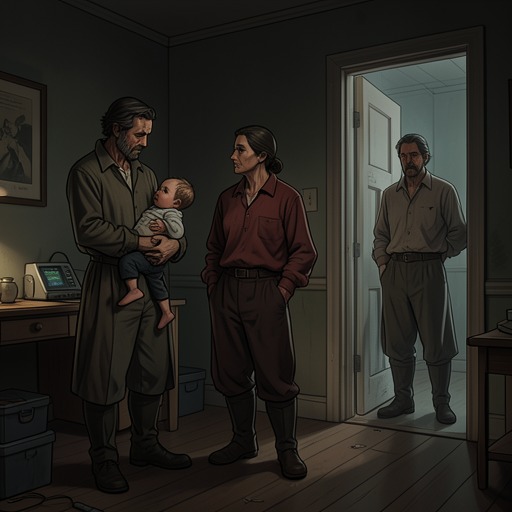
At his cabin, Sully makes room for both Maren and Lee. The old but sturdy house has a well and cast-iron pump behind the porch, a sitting room with a woodstove and braided rug, and mounted deer heads whose largest antlers nearly touch the ceiling. Sully assigns the two visitors the bedroom’s twin beds, covered with red-and-blue patchwork quilts, and offers Lee the couch if sharing a room would be uncomfortable. The arrangement is ordinary, practical hospitality, but it also gives Maren shelter and a place in Sully’s household.
Over dinner, Sully revises the advice he had given her when they first met: rather than insisting that people should avoid making friends, he says that a hard, lonely journey need not be made lonelier. He then describes people like them as needing to make their own family. Maren accepts a second helping and thanks him both for dinner and for looking out for her. Her thoughts turn to her other grandfather, who has wealth and a navy-blue Cadillac but, in her view, would never cook for her or offer her a place to stay. Sully’s care appears, by contrast, to be something enacted through food and shelter. Yet the promise of chosen family will later be complicated by the blood tie he has not disclosed.
The Hidden Family Connection
Maren’s understanding of her family is already unsettled when she encounters the account of her father’s childhood and origins. Barbara Yearly says the boy had been found in mysterious circumstances before the Yearlys adopted him, while acknowledging that the family may have been too eager to overlook those circumstances. Maren has wondered why the Yearlys kept her; she recalls that they may have felt bound by a promise and wanted to remain good people. Her father’s own account describes being treated as an inadequate replacement for Tom, with his adoptive family repeatedly measuring him against the absent boy. These histories make the question of who belongs to a family more complicated than a simple distinction between blood and adoption.
In his writing to his child, Frank recalls that, as a very small boy, he was led by a man into a gas-station restroom and ate him after the man tried to make him do something bad. Frank distinguishes his experience from ordinary people who eat human flesh as they would steak or hamburgers: he describes an overwhelming hunger that continued as he consumed the man, even grinding the bones with his milk teeth. He writes that Maren’s mother helped him feel capable of living honestly despite what he had done. The account establishes a history of appetite and secrecy in Maren’s paternal family, though it does not by itself explain Sully’s conduct or prove how that history passes between generations.
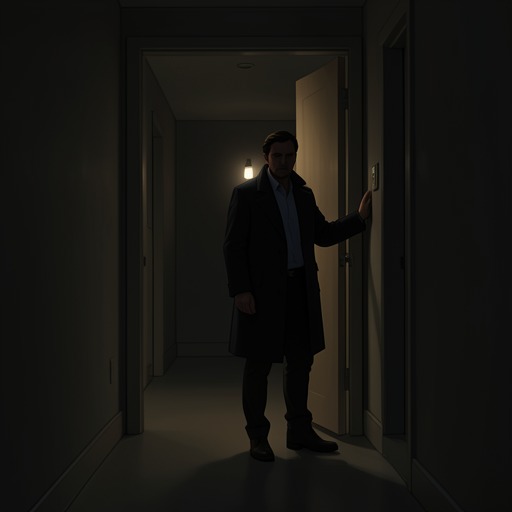
The revelation comes when Maren wakes in Jamie Gash’s spare room and finds Sully seated in the darkness. He has seen her father’s national-park identification card and says that Frank left it there; then he tells Maren that Frank is his son. The news transforms the earlier scenes of welcome. Sully is not merely a traveler who once offered Maren company: he identifies himself as her grandfather, linking his concealed past to the father she has been trying to find. Maren’s shock is sharpened by the fact that she had not understood that her father knew nothing about her. Sully’s claim supplies a new family connection, but it does not restore the relationship she hoped to have with Frank.
Waiting for Maren
Sully explains that he could not get to Frank without making a scene and waited too long; Frank is now hiding, and Sully believes he cannot reach him. He then discloses that he knew Maren was out there and had been waiting for her to come back. His words make the relationship’s asymmetry plain: Maren had been searching for her father, while Sully had been watching for her as a route toward the family he could not reach directly. The earlier note and invitation acquire a more ominous significance in light of this confession. What Maren experienced as an offer of companionship had also placed her within Sully’s attention as his granddaughter.
Sully’s relation to family is not expressed through the same form of feeding as Frank’s childhood experience. Maren recognizes that Sully eats people who are already dead, and his breath carries the evidence of that practice. The contrast does not erase the disturbing resemblance between father and son: Frank’s account of his first act and Sully’s consumption of corpses bring bodily hunger into the family history. Sully’s words about making a family therefore have two possible meanings. They can describe the care he offered at the cabin, but they also sit beside a kinship claim formed around secrecy, appetite, and the pursuit of relatives.
From Grandfather to Pursuer
Sully’s claim of kinship does not lead to reconciliation. He attacks Maren with the knife he had used to peel an apple, pressing her against the bed and putting the blade to her left forearm. Maren fights back by kicking at his legs, freeing one hand, and batting the knife away by its handle. Reaching for Mr. Harmon’s Sphinx trophy on the nightstand, she strikes Sully on the back of the skull and then hits him again as he raises a hand to his head. Blood gets on her fingers. She escapes down the cabin’s creaking wooden steps with only her journal and her birth certificate, leaving her belongings behind because she expects him to recover quickly.
That escape does not end the pursuit. About a month later, Sully finds Maren in Kerri-Ann Watt’s room at Bridewell. He has a pocketknife and blood crusted around his fingernails. He tells her that she has been a bad girl and casts himself as the grandfather responsible for setting her right, turning kinship into a justification for control. He pushes her toward the bed, bolts the door, and threatens to slit her open if she looks toward the exit again. Maren knows Lee will not return for hours, and the fading daylight leaves the room in shadow. The domestic role Sully once performed by offering a bedroom and a meal has become its opposite: he has followed Maren into another room and made it a trap.
The Confrontation and Its Reversal
Maren tries to keep Sully from treating his claim as an unquestionable right over her. She tells him that Lee can handle him and that Lee eats people the world is better off without. Sully answers by insisting that everybody does it, a claim that echoes the attempt to make his own behavior seem inevitable. Maren counters that his assertion is not true and warns that if he eats her, Lee will eat him. She is not simply pleading for rescue; she uses what she knows about Lee to make Sully anticipate the consequences of his attack.
When footsteps approach in the corridor, Maren is sure Lee has arrived. Sully lunges. She lets go of his hand at the last moment, sending him forward onto the bed, where his own knife plunges into a pillow. She climbs onto his back and grabs his knife hand from behind just as the dead bolt gives way and the door opens. Sully looks startled and almost frightened; for a moment, the man who has hunted Maren for a month seems frail. Lee takes Sully by the arm and tells Maren to wait in the bathroom. She bolts the door again. The scene closes with the immediate balance of power reversed: Sully no longer controls the room, while Maren is left to wait as Lee confronts him. Their relationship has reached its starkest form—not the chosen family Sully once invoked, but a family claim answered by resistance and intervention.