Travis
Bones & AllTravis is an orderly at Bridewell Hospital whose gentle attention helps Maren approach her estranged father, Frank Yearly, and whose effort to show Frank that he was not alone has grave consequences. He becomes more than a hospital attendant: he helps bring Frank’s past into the room, then admits that his own need for connection shaped the search that preceded Frank’s self-inflicted injury. His kindness and his mistake are bound together by the same concern for isolation.
Identity and Introduction
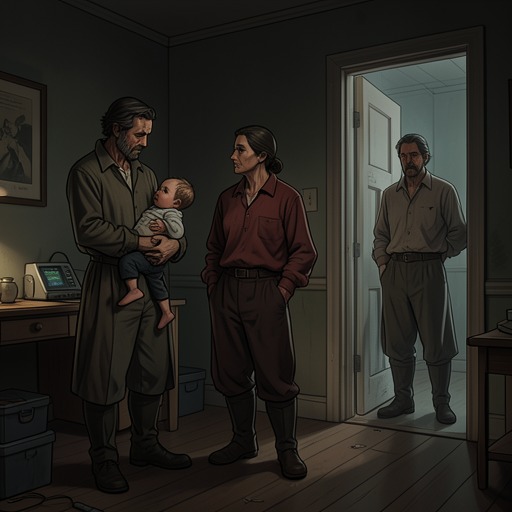
Maren first sees Travis when Dr. Worth summons him to her office. He is tall and somewhat overweight, wearing gray hospital scrubs, with an overdue haircut. His appearance is not what makes the first impression, however: Maren reads him as gentle and teddy-bearish and immediately expects that he will be kind to her. That initial instinct proves consequential. At Bridewell, where her father is hospitalized and their relationship has been interrupted by years of separation, Travis is one of the people who makes a meeting possible.
His work is practical as well as sympathetic. When Dr. Worth asks whether Frank is awake, Travis confirms that he is. Later, he tells Maren that the doctor is attending another patient in the north wing, so it is safe for Maren to remain a little longer. He understands that the visit needs time and gives her that time without making the exchange about himself.
Helping Frank Speak
At Frank’s bedside, Travis acts as a quiet intermediary between father and daughter. Maren reaches for Frank’s limp, clammy hand, but Frank’s attention remains fixed on Travis as he opens the bedside drawer. Travis tells Maren that Frank wants her to read something, and when she asks how he knows, he explains that Frank came to Bridewell during Travis’s first week on the job. He frames their history as a road they have walked together. The remark suggests a continuity of care: Travis has known Frank not only as the father Maren has come to see, but as a patient whose trust has accumulated over time.
He helps Frank share two different kinds of evidence. First, Travis prompts him to show Maren the photographs. From the drawer he produces a small leather album stamped in gold leaf with the title Our Perfect Summer. Inside, Maren finds her mother’s initials joined to Frank’s in a red heart, with 1980 beneath them. The album opens onto Frank and Janelle’s early life together: the summer when they met at Laskin National Park, before marriage and before Frank’s secret came between them. Travis does not supply that history himself; his role is to help Frank place it in Maren’s hands.
The photographs are also a form of access to a mother Maren remembers through guilt and loss. She turns the pages in silence, seeing Janelle in her ranger uniform, on horseback, and laughing over a hot fudge sundae. The album lets Frank show his daughter a life in which Janelle was not yet defined by what followed. Travis’s simple act of retrieving it enables a private family history to become visible to Maren.
Frank’s Secret and Travis’s Responsibility
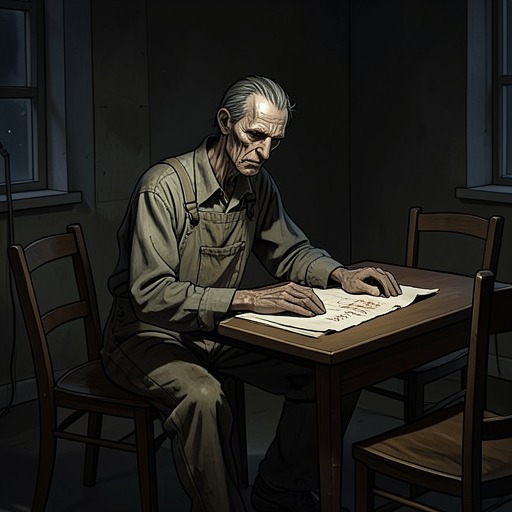
Travis also helps create the conditions for Frank’s written account to be read. Frank’s notes move from his childhood memories and his fear that he is a monster to the account of his first act of cannibalism: as a small boy, he ate a man who had led him into a restroom at a gas station. The revelation clarifies what Frank had concealed from Janelle and why he feared that his daughter might inherit the same nature. Travis is not the source of the confession, but his care for Frank and his practical assistance allow Maren to encounter it through the objects Frank has left for her.
Later, Travis tells Maren that he believes he is responsible for what Frank did to himself. He explains that he had hoped to find proof that Frank was not alone and had spent months searching for the right people and working out how to ask them questions. He knew the inquiry was dangerous but continued anyway. The admission establishes both his motive and the cost of his intervention: he wanted to relieve Frank’s isolation, yet the evidence he sought did not protect Frank from harm. Travis does not present his intention as an excuse; he names his own part in what happened.
Loneliness and Relationship with Maren
When Maren asks why he is so fixated on the Eaters, Travis denies that he belongs to their group. His interest is not presented as proof that he shares their condition. Instead, the conversation reveals a loneliness that predates his investigation. He tells Maren that he has felt alone all his life, tried repeatedly to make friends, and felt that no one remained to love him after his mother died. A man he had described as a friend, a police officer, was not, in Travis’s view, truly a friend.
As he cries, Maren feels pity mixed with embarrassment. When Travis meets her eyes, she sees not simply an adult orderly but an inconsolable little boy. He recognizes a parallel between them: Maren’s parents are alive, but she is also alone. His words do not erase the difference between her family history and his, nor do they make them interchangeable. They reveal instead why he was drawn to Frank’s case and why he hoped that discovering others like Frank might offer more than information. For Travis, the search for proof was also an attempt to find a connection that his own life had not provided.
Narrative Role and Significance
Travis occupies a fragile position between care and intrusion. At Bridewell he offers Maren time, steadiness, and access to her father’s photographs and writings; outside that immediate bedside role, his investigation has helped precipitate the crisis for which he blames himself. The novel therefore gives his compassion a consequence rather than treating kindness as automatically harmless. He wants to lessen another person’s solitude, but his method carries risks he recognizes without being able to control.
His encounter with Maren also makes loneliness a point of recognition rather than a cure. Travis can name the isolation they share, but he cannot undo Frank’s injury or restore the family histories that shaped either of them. His importance lies in making the hidden legible: he helps Frank’s private record reach Maren, and then exposes the personal need behind his own search. In both cases, the attempt to reach another person begins with the hope that nobody has to face the truth alone.