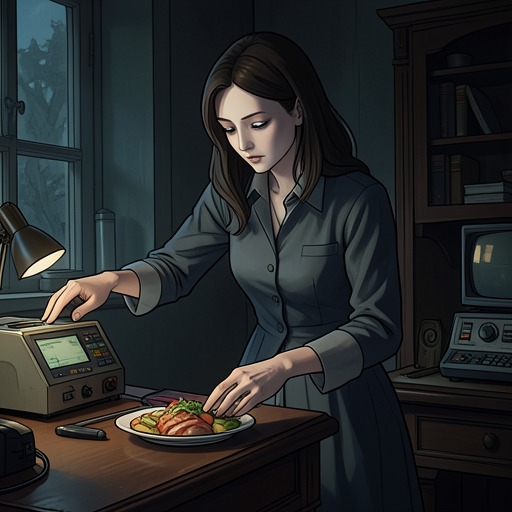
“Two kinds of hunger”
Bones & AllTwo kinds of hunger is the expression Maren uses to distinguish everyday appetite from the cannibalistic compulsion that can overtake her. Its importance lies not only in naming two urges but in showing how differently they operate: one can be satisfied with ordinary food, while the other waits, attaches itself to a person, and makes resisting feel like standing before a banquet while being told not to eat. The distinction gives the novel a language for Maren’s fear of her own nature, and for its broader scrutiny of what societies accept as food.
The division between appetites
Maren describes the first hunger as one she can satisfy with cheeseburgers and chocolate milk. The second is more dangerous precisely because it does not demand immediate attention. It can wait for months or even years, she says, before she gives in; then the person it has taken as its focus seems to her like the only thing capable of filling a great hole inside her. The image makes the compulsion feel both internal and specific: it is a hunger within Maren, but it is not interchangeable with ordinary appetite, and its object is not simply a meal.
The expression emerges in the aftermath of the Christmas party where Jamie Gash disappears. Maren and her mother drive home in silence, and Maren turns Jamie’s eyeglasses over in her hands. She has completed her homework but does not turn it in. The scene moves from a concrete remnant of Jamie to Maren’s attempt to understand what has happened inside her. Her account makes the two hungers a distinction learned through consequence, not an abstract theory of appetite.
That distinction is also the substance of Maren’s mother’s plea that she try to be good. Maren nods, but understands that effort alone cannot settle the matter: the demand feels to her like being led to a banquet and ordered not to eat. The comparison exposes the distance between an outsider’s moral instruction and the force of Maren’s bodily compulsion. It does not excuse what she does; instead, it shows why the language of simple obedience cannot describe her struggle.
Hunger as a sensory warning
Before Maren can fully explain the danger, she experiences it through smell. At summer camp, standing beside Luke Vanderwall in the dark, she detects the lake’s rotten-egg odor, chili powder on his breath, and even the lint between his toes. The unusual precision of the perception turns closeness into alarm: she recognizes a hunger and a certainty she cannot yet account for, and fears that she is about to repeat something horrible from her early childhood. She knows nothing about Penny Wilson at that moment, but senses that one of the two children will not come out of the tent.
The tent is not magical. What makes the moment ominous is Maren’s sudden conviction, registered through her body before she can make sense of it. Luke has made something for her, and his eagerness for outdoor life is part of what she smells: wet leaves, salty skin, and hot cocoa in a tin cup shaped by his hands. As the two play old maid, the ordinary details of their evening become unbearable to her. She stops wanting to play and imagines the future Luke will lose: growing up, becoming a forest ranger, riding horses, fighting forest fires, and living in a tree house. The hunger does not erase her awareness of Luke as a person with a future; the force of that awareness sharpens her dread of what may happen.
Later, the same sensory pathway makes kindness from Andy feel perilous. In his car, Maren smells corn chips, cinnamon gum, and cigarette smoke, and the sensations make her twitch. She asks him not to be so nice because she has done terrible things and fears that, if he keeps her from leaving, she will do the same to him. When he locks the doors and pulls her toward him, the scene binds her warning to immediate danger: ordinary closeness and help cannot be separated from the possibility that her hunger may attach itself to the person offering them.
Ordinary food and temporary reprieve
Maren’s wish for a Snickers bar at Walmart shows that ordinary appetite remains real, but also that she sometimes wants food to serve as a brief disguise. She imagines that candy could let her forget everything for a minute and a half and pretend to be normal. The modest duration matters: the snack promises relief, not a cure. Unlike the second hunger, it does not take a person’s shape, but Maren hopes it might temporarily interrupt her consciousness of being different.
That contrast gives the expression its everyday scale. Cheeseburgers, chocolate milk, and candy belong to recognizable eating; the cannibalistic hunger is not a larger version of the same craving. It has its own pattern of waiting, fixation, and consequence. Yet the novel keeps the two forms of eating in uncomfortable proximity rather than treating ordinary food as ethically neutral by definition.
Explanations, inheritance, and limits
Sully offers Maren another way to think about the condition. He tells her that he can sometimes sense when someone is close to death, though he cannot describe how he knows, and explains that he once felt like a vulture waiting outside a person’s home. He now treats his nature as something that cannot simply be changed. His account differs from Maren’s: he says he eats people who are already dead, whereas her terror centers on a hunger that may drive her toward someone still alive. His explanation supplies a rule of acceptance, but it does not resolve the moral danger that Maren experiences.
Sully also describes communities in which eating the dead is sacred and understood as a way for children to take in the wisdom of their elders. Maren challenges the logic: why not teach children that wisdom while still alive? Sully replies that wisdom cannot be taught. Their exchange complicates the expression’s meaning without making the practices equivalent. The same broad act of consuming human flesh can carry different meanings in Sully’s account and in Maren’s feared compulsion; the circumstances, the relation to the dead, and the consequences matter.
Frank’s account of his childhood gives Maren’s condition a family history. As a very small boy, Frank was led by a man into a restroom at a gas station and ate him after the man tried to make him do something bad. Frank remembers that, even with milk teeth, he ground the man’s bones down, and that the more he ate, the hungrier he became. His testimony echoes the escalating hunger in Maren’s description, while remaining its own remembered event. He says Maren’s mother made him feel he could live well and honestly even after learning what he had done; he also says he left because he could never be completely sure he would not hurt her or Maren. His confession makes the hunger a shared family secret, not proof that Maren’s future is predetermined.
Ethical and narrative significance
The expression’s distinction between ordinary and cannibalistic hunger is central to the book’s ethical tension. In the acknowledgments, the author connects the novel to a desire for a more honest examination of flesh eating and its environmental and spiritual consequences. Sully’s comparison with sacred consumption and Maren’s reliance on familiar foods place different forms of eating beside one another, making the boundary between accepted appetite and forbidden appetite available for scrutiny. The novel does not erase the differences between eating animals and eating people; it uses Maren’s divided experience to make the assumptions supporting that boundary harder to leave unexamined.
As a narrative device, the expression also translates what Maren first experiences as bodily intensity into a concept she can tell herself and others. Smells, a tightening sense of certainty, the memory of Jamie’s eyeglasses, and the imagined future lost to Luke all precede or exceed calm explanation. Naming two hungers organizes these sensations without making them harmless. The phrase therefore holds together the novel’s central contradiction: Maren can recognize the person in front of her, fear the harm she may cause, and still experience a compulsion she cannot satisfy with ordinary food.