Frank's first childhood act of cannibalism
Bones & AllFrank's first childhood act of cannibalism begins with an attempted assault at a gas station and becomes the secret that shapes his understanding of himself as a danger to those he loves.
The gas-station attack and its aftermath
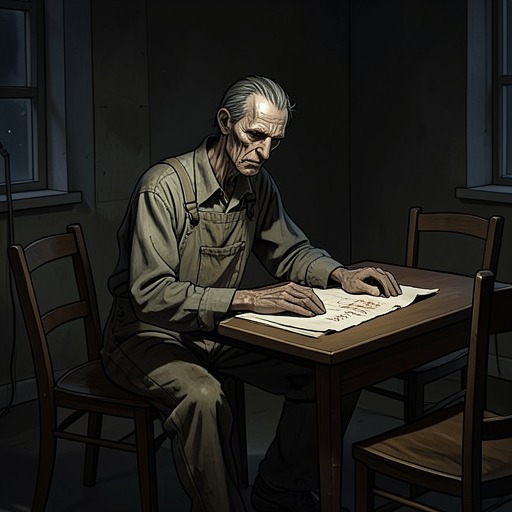
Frank’s notebook identifies the first thing he remembers: standing beside a bus at a gas station while a man led him by the hand into a restroom behind the pumps. The man locked them inside and tried to make the boy do something bad; Frank’s account says that he responded by eating him. He remembered nothing from before waking in the hospital. Years later, his adoptive mother told Maren that witnesses had seen the strange-looking man take the boy off a Trailways bus and lead him behind the building. They found Frank unconscious and covered in blood after opening the restroom door, but the man had disappeared. The gas-station owner called the police; Frank’s parents and the attacker were never found, and the adoption agency eventually brought the boy to the couple who named him Francis.
A confession of hunger and fear
Frank Yearly’s notebook distinguishes his act from ordinary human consumption of meat: he describes eating the man not as a choice to treat another person as food, but as the response of a small child being attacked. Even with milk teeth, he ground the man’s bones down to nothing; eating did not satisfy him but made him hungrier. The violence that began in the restroom therefore also disclosed a condition Frank could not explain away as a single defensive act. In his account, the child survived, but what he discovered about himself was frightening and lasting.
That discovery shaped how Frank understood his capacity to be a husband and father. He writes that Janelle, after learning what he had done, could make him forget that he was a monster and believe he might live honestly and do good. His love for her was bound to that reprieve, but it could not remove his fear that he might harm her or their daughter. He says he left because he could never be completely sure he would not hurt them. The childhood act thus reaches beyond the gas station: Frank’s later separation from his family becomes an attempt to protect them from a hunger he could neither explain nor trust himself to control.
An inherited pattern of recognition
The episode’s significance becomes clearer in the later echo of Maren’s childhood. In the darkness beside Luke and the red tent he had made for her, she registers him in unnerving detail: the lake’s rotten-egg smell, chili powder on his breath, even the lint between his toes. Then hunger arrives with certainty. Maren does not consciously remember Penny Wilson, but she senses that she once did something horrible and is close to doing it again; she knows that one of them will not come out of the tent. Where Frank’s notebook makes a child’s first act of cannibalism the beginning of his knowledge about himself, Maren’s bodily recognition precedes any clear explanation of her own past.
The earlier aftermath of Penny Wilson’s death gives that parallel a physical trace. Maren’s mother finds blood on her daughter’s face and clothes and, inside her mouth, the hammer of Penny’s eardrum. The discovery prompts the family’s first hurried move, establishing flight as a response to the violence. Maren later says she does not remember the scene, though she knows what happened; the gap between conscious memory and bodily evidence echoes the way Frank’s remembered beginning is bounded by what he can recall. Together, their stories make the childhood act more than an isolated horror: it is a family secret encountered through hunger, aftermath, and the effort to escape.
Hunger, appetite, and the meaning of eating
Frank’s first act belongs to a wider pattern in which hunger is registered through the body before it can be made into a stable explanation. Later, after Maren eats Andy, she brushes her teeth four times and repeatedly gargles with Listerine, but still tastes him beneath the mint. The mouth becomes evidence that an act cannot simply be washed away: bodily traces persist after the moment of eating, just as the childhood assault remains central to Frank’s account of who he is.
Sully offers a different way of living with the same condition. He says he eats people who are already dead and can sometimes sense, from their smell or faces, that death is near. He remembers once waiting outside someone’s home like a vulture, but says he no longer thinks of it that way and accepts that a person cannot change what he is. His account of communities that eat deceased relatives as a sacred means of inheriting their knowledge gives human consumption a ceremonial meaning; Sully then distances himself from that interpretation, saying he simply eats. Against this range of explanations, Frank’s childhood experience remains starkly personal: the hunger intensifies rather than resolves, and becomes a source of fear about the people he loves.
The novel’s boundary between human flesh and ordinary meat is also unsettled by the author’s stated purpose. In the acknowledgments, the author links writing about cannibals to a desire for individuals and society to examine flesh-eating and its environmental and spiritual consequences. That framing does not erase the violence of Frank’s experience; it places the horror beside a question about which forms of eating a society treats as ordinary, and which it marks as monstrous.