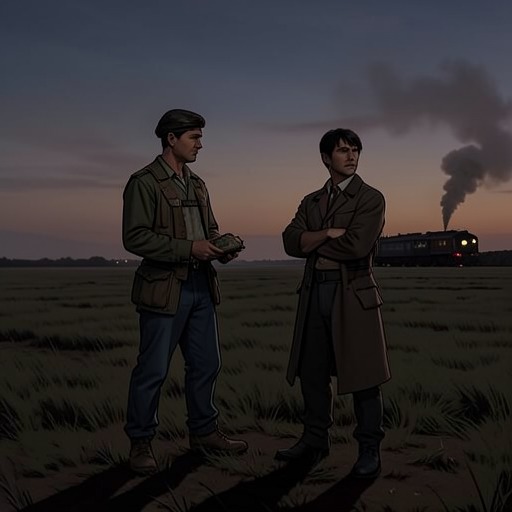
Ghouls · Eaters
Bones & AllGhouls / Eaters are people compelled to consume human flesh, a condition that makes the novel’s language of monstrosity inseparable from questions about appetite, ethics, and ordinary meat eating. The hunger is not simply a chosen vice: it arrives as a bodily certainty, yet its consequences vary according to how each person responds to it. Maren’s experience and Sully’s rules show that sharing the condition does not make its bearers alike.
Nature and Hunger
The novel introduces the creatures through competing names. In the author’s acknowledgment, the beings are described as ghouls, while cannibal is identified as the easier word for explaining the premise. The distinction matters: the story presents a specific, recurring hunger rather than treating every person who eats human flesh as equivalent. The author also connects the novel’s purpose to examining flesh eating and its environmental and spiritual consequences. That framing makes the taboo of human flesh a way to bring the ethics of eating into sharper view, not merely a device for horror.
For Maren, the hunger announces itself before she can explain it. Standing with Luke Vanderwall in the dark beside the tent he made for her, she can smell the lake on him, the chili powder from dinner, and details as minute as lint between his toes. The sensory intensity turns into a warning: she feels hunger and certainty together, and suspects that she is about to repeat something terrible from her early childhood. She retreats rather than remain with Luke. The episode establishes the appetite as an embodied perception that can precede deliberate action, while leaving Maren conscious that what her body urges her to do could harm another person.
Maren’s childhood history makes that fear concrete. After Penny Wilson’s death, her mother found blood on Maren’s face and clothes and a hard fragment between her gums: the hammer of Penny Wilson’s eardrum. Maren does not remember the scene herself, but knows what happened; even as a child, she loathed herself. The fragment in her mouth compresses the creature’s horror into an intimate physical detail, while her mother’s failure to recognize what she was seeing leaves the truth difficult to name within the family. Later, Maren says she had believed herself alone until she encountered two others like her in less than a week, turning a private terror into evidence of a condition shared by other people.
Rules, Difference, and the Ethics of Appetite
Sully presents the shared hunger not as a basis for solidarity but as a danger. He warns Maren that a person may be dangerous to many others and still be vulnerable to someone like herself; Eaters, he says, should avoid their own kind if they want to keep their faces. He immediately complicates his warning by insisting that he and Maren are not alike: she has a pulse, while he has not been a teenager since the nineteenth century. Their condition therefore does not erase differences of age, body, or conduct, and meeting another Eater offers no guarantee of safety.
Sully’s own rule is to eat people who are already dead. He says he learned to recognize when someone was likely to die soon, though he cannot explain whether that knowledge comes from smell or appearance; he simply knows. He remembers once feeling like a vulture waiting outside a person’s house, but says he no longer thinks of himself that way. His maxim, “Can’t help what you are, Missy. That’s rule number one,” treats the appetite as an inescapable nature. Yet his practice of waiting for death distinguishes his conduct from Maren’s experience of hunger arriving in the presence of someone living. The rule limits when he feeds, but does not make the act emotionally or physically clean.
To explain his practice, Sully invokes communities in the South Pacific that, as he describes them, make a sacred feast of their dead. He imagines knowledge passing through the family as the dead person’s children consume parts of the bodies of their father, mother, and grandfather. Maren challenges the logic: if the older generation has wisdom, why not teach it while alive? Sully answers that wisdom cannot be taught. Their exchange leaves the supposed inheritance unresolved: his story gives eating a language of kinship and transmission, while Maren’s question exposes the violence and strangeness that this explanation cannot dissolve. The novel’s creaturely taboo thus touches the ethics of ordinary flesh eating without making the acts identical; Sully offers a rationale, but Maren does not simply accept it.
Bodily Evidence and the Limits of Cleanliness
The distinction between Eaters and people who consume human flesh by ordinary choice is made starkly in Francis Yearly’s account of his first feeding. As a small boy, he ate the man who had led him into a gas-station restroom to abuse him; even with milk teeth, he ground the man’s bones down, and eating only made him hungrier. Francis explicitly separates this compulsion from the way an ordinary person eats steak or a hamburger. His testimony makes the condition both bodily and moral: the hunger begins in an act of survival against an attacker, but its persistence leaves him afraid of what he might do to those he loves.
The appetite is registered through senses that make recognition feel immediate and difficult to control. When Maren enters Mrs. Harmon’s house, she smells a meal that should have been tasted only once, along with blood unlike the smell she knows from living people. The altered odor precedes her sight of Sully kneeling over Mrs. Harmon’s body, and the scene’s familiarity silences her. Elsewhere, the detail of cocktail sauce and shellfish on a man’s breath accompanies Maren’s attack on him: he appears to welcome her closeness, while she understands too late that he has mistaken what is happening. The same intimate sensory attention that identifies hunger also sharpens the distance between what another person believes and what an Eater is doing.
After consuming Andy, Maren tries to erase the evidence from her mouth. Red remains around her lips, down her chin, and between her teeth; she brushes four times and gargles repeatedly with Listerine, yet can still taste him beneath the mint. The effort to clean herself does not undo the act, and the familiar bathroom offers no refuge from it. Sully’s breath supplies a harsher counterpart: Maren compares its smell to a day-old battlefield, a backed-up sewer, and a hundred landfills, while recognizing that he is about to use the apple-peeling knife against her. In these scenes, bodily traces do more than mark a feeding; they expose how little the Eaters’ rules or attempts at concealment can separate appetite from its consequences.
Monsters, Stories, and the Human Boundary
Before Maren can recognize the Ghouls / Eaters as a condition shared by living people, she encounters creatures like herself in books: giants, trolls, witches, ghouls, and the Minotaur. She imagines herself not as the monster at the center of a tale but as the hero’s narrow escape, and recalls the myth of Chronos devouring his children to prevent them from overthrowing him. The comparison gives her hunger an old, mythic shape, but it also marks her isolation: stories supply a vocabulary for what she is without offering a community in which she can belong.
Reading becomes a quiet measure of the distance between Maren and her mother. At school, Maren spends her free time in libraries and is praised as a voracious reader; when a teacher raises the subject, her mother pretends to feel ill so she can leave the conference. Her mother never reads her fairy tales, a silence Maren understands as protective knowledge. Even Roald Dahl’s The BFG disappoints her: its heroine does not eat anyone, while the man-eating giants are punished. The familiar story restores the boundary between human and monster just as Maren’s own life makes that boundary unstable. By placing her appetite beside the safe, defeated monsters of children’s literature, the novel shows how little those inherited stories can explain or contain.