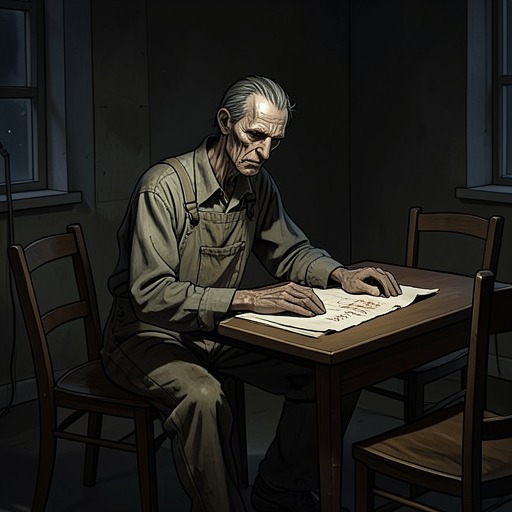
Maren and Francis Yearly, father and daughter
Bones & AllMaren and Francis Yearly, father and daughter, are bound first by a name Maren discovers after her mother leaves and later by a history neither has fully known. Their relationship is shaped by distance and imagined explanations: Maren travels toward a father she hopes will make her feel less alone, while Francis’s account reveals that he did not know he had a daughter. The gap between biological kinship and lived connection gives their bond its central tension; inheritance links them, but care, knowledge, and reunion remain uncertain.
Identity and First Discovery
After Janelle leaves, Maren finds her birth certificate among the things her mother has left behind. The document identifies her father as Francis Yearly and records her birth in Wisconsin; the faded name on the form turns a vague possibility into a specific person. Maren already knows that she must have a father, but seeing Francis’s name makes the fact emotionally real. The certificate is not merely information: it is the first tangible evidence of a relationship from which she has been excluded.
The money and document together seem to point Maren toward Sandhorn, Minnesota, where she understands her father to be from. She reads her mother’s departure as an instruction to find him and forget Janelle. Yet Maren does not simply accept that direction. She initially wants to repair things with her mother, then chooses to travel toward her grandparents, whose address she has kept in her notebook. Her father’s identity enters her life amid abandonment, but the first journey she plans is still an effort to find a place in her family.
The Father Maren Imagines
As Maren travels, she builds a hopeful version of Francis from what she knows and what she longs for. She believes there must be a good reason he left, partly because she thinks Janelle still loves him and continues to wear his wedding ring. In her imagined future, Francis wears his ring too, takes her to an Italian restaurant, tells her everything, and teaches her how to manage in the world. She pictures a home with place mats and picture frames, shared friends, and Sunday volunteering at a soup kitchen.
This imagined household answers several absences at once: Maren has no secure home, does not know her father, and fears that no one could accept the truth about her. A father who knows the truth and still welcomes her would make those uncertainties bearable. The fantasy is tender, but it rests on assumptions rather than contact. Maren has no evidence that Francis is waiting for her, understands her condition, or can provide the stable family life she invents for them.
Sully warns Maren against searching the past, but she says she wants to know where her father came from and why he left. She has begun to suspect that Francis, like her, is an eater, and wonders whether that is why he abandoned the family. When Lee later asks why she did not travel with him, Maren explains that she wanted to find her father first. She continues to hold the search as an objective even when Lee’s company offers another possible kind of companionship. On the road, she becomes convinced that Francis left because he thought she would be safer without him. That belief gives his absence a protective meaning, but it remains Maren’s interpretation, not something he has told her.
Francis’s Family History and Secret
Francis’s own account complicates Maren’s picture of the father she hopes to find. Barbara Yearly tells Maren that Francis was adopted after Tom and that the boy had been found under mysterious circumstances. The Yearlys appear to have kept him partly because sending him back would have meant going back on a promise. Their home provided food and a bed, but Francis grew up under the shadow of Tom, an absent child against whom he was repeatedly measured. The family’s decision to keep him made him a son in practice, while their comparisons made him feel like an inadequate replacement.
Francis’s account explains the secret behind those mysterious circumstances. As a small boy, he was taken into a gas-station restroom by a man who was trying to make him do something bad. Francis says he ate the man. He describes the act not as ordinary human cannibalism but as an overwhelming hunger that continued as he consumed the body. His account connects Maren’s suspected nature to her father’s experience, making their kinship more than a name shared on a certificate. At the same time, the resemblance does not mean Francis has knowingly passed on guidance or protection: he leaves Janelle before Maren is born and does not know about his daughter.
Francis later marries Janelle, whose parents come to the wedding in the spring. He worries that they suspect his secret, although he regards them as good people and hopes Maren is close to them. Janelle knows that he is withholding something but continues to love him without demanding that he confess. Francis believes, for a time, that he might never need to tell her. His marriage and his affection for Janelle show that his history is not only one of secrecy and isolation; they also help explain the family Maren imagines from the signs of enduring love she sees in her mother.
Knowledge, Distance, and Unequal Longing
Francis’s written account addresses a child he calls little Yearly and says that he is safe. Maren realizes, however, that her father did not know about her; the prospect had never occurred to him. His reassurance and her discovery of his ignorance meet in painful contrast. He can offer care to the imagined child who might someday read his words, but he has not recognized Maren as that child. The distance between them is therefore not simply geographic. It is a separation in knowledge: she has been seeking him, while he has not known whom he might be missing.
The relationship nevertheless carries a continuing pull. Maren learns that Francis’s national-park identification card was left at Sully’s cabin, and Sully reveals that Francis is his son. That disclosure places Francis within a wider family history Maren is still trying to understand. Later, Maren thinks of the father who would wake each morning hoping she would visit. The image reverses the earlier fantasy: she once pictured herself arriving to find a father ready to welcome her, while now she recognizes that he may also be waiting, without knowing whether she will come.
The Meaning of Their Bond
Maren and Francis’s relationship distinguishes biological inheritance from the daily acts through which family is made. Francis’s adoption by the Yearlys shows that a promise and the decision to keep a child can establish a family, even when the child is burdened by comparison and uncertainty. His bond with Janelle, meanwhile, is sustained by her love despite the secret he conceals. Maren inherits a connection to Francis and a condition resembling his, but neither fact supplies the knowledge or care that their separation has denied them.
For Maren, the search for Francis begins as a hope that a father can explain why she was left and offer a home where she can be known. The evidence she gathers both supports and unsettles that hope: he has a history that may illuminate her own, and he may want her to visit, but he did not know she existed when she needed him. Their bond is thus defined less by a completed reunion than by the change in what Maren understands. Francis moves from a name on a blue, creased document to a person with an adopted past, a hidden hunger, a marriage, and an unfulfilled possibility of fatherhood.