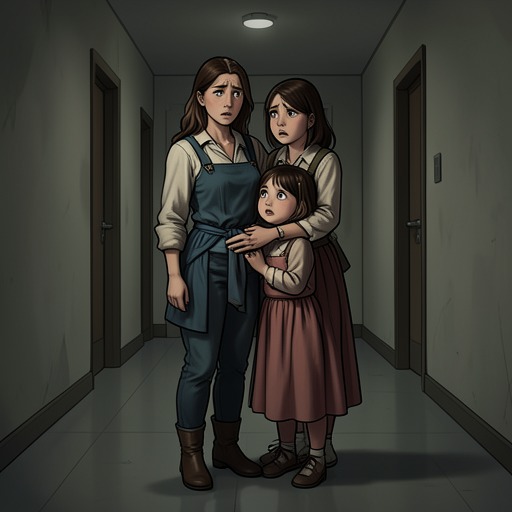
Maren and Janelle, mother and daughter
Bones & AllMaren and Janelle, mother and daughter, are bound by love that persists alongside fear, secrecy, and abandonment. Janelle raises Maren without calling her monstrous, but the secret that shapes their lives becomes too heavy for her to carry; when she leaves, Maren is left to interpret that departure as a verdict on her own nature.
Early Care and the Unspoken Secret
Maren’s first known act of eating a person occurs when she is a baby, too small to swallow the bones. Left with Penny Wilson for an hour and a half, she is found asleep beside the remains, with blood around her mouth and tears drying on her cheeks. Janelle returns to this scene in the story she later tells her daughter: she screams, and at first believes a satanic cult may have harmed the babysitter. Maren explains that she does not remember the event herself, but knows it through what she has been told. From the beginning, their relationship is shaped by a terrible knowledge that belongs to Janelle as witness and to Maren as the person who caused the death without understanding it.
Janelle does not turn that knowledge into an accusation. Maren remembers her as kind, and says that her mother never spoke to her in terms of what she had done or what she was. That restraint matters: Janelle does not pretend the harm did not happen, but she also does not reduce her daughter to it. When Maren asks what became of the bones, Janelle refuses to answer, saying, “There are some things I’m never going to tell you no matter how many times you ask.” The response preserves a boundary around the past while leaving Maren to imagine what her mother concealed. Secrecy is part of Janelle’s care, but it also marks what the two cannot share openly.
The Camp Incident and the Strain of Care
The pattern becomes harder to sustain when Maren, still a child, eats someone at camp. Janelle arrives pale and silent as other parents whisper that the missing boy is unlikely to have survived. Maren fears that his parents will see her and know what she has done; instead of leaving with her mother, she drops her hand and runs back to the cabin. The scene places Maren’s shame beside Janelle’s public composure: the mother has to lead her away while the surrounding adults mistake the child’s distress for ordinary grief.
Later, Janelle asks Maren to look at her and tell her it is not true. Maren cannot deny what happened. Janelle remains eerily calm, and when her daughter hides her face, she carries her to the car. Her response neither erases the victim nor makes her daughter’s confession easier. It shows a mother trying to confront what she knows without withdrawing all physical care. That balance is fragile, however. Maren experiences herself as a burden and comes to believe that her nature has made her mother’s life unbearable, even though Janelle has not told her that she is bad or unlovable.
Leaving and the Missed Reunion
Janelle’s departure gives that fear its most lasting form. Maren wakes to find her mother gone: she has risen before daylight, packed a few things, and driven away. In the account of the morning, a note on the kitchen table reads, “I’m your mother and I love you but I can’t do this anymore.” The words hold affection and refusal together. They do not tell Maren that she was never loved, but they tell her that love has not been enough to keep Janelle in the role of her caregiver. Maren nonetheless concludes that her mother no longer loves her, then turns that conclusion against herself, wondering whether Janelle ever did.
Maren later learns that Janelle has gone to her own parents, and travels to their house rather than immediately seeking her father in Sandhorn. She watches from outside as Janelle sits at dinner with her parents. Her mother pushes food around her plate, answers in single words, drops her fork, and hides her face in her hands; Maren’s grandmother rises to embrace her. Seeing Janelle cry helps Maren understand a pain she had previously witnessed without comprehending, including her mother’s withdrawal and the empty wine bottles she had seen at home. But the understanding does not become a reunion. Maren stays hidden, and when she leaves Edgartown by bus she knows she is going away from her mother, not toward her. The picture window becomes an image of their distance: Maren can see Janelle, but cannot enter the family scene or restore their shared life.
Family, Inheritance, and What Maren Learns
The account left by Francis Yearly gives Maren a view of her mother’s life before and around their family. Janelle met Francis while he was keeping a secret about his childhood; she knew that something was withheld, yet continued to love him before learning what he had done. Her parents attended their wedding in the spring, and Francis recalls hoping that Janelle would remain close to them. This history complicates Maren’s sense that her mother’s life began and ended with the burden of raising her. Janelle had chosen a partner and built a life with him, but the secret that he feared disclosing also belonged to the family history inherited by their daughter.
That inheritance does not make the mother-daughter bond straightforward. Francis’s account reveals that he ate a man as a small boy, while Janelle’s own response to Maren’s condition is recorded through acts of care, silence, and eventual departure. The two parents’ histories are not identical, and the evidence does not establish that Janelle understood the full family connection. What Maren receives from her mother is instead a difficult mixture: protection from condemnation, unanswered questions, and an abandonment that she cannot separate from her self-loathing. Later, when Sully argues that people like them must make their own family, Maren contrasts such chosen care with the grandfather she believes would rather she had never been born. That contrast underscores what was lost with Janelle without reducing their relationship to loss alone. Janelle’s love was real; so was her inability to continue, and Maren’s understanding of both arrives only after they have parted.