Maren’s homelessness
Bones & AllMaren’s homelessness begins not with a departure she chooses but with the discovery that Janelle has left her behind. A single sentence on the kitchen table—“I’m your mother and I love you but I can’t do this anymore.”—makes the abandonment explicit, while the belongings left in the apartment show that Maren herself has been treated as something that could be left behind. What follows is a search for family and a place to go, repeatedly narrowed by limited money and the precarious kindness of strangers.
The abandonment and what remains
Maren wakes to an apartment that is too quiet and without the smell of coffee. Janelle’s note offers love and refusal together, but not an explanation. Maren cannot reconcile the departure with the recent circumstances: she believes she has not done “the bad thing” for more than six months, Janelle has settled into a new job, and they have liked the apartment. Her bewilderment is sharpened by the ordinary domestic objects around her. The sheets and comforter are still on the bed; paperback novels, nearly empty shampoo and hand-lotion bottles, and a few less-pretty blouses remain behind. Maren recognizes these as the kinds of things the two of them would abandon when moving, but this time she understands that she, too, has been left.
The scene makes homelessness an intimate rupture before it becomes a matter of shelter. Maren rereads the note and interprets its silence as a judgment about danger: Janelle can no longer protect her, and believes she should be protecting the rest of the world instead. That understanding does not settle what has happened. It leaves Maren with the material fact of the empty household and the harder question of whether she can make things right with her mother.
Money, documents, and competing destinations
After a hospital stay, Janelle puts an arm around Maren as they leave together. The car is already packed: garbage bags and cardboard boxes fill one side of the backseat to the ceiling, with more bags in the passenger seat and, as Maren supposes, the trunk. While Maren was eating Jell-O in the hospital, Janelle had been fitting as much of their life as she could into the car. The gesture suggests a journey planned without Maren’s participation, even though, at that moment, they are still leaving together.
The morning after Janelle leaves, Maren reacts to the changed household by throwing a dish onto the floor simply to feel what that would be like. She then picks up the fat white envelope Janelle has left. It contains money, but also Maren’s birth certificate, blue and crinkly, which she unfolds slowly. The document gives her a fact she had not possessed in that form: her father’s name is Francis Yearly. It also identifies Sandhorn, Minnesota, as the destination Janelle apparently expected her to reach with the money. Maren initially reads the arrangement as an instruction to find her father and forget her mother, a prospect she cannot accept.
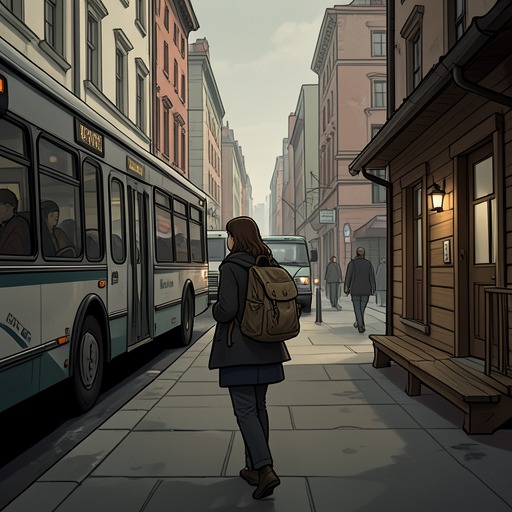
Instead, she chooses to pursue Janelle. She has saved her grandparents’ address from a Christmas-card envelope and pasted it inside her notebook; she had already memorized it after retrieving it from the trash. She knows she has not seen her grandparents since before Penny Wilson, and that Janelle would never take her to visit them. Now that Janelle has gone there, Maren decides to follow, believing a hundred dollars will be enough. She eats what remains in the refrigerator, showers, and packs her belongings into an old army rucksack marked “SHIELDS” and “U.S. ARMY,” which had belonged to her grandfather. Because she expects the pack to grow heavier as she carries it, she must choose among her books, taking her birthday book and the two volumes of Alice’s Adventures in Wonderland and Through the Looking-Glass, and What Alice Found There, alongside other books and a few belongings. The rucksack turns the departure into a concrete limit: the life she can carry is only what will fit.
Travel without security
Maren’s route does not proceed as she intended. After traveling in the opposite direction from Sandhorn, she realizes she has wasted most of the money Janelle left: a hundred dollars would have covered the trip from Cincinnati to Minnesota, but she has nearly spent it. In a filthy restroom, she locks herself in the last stall with her rucksack and cries. She describes herself as nearly penniless and definitely homeless, and regrets not accepting an earlier offer of help. When she emerges, she makes a new plan: to reach Minnesota by hitchhiking. A taxi driver directs her toward a college, reasoning that students heading home for the summer might offer a ride.
A ride does come, but it provides no lasting security. When the driver exits near a Walmart, Maren runs inside after thanking her. On coming back out, she finds her rucksack abandoned in an empty parking space and the car gone. She counts her remaining money: ten dollars and a scattering of dimes and quarters. The loss makes the next ride feel almost impossible to attempt. Her immediate reaction is to turn the driver’s unexplained departure into a suspicion about herself, wondering whether the driver had smelled something on her and connecting the possibility to the girls at school who had never liked her. Even in transit, Maren has no stable place to return to and little control over the decisions of the people carrying her.
Temporary shelter and the shape of the state
Maren’s homelessness also places her in situations where a place to stay depends on another person’s offer. In one exchange, a man tells her that nobody is making her stay and that she can do whatever she wants; he hopes she will accept that he has no intention of staying there longer than one night. Maren has already asked whether they are really staying there that night. His answer establishes the shelter as temporary, with her freedom to leave stated plainly, but it does not promise a home or a secure onward journey.
Across these episodes, homelessness is defined by repeated dislocation rather than by a single night without a bed. The apartment remains full of Janelle’s discarded possessions; the car is packed for a departure Maren does not control; the envelope offers money and a birth certificate but no settled destination she can accept; and the rucksack reduces her possessions to what she can carry. The search for Janelle’s family becomes a route made of uncertain rides, dwindling coins, and provisional shelter. Maren’s efforts to keep moving are also efforts to preserve a connection to her mother, even as the journey exposes how little protection or practical certainty that connection can provide.