Mr. Harmon's Sphinx trophy
Bones & AllMr. Harmon's Sphinx trophy moves through the story from stolen possession to evidence of Sully’s predatory habits, then to the improvised weapon with which Maren escapes his attack. Its significance lies in that change of use: an object buried among things taken from victims becomes the means by which one of Sully’s intended victims fights back, and the wound it leaves remains visible when they meet again.
Discovery and Provenance
While searching Sully’s cabin for a distraction, Maren first finds ordinary paperbacks and then looks for ingredients for hot chocolate and grilled cheese. With neither bread nor cheese nor cocoa powder available, she settles for beef jerky. Opening a cupboard by the back door, expecting candles or games, she instead encounters a dense jumble of clothing, women’s jewelry, Walkmans, collectible coins in plastic cases, pewter tableware, and miscellaneous keepsakes. Her hand identifies the trophy by its contours before she draws it out and recognizes it as Mr. Harmon's Sphinx trophy.
The location among the other objects shapes Maren’s understanding of what the trophy means. She tries to tell herself it is a memento, but rejects that explanation: Sully takes things he can sell, not keepsakes of people he has killed. The trophy’s presence in the cupboard therefore connects Mr. Harmon’s property to Sully’s collection of possessions taken from victims. The discovery is not simply a reunion with a familiar object; it makes the cabin’s clutter legible as the material residue of Sully’s actions.
From the Cupboard to the Nightstand
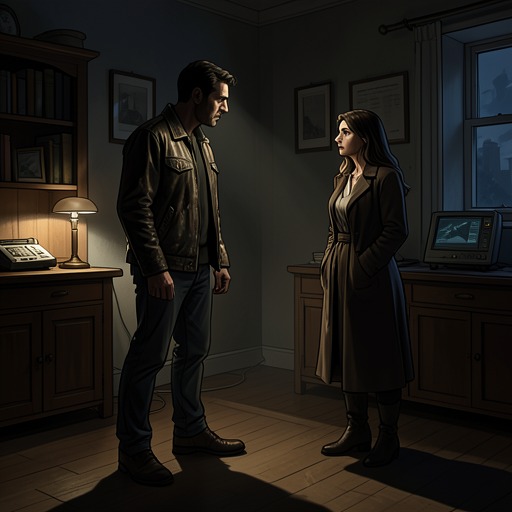
Maren continues into Sully’s bedroom without turning on the light. Although the bed is made, objects that did not fit in the cupboard are scattered around the room, including lamps, clocks, and porcelain dolls. At the bedside table she finds more jewelry, a tarnished silver flask that is not Sully’s, and credit cards under different names. Among them is an identification card marked National Park Staff, Francis Yearly, bearing a blurry black-and-white photograph of her father.
When Maren later goes into the bedroom, she turns the key softly, takes out the Sphinx, and sets it on the nightstand. She puts her father’s identification card in her rucksack, then lies down without removing her jeans beneath the red-and-blue patchwork quilt in the bed Lee had slept in. The trophy is thus separated from the cupboard’s jumble and placed beside the bed, while the identification card is carried with her. At this point the trophy remains an object she has removed from Sully’s hoard; its proximity to the bed will matter when the encounter becomes physical.
Use in Maren’s Escape
During Sully’s attack, Maren recognizes that she must free her left hand and reach for the trophy. She draws up a knee and kicks at his legs, a weak effort that nevertheless distracts him from holding her hands. As she pulls her hand free, she bats his knife away by its handle and keeps kicking while reaching behind her. Her fingers find the Sphinx’s cold metal contours. Gripping it by a wing, she swings it over her head and strikes the back of Sully’s skull.
The first blow makes Sully lose his hold on the knife. He curses her and raises a hand to his head; Maren then hits him again, hard enough that he falls on top of her. She feels blood on her fingers, drops the trophy to the floor, pushes Sully away, and rolls out of bed to find her sneakers. The trophy’s shape and weight are no longer merely recognizable features: its contours give Maren something to grasp, and its wing serves as a handle in the instant when she needs a weapon. It interrupts Sully’s control long enough for her to flee.
Maren escapes down the creaking wooden steps into the forest with only her journal in her hand and her birth certificate in her jeans pocket. She later reflects that she could have gathered her belongings into her rucksack, but did not know how quickly Sully would recover. The trophy’s role in the escape is therefore narrow but decisive: it does not secure her safety or provide a plan for what comes next; it creates the opening through which she gets out of the cabin.
Injury and Aftermath
When Sully confronts Maren again, he bears a nasty bruise on the back of his head, with a jagged line where the corner of the trophy broke the skin. He tells her that the blow left him unwell: he forgets where he has been and what he was doing, sometimes cannot see, and finds that daylight worsens his headache. His account makes the physical consequence of the cabin struggle persist beyond the scene itself. The trophy has left a mark on Sully that Maren can see, as well as effects he says continue to interfere with his memory and vision.
The later confrontation also returns the object to the conflict in words, even though it is no longer in Maren’s hand. Sully blames her kicking for the trouble; Maren answers that if he had left her alone, she would not have had to strike him. Their exchange fixes the trophy’s place in the chain of action: Sully attacks, Maren uses what is within reach to resist, and the injury becomes part of their subsequent reckoning. First hidden among stolen possessions, then set on a nightstand, and finally used in a desperate struggle, Mr. Harmon's Sphinx trophy links Sully’s past taking to Maren’s immediate fight to escape.