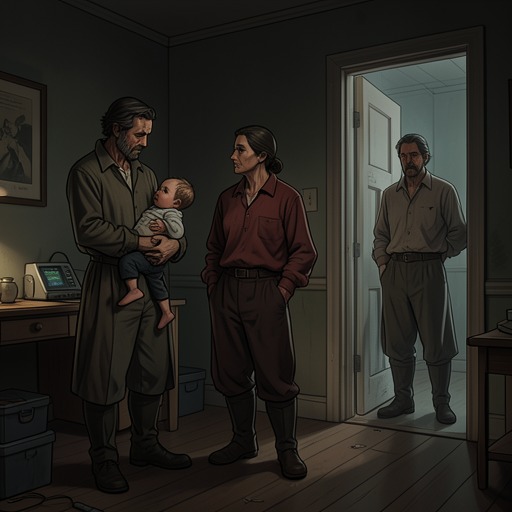
Sully and Frank Yearly
Bones & AllSully and Frank Yearly are father and son, but their relationship is defined by separation rather than shared life. Frank was taken from Sully as a boy and raised by the Yearlys, while Sully’s belated search for him ends not in reunion but in an indirect claim on Frank’s daughter, Maren. The revelation recasts both Frank’s hidden origins and Sully’s earlier language about making a family, without erasing the difference between blood ties and the care that Frank and Maren actually receive.
Separation and Adoption
Frank’s childhood began with a loss he could not explain. In a letter addressed to his daughter, he describes his earliest memory as being very small beside a bus at a gas station, led by a man into a restroom. The man locked them inside and tried to make Frank do something bad; Frank ate him instead. Frank remembers being only a little boy, with milk teeth, and says that the more he ate, the hungrier he became. The account establishes the frightening fact of his cannibalistic nature, but it does not say that Sully knew about this incident or that it caused their separation.
Barbara Yearly later confirms that Frank had been adopted. She says that the boy had been found under mysterious circumstances and that the Yearlys, on reflection, may have been too eager to overlook those circumstances. Her remark gives Frank’s childhood a history of unanswered questions: he was welcomed into a family, but the circumstances that brought him there remained obscure. The available account does not explain precisely how Sully lost him, or what the adoption process involved.
Frank’s letter reveals what life in the Yearly home meant to him. He had meals and a warm, clean bed, yet felt that he was an unsatisfactory replacement for Tom Yearly. The family sometimes spoke of Tom as his older brother; on Barbara’s bad days, she set a fourth place at dinner, and at other times Frank himself was called Tom. Frank recalls a steady comparison with the absent boy, who was imagined as a better student and a future doctor, lawyer, engineer, or veterinarian. Adoption gave Frank shelter and a place in the household, but it did not free him from feeling measured against someone else.
Frank’s Hidden History
The distance between father and son is also a distance in knowledge. Frank writes that he does not know whether anyone else in the world is like him, distinguishing his childhood act from ordinary people eating other people as they might eat steak or a hamburger. His account is a confession to Maren, not a disclosure to Sully. Nothing in the revelation of their kinship establishes that Frank told his biological father what he had done.
Frank’s later life offers another contrast between secrecy and acceptance. He says that Janelle loved him despite knowing there was something he kept from her; she did not require him to explain it before continuing to love him. He also recalls worrying that her parents suspected his secret. These details show the relationships Frank formed as an adult, but the account does not show him reconnecting with Sully or telling Janelle about his biological father. Frank’s letter to Maren is the clearest record of the history he had kept from his daughter, including the fact that he himself may not have understood all of his origins.
That silence matters when Maren later finds Francis Yearly’s national park staff ID among Sully’s possessions. The card bears Frank’s photograph and smile, turning an otherwise unexplained family connection into a physical clue. Maren recognizes her father, but cannot understand why Sully has the ID or how he could have met Frank. The object makes the concealed relationship materially present before either man explains it: Frank’s identity is among Sully’s belongings, though Frank is absent.
Sully’s Account and the Revelation
Sully confirms the connection when Maren wakes to find him sitting in the corner of a bedroom. He says that Frank left the ID at the cabin and identifies Frank as his son. Maren, who has not known that she had a paternal grandfather in Sully, asks whether he means her father. Sully then describes the separation from his perspective: a woman got into a car and took the boy away, and by the time Sully caught up, she had lost him; another man then took the boy. Sully recognizes that the woman was Maren’s grandmother only after Maren makes the connection explicit.
His explanation is both an account and a confession of failure. Sully says he could not reach Frank while Frank was living with the Yearlys without making a scene. He waited too long, and Frank was now hiding, beyond Sully’s reach. The story does not supply the circumstances behind each transfer of the child or clarify exactly why Sully believed a confrontation would be dangerous. It does establish that he knew where Frank had been raised, considered approaching him, and ultimately did not do so.
Sully’s response to Maren’s question about her grandmother is a cold laugh, which she understands as the answer to what happened to the woman. The exchange gives the family history a threatening dimension: Sully’s account of losing Frank is not accompanied by an explanation of the grandmother’s fate, and Maren is left to interpret his reaction. His bluntness and omissions make the revelation less like a recovered family story than an encounter with someone whose claims of kinship carry danger as well as information.
The Granddaughter as a Substitute Link
Sully says he knew Maren was out there and had waited for her to return. When he could not get to Frank, he says, he could at least get to Frank’s daughter. His explanation makes Maren a substitute route to the son he failed to reach. It also distinguishes Sully’s knowledge from Frank’s: Sully knew of Maren, while Maren understands from her father’s earlier words that Frank did not know about her. The relationship thus passes through generations unevenly, with the grandfather aware of the granddaughter and the father separated from both his own father and, at least at that point, the knowledge of his child.
The disclosure also changes how Sully’s earlier conduct can be read. At dinner, he had told Maren and Lee that people like them had to make their own family. He cooked for Maren, offered her another helping, and looked out for her; she thanked him for the meal and for caring for her. Because the revelation shows that Sully is her grandfather, this practical kindness sits beside a biological connection he had not disclosed. The scene does not prove that he was consciously revealing or acting upon that kinship at dinner, but it gives his appeal to chosen family an added irony: he speaks of family as something people make while concealing a family bond that already exists.
The contrast is not simply between a real family and a chosen one. Frank’s adoption by the Yearlys provided food, shelter, and a home, yet he experienced himself as a replacement for Tom; his adult relationship with Janelle, by contrast, offered love that did not depend on his confessing everything. Sully’s claim is biological, but his long absence and his decision to approach Maren instead of Frank leave the relationship without the history of shared care that might make the claim feel secure. Through Frank’s adoption, his silence, and Sully’s eventual disclosure, the story treats descent as a fact that can be hidden or recovered, not as a guarantee of intimacy.