Sully reveals his identity to Maren and attacks her
Bones & AllSully’s revelation that he is Maren’s grandfather transforms a long, uneasy association into a direct threat: he has been waiting for her as a substitute for the son he lost, and he attacks her when she understands what he intends. The scene brings the family history behind Maren’s identity into the open, then makes survival depend on her ability to resist the man claiming kinship with her.
The discovery and its family history
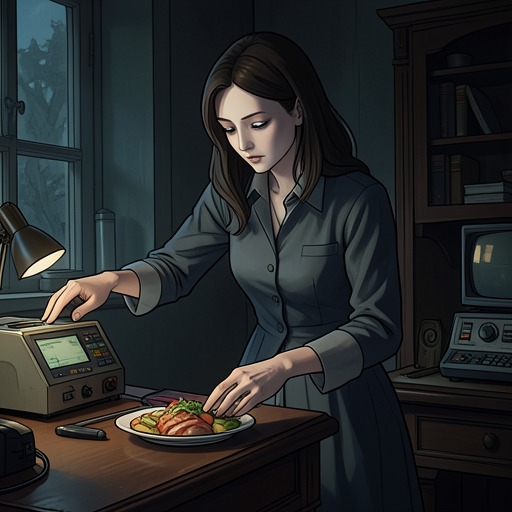
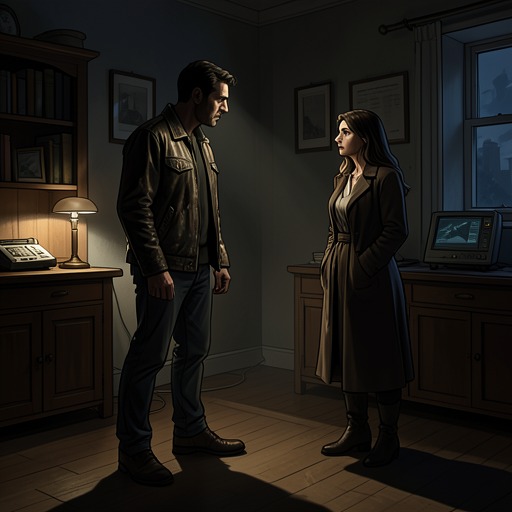
Maren wakes beneath a pile of coats in Jamie Gash’s spare room, briefly mistaking her mother’s voice for a sign that she has returned to find her. The hope disappears as she becomes fully conscious: someone is in the room, and she has not managed to make the locked door a barrier. Sully sits in a chair in the dark and remarks that she has found the staff identification card. When Maren recognizes it as her father’s and asks how Sully got it, he tells her that Frank Yearly is his son.
The claim unsettles Maren because it connects Sully not only to her father but to the family history she had never understood. Sully says that Maren’s grandmother took the boy away in a car and that, by the time he caught up, she had lost him; another man then took the child. Maren realizes that the woman he means was her grandmother. When she asks what happened to her, Sully answers with a cold laugh, making the implication of her death unmistakable without explaining its circumstances.
Sully says that he could not reach Frank while Frank was living with the Yearlys without causing a scene, and that by the time he might have acted, Frank had gone into hiding. His attention then turns to Maren: if he could not get to his son, he could at least get to his granddaughter. He says he had known she was out there and had been waiting for her to come back. The claim of family is therefore bound to a history of separation and pursuit; Sully’s long wait is not an offer of reconciliation but the setup for the violence that follows.
The attack and escape
Sully’s explanation of what he eats turns the family revelation into an immediate bodily threat. Maren imagines his son’s pickled tongue and his granddaughter’s heart cooked in a stew; his breath, which smells like a battlefield, a backed-up sewer, and landfills, confirms the horror of a man who feeds on corpses and never brushes his teeth. The knife is out of sight, but Maren knows Sully has it—the blade he used to peel an apple—and understands that he intends to kill her. His insistence that he eats people only after they are dead offers no protection: he admits that he does not always leave them to die on their own time.
As Sully lunges onto the bed and pins Maren’s arms, the knife presses against her left forearm. She does not want to die, despite having often wished for death, and fights for the small opening his grip leaves her. Kicking at his legs distracts him long enough for her to wrench one hand free and bat the knife away by its handle. Reaching behind her, she grabs Mr. Harmon’s Sphinx trophy from the nightstand, swings it into the back of Sully’s skull, and strikes him again when he rears up. He falls across her; blood slicks her fingers. Maren pushes him aside, gets out of bed, and reaches for her sneakers.
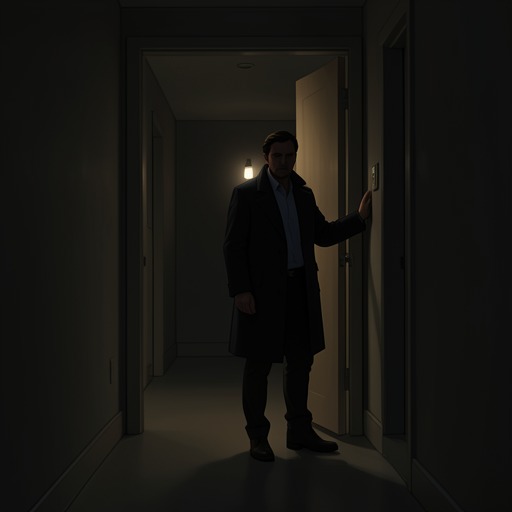
There is no time to collect her belongings. Maren runs down the creaking wooden stairs and into the forest with only her journal in her hand and her birth certificate in her jeans pocket. The muddy track makes her slip, but she keeps moving, aware that the road is two or three miles away and that a ride in the middle of the night is unlikely. Near the end of the track, a light leads her to a car standing empty with its driver’s door open. She recognizes Travis’s black sedan by the Donald Duck keychain dangling from the ignition, but sees no sign of Travis and does not call out.
Kinship as care and coercion
The revelation also unsettles the difference between being related to someone and being treated as family. Frank Yearly had been taken in by the Yearlys after Tom’s death, but Maren later understands that they may have kept him partly because sending him away would have meant breaking a promise. He had food and a clean bed, yet lived beneath Tom’s shadow: sometimes the family called him Tom, and at other times measured him against the imagined accomplishments of the dead boy. Barbara Yearly recalls that Frank had been found under mysterious circumstances, which the family had been too eager to overlook. The past Sully discloses thus reaches into a household whose apparent shelter did not erase the conditions of Frank’s belonging.
Frank’s account of his childhood gives that history another dimension. As a very small boy, he was led into a gas-station restroom by a man who tried to abuse him; Frank killed and ate him. He describes this as something different from ordinary people choosing to eat human flesh, and remembers becoming hungrier the more he consumed. Janelle loved him even after learning his secret, making their marriage and her acceptance a form of care that did not depend on his revealing everything at once. Against these histories, Sully’s earlier claim that people like them must make their own family carries a bitter complication: the language of chosen family can name genuine protection, but Sully’s claim of blood kinship now accompanies a threat to Maren’s life. The scene distinguishes family made through sustained care from kinship invoked to justify possession.
An escape without resolution
The blow with the Sphinx trophy creates an opening, not a confirmed defeat: Maren leaves Sully behind without knowing how soon he might recover, and the scene never establishes whether he is dead. Its final image transfers the uncertainty to Travis’s black sedan, waiting empty at the end of the track with the driver’s door open and Donald Duck still dangling from the ignition. Maren has escaped the bedroom, but neither Sully’s fate nor Travis’s whereabouts is settled. The disclosure therefore ends not with an explanation that makes the family history safe to possess, but with Maren carrying her birth certificate and journal into the next danger.