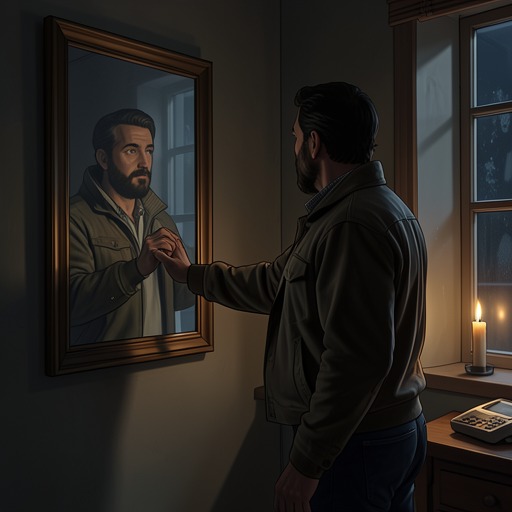
Truth Told as a Story
Bones & AllTruth Told as a Story is the book’s account of how truth can be morally demanded, practically silenced, and finally made audible by being presented as fiction. Through Maren’s exchanges with Janelle and Sully, telling the truth is never just a matter of speaking accurately: it depends on whether listeners can accept what is said, and on the form a speaker uses to make a listener listen.
The duty to tell and the pressure to remain silent
Maren invokes a rule she has been given when she reminds Janelle, “You said I should always tell the truth.” Janelle does not deny having taught her that principle. Instead, she distinguishes its moral force from its immediate risks: she says they cannot tell anybody because no one will believe it. Maren’s question turns that conflict toward other people, raising the possibility of telling about Luke while Janelle tells about Penny. The account does not resolve that proposal into a public confession; it shows the possibility being checked by anticipated disbelief.
Janelle’s response makes silence a decision shaped by the audience rather than a denial that anything happened. The difficulty is not simply that the truth is painful to say, but that the people who might hear it are expected to reject it. Yet Janelle leaves open a future in which that condition changes. After a pause, she tells Maren, “Someday you’ll have to answer for this,” and adds, “Someday someone will believe you.” The two statements hold accountability and recognition together: an answer is still owed, but the chance to give it is deferred until there is someone willing to accept it.
Maren’s fear of being recognized
The truth’s danger also appears in Maren’s memory of going with Janelle to a police station after someone stole the radio from their station wagon. Maren was about twelve, and the list of names “on my heart” was not yet long. Although the stated purpose of the visit was to report the theft, she feared that the police would look at her and know what she had done. Her anxiety shifts attention from the incident being reported to the possibility that she herself might be exposed. Truth, in this recollection, is not only information a person could offer; it is also something Maren fears another person might read in her.
Above the station’s door hung a framed needlepoint bearing the words “THE TRUTH WILL SET YOU FREE.” The slogan gives the scene a stark irony: the public promise of liberation confronts a child who is frightened that recognition will reveal her wrongdoing. The text does not specify here what Maren had done, and the force of the memory does not depend on supplying that missing detail. What it establishes is the unease between a maxim that treats truth as release and Maren’s fear that being known could instead expose her.
Sully’s method of telling
That memory returns while Maren is with Sully. After the record ends, she says, “There isn’t any devil, you know.” Sully answers not by arguing abstractly about the devil, but by describing a performance he says he stages in bars. He orders a round of drinks and tells the people there about himself, while presenting the tale so that they do not realize it is true. He warns them to watch behind themselves on the walk home, lock the door, and look under the bed; the men laugh and credit him with a good imagination.
Sully’s explanation makes the story a disguise that protects a truth from immediate disbelief. His listeners can accept the tale as entertainment precisely because they do not recognize its speaker as the subject. He states the principle directly: “That’s how stories start. We tell ’em about ourselves like they ain’t true, ’cause that’s the only way anybody’s gonna believe us.” The account does not establish that every story is a confession, or that disguise guarantees belief. Sully describes a specific tactic: detach a speaker’s identity from what he says, and an audience that might dismiss a direct admission may listen to the same material as an invented tale.
Memory, irony, and the possibility of a witness
The sequence links Maren’s private fear at the police station to Sully’s public performance without making their circumstances identical. Maren feared that an authority figure might recognize what she had done; Sully describes listeners who fail to recognize that his story is about him. In one scene recognition threatens exposure, and in the other its absence enables an audience to hear the account at all. The contrast gives storytelling a double edge: it can conceal the teller even as it carries concealed truth to listeners.
The order of the exchange matters. Maren’s memory of the needlepoint rises while she is thinking about Sully’s remarks, so the slogan’s promise of freedom is placed beside his claim that people believe a story only when they do not know it is true. Janelle’s promise that someone will believe Maren someday offers a different possibility: not permanent concealment, but a future listener capable of receiving a direct account. Together, these moments define truth-telling as a struggle between disclosure and self-protection, and between the need to answer for an act and the need to be believed when answering.