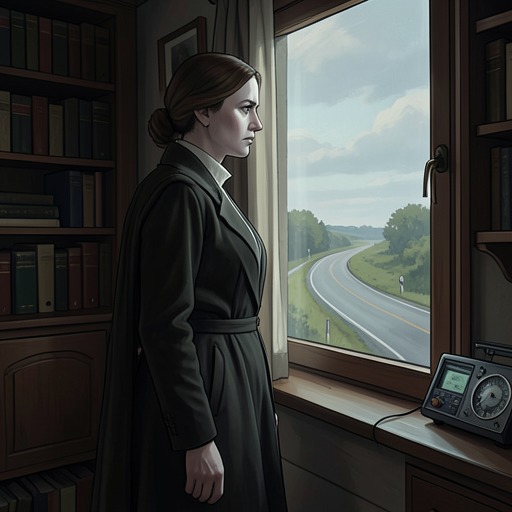
Anne’s Fatal Car Accident
Bonjour tristesseAnne’s fatal car accident transforms an evening of imagined reconciliation into a death that Cécile and Raymond can neither explain nor fully confront. The news arrives as they are writing to Anne, expecting their apologies to bring her back; the circumstances of the crash make an accident plausible, but Cécile’s later reflection preserves the possibility of suicide without resolving it.
Causes and Background
Earlier that evening, Cécile and Raymond clear away their meal and set themselves up across from one another with a large lamp, pens, an inkwell, and writing paper. They work on letters filled with tenderness, apologies, and repentance, treating the task as a way to recover Anne. Cécile becomes nearly convinced that Anne will forgive them and imagines her return to their Paris sitting room. Their hope is not merely that a letter will reach her: they picture a specific scene of pardon, already rehearsed in their minds.
At ten o’clock the telephone rings. Cécile and Raymond initially take the call for the answer they have been waiting for, and Raymond rushes to the receiver with a joyful greeting. The expectation lasts only a moment. He listens, answering quietly, while Cécile watches him pass a hand over his face. The call’s emotional reversal is sharpened by the letters still being written: the imagined return gives way to news that makes reconciliation impossible.
The Crash and Its Immediate Aftermath
Raymond tells Cécile that Anne has had an accident on the Estérel Mountain Road. It took time for those trying to reach her to find her address; they contacted Paris and received the number of the family’s present location. Raymond says the crash occurred at the road’s most dangerous spot, where many accidents had happened, and that the car fell fifty metres. He regards survival as nearly miraculous.
Cécile remembers the rest of the night as a nightmare, through a sequence of stark details rather than a continuous account: the road appearing in the headlights, Raymond’s motionless face, and the clinic door. Raymond does not let her see Anne. Cécile waits on a bench in the waiting room, looking at a lithograph of Venice and thinking of nothing. An nurse tells her this was the sixth accident at that spot since the beginning of the summer. Raymond remains away from the waiting room; the account does not describe what happens inside the clinic, only the separation and uncertainty Cécile experiences outside it.
Accident or Suicide
After the news, Cécile understands Anne’s death as a final distinction between Anne and herself and Raymond. She imagines that if she and her father had killed themselves, they would have used a gun and left an explanatory notice intended to haunt those responsible. Anne, by contrast, has left them what Cécile calls an enormous chance to believe in an accident: a dangerous stretch of road and an unstable car provide a possible explanation that they can accept.
That possibility is not turned into a confirmed motive. Cécile acknowledges that speaking of suicide may be romantic on her part, and questions whether Anne would have killed herself over people such as her and Raymond, who need no one, living or dead. She adds that she and her father never spoke of anything but an accident. The account therefore holds two ideas in tension: the crash has a credible, dangerous setting, while the family’s willingness to accept that explanation is itself part of the aftermath. The text offers no definitive resolution beyond Anne’s death.
Return to the House
The next day, Cécile and Raymond return home at about three in the afternoon. Elsa Mackenbourg and Cyril are waiting on the stairs. Cécile sees them as slight and forgotten figures, neither of whom knew or loved Anne, and their presence makes their romantic concerns seem diminished beside the loss. Cyril reaches toward Cécile and touches her arm. She recognizes that she had valued his kindness, attractiveness, and the pleasure he gave her, but had never loved or needed him. She intends to leave the house, Cyril, and the summer; Raymond takes her arm, and they enter together.
Inside, Anne’s jacket, flowers, bedroom, and perfume remain. Raymond closes the shutters and brings out a bottle and two glasses, the only remedy available to them. The apology letters are still on the table. Cécile pushes them away, scattering them onto the floor; Raymond, returning with a filled glass, hesitates and steps around them. Cécile finds the gesture symbolic and in poor taste, then drinks in one swallow. In the half-darkness she sees Raymond’s shadow at the window, while the sea beats on the beach. The unfinished letters and the avoided papers give physical form to the reconciliation that can no longer happen.
Narrative Significance
The event is structured around a sharp collision between expectation and fact: the same telephone call that seems likely to announce forgiveness instead reports the crash. Cécile’s remembered fragments, the clinic’s withheld view of Anne, and the later presence of Anne’s belongings keep the death emotionally immediate without supplying a complete account of its cause. Her speculation about suicide remains deliberately uncertain, framed as both a possibility and a potentially self-dramatizing interpretation. What is certain is the consequence: the family returns to a house still marked by Anne’s presence, with apologies written but useless, and no account of the accident capable of restoring her.