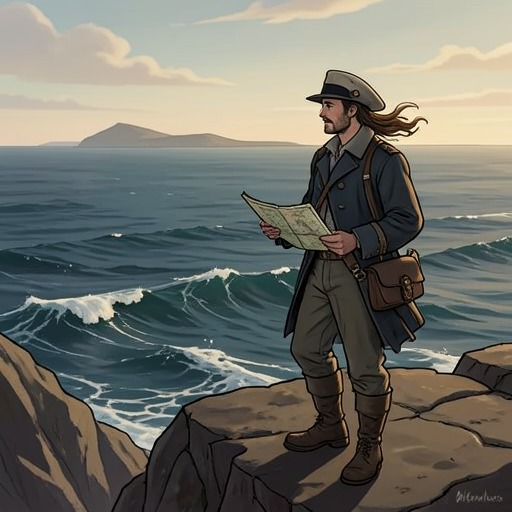
1492
Book of EstherThe book presents 1492 as a hinge in the history of exploration and, more particularly, in the providential opening of routes for the Gospel. In that year Christopher Columbus, serving Spain after acquiring Portuguese nautical experience, sailed west in search of India and discovered the West Indies. The author places this voyage within a larger sequence in which navigation, invention, and apparently contingent human ambitions made distant lands reachable and thus available to the efforts of the friends of the Bible.
The Voyage and Its Immediate Result
Christopher Columbus’s expedition in 1492 was undertaken in the hope of reaching India by sailing west. Instead, it brought him to the West Indies. The book treats that outcome not as an isolated geographical discovery but as the opening of a wider prospect: regions of the globe previously unknown to Europeans could now be approached by sea, enlarging the field for future exploration and religious mission.
The account emphasizes the unusual path by which Columbus came to undertake the voyage. A particular providence, the author says, brought him to Portugal, where he was enriched with nautical skill, before Spain employed him on an expedition of discovery. The sequence links training and opportunity across political borders: Portugal’s maritime knowledge formed part of the background to a voyage sponsored by Spain.
The Navigational Conditions
The voyage followed a profound change in the practical limits of ocean travel. Before the mariner’s compass, the sun and stars served as guides at sea, and even daring navigators hesitated to venture beyond sight of land. Long journeys were made slowly and dangerously by following coastlines. The compass’s magnetic direction, applied to navigation through the nautical needle, supplied a means of steering beyond those familiar shores.
The book therefore connects Columbus’s voyage to a sequence of invention and use rather than to individual daring alone. It describes the compass as a crucial answer to the question of how the Gospel could reach all nations when so much of the globe remained unknown and ocean crossings seemed practically impossible. In the author’s interpretation, the instrument made wider voyages conceivable; the navigators who perceived and used its value turned that possibility into exploration.
The Wider Chronology of Discovery
The year 1492 begins a brief chronology whose next major point is 1498. In that year, according to the account, Christopher Columbus reached the continent of America, while the Portuguese arrived in India by the passage of the Cape of Good Hope. The book presents the paired developments as evidence of an extraordinary acceleration: during the fifteenth century, it says, people advanced in exploring the habitable globe more than in all preceding ages combined.
The resulting geography matters to the book’s argument. The lands of North America and South America, along with the vast regions of the East Indies, are described as lying open to the exertions of the friends of the Bible. Later exploration by Captain Cook and other British seamen extended that prospect to additional territories and islands. Thus 1492 is not treated as a completed episode but as an early point in an ongoing movement toward places the author believed the Gospel was destined to reach.
Providential Interpretation
The author reads the voyage against the promise that the Gospel would be preached among all nations before the end of the world. At the time of that promise, he argues, half the globe was unknown, and no known means offered a plausible route to the lands beyond the oceans. The compass, the development of navigational skill, and the ambitions that drove exploration supplied successive links in a chain that made worldwide travel possible.
This interpretation does not deny the human motives involved. The book names the love of glory and the desire for a deathless name as possible incentives for individual explorers, while arguing that such aims could nevertheless serve purposes beyond those intended by the people pursuing them. On this account, 1492 matters both for what Columbus found and for the larger consequence the author draws from it: a new reach for exploration that, alongside other arts and inventions, could carry the Bible toward distant populations.