Haman and Mordecai's Enmity
Book of EstherHaman and Mordecai’s enmity is the personal conflict through which the narrative exposes a larger danger: a powerful courtier’s rage at one man becomes a threat to an entire people. The commentator does not present the feud as a simple contest between a wholly righteous resister and a wholly wicked persecutor. He condemns Haman’s murderous response, but also argues that Mordecai’s refusal to honor him was an error that helped bring the Jews into peril. The relationship thus carries both the story’s political reversals and its insistence that human responsibility remains real within Divine Providence.
The refusal and its disputed justification
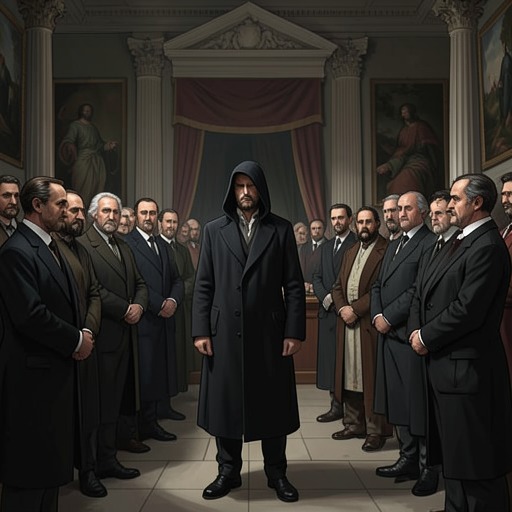
After Ahasuerus promoted Haman above the other princes, the king commanded his servants to bow down and honor him. Mordecai would not comply. The commentator rejects the usual attempts to excuse this refusal: in his reading, the account gives no evidence that the required honor was idolatrous, and ordinary civil respect could lawfully have been shown to a Persian official. Nor, he argues, would Haman’s possible descent from the Amalekites justify Mordecai’s action. The command to destroy Amalek applied to Israel as a nation in its own land, not to Mordecai serving at the Persian court.
This judgment makes the conflict morally complicated without making the two men equivalent. Mordecai’s conduct is described as ignorance of duty, not as a license for Haman’s violence. The commentator argues that Mordecai could have complied with a lawful command, while Haman chose to answer an affront with collective destruction. Their conflict therefore begins in a disputed act of courtly obedience, but its consequences are shaped by the radically different scale of their responses.
From personal insult to a national threat
Haman’s anger at Mordecai does not stop at its immediate object. The commentator emphasizes the narrative’s stated progression: Haman sees that Mordecai will not bow, becomes furious, and decides that killing Mordecai alone is not enough. He then seeks to destroy all the Jews throughout Ahasuerus’s kingdom. Mordecai’s refusal is the occasion for the escalation; Haman’s decision to make an entire people answer for one man’s behavior is the choice that turns their enmity into a national crisis. The decree against the Jews gives Haman’s personal hostility the machinery and reach of imperial authority.
The commentator consequently holds Mordecai accountable for the foreseeable danger his action brings upon himself and those connected with him, even though the threatened vengeance is ultimately prevented. He warns that an ill-informed refusal to submit to superiors can bring odium and persecution upon a wider community. Yet this criticism does not shift the guilt for Haman’s intended destruction away from Haman. The episode instead keeps two claims in view at once: a mistaken act can contribute to danger, and the person who converts that occasion into persecution remains responsible for doing so.
Restraint, delay, and the reversal of power
Haman’s enmity repeatedly meets restraints he does not control. After Esther’s banquet, he leaves pleased by the honor of being invited with the king, but sees Mordecai at the king’s gate and again receives no sign of deference. Though enraged, Haman restrains himself rather than attacking Mordecai immediately. The commentator makes this restraint a striking instance of Divine Providence operating through a person’s own action: Haman remains free in his decision, yet his delay prevents immediate violence.
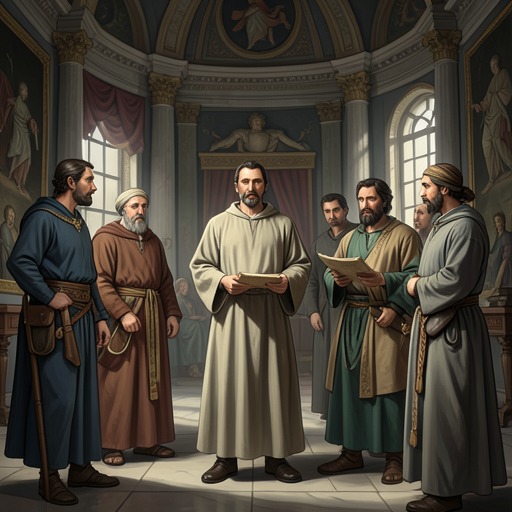
A second delay concerns Mordecai’s earlier service. He had uncovered a conspiracy against Ahasuerus, but the king did not reward him at the time. The commentator argues that immediate recognition would have altered the circumstances that allowed Haman’s hostility and Mordecai’s danger to become so visible. But the postponement cannot last much longer: Haman’s wife and friends advise him to prepare Haman’s gallows, fifty cubits high, and ask the king the next day for Mordecai’s execution. Haman approves and has the gallows made.
At this crisis, Ahasuerus cannot sleep. He orders The royal chronicles read, and the account of Mordecai’s service comes to light. The king asks what honor has been given to Mordecai and, without naming him, asks Haman what should be done for the man the king delights to honor. Haman assumes the honor is meant for himself. The commentator stresses the irony of Haman being present at precisely this moment and being asked in a way that conceals the intended recipient: the enemy’s own answer helps determine the honor awarded to Mordecai. Haman is made to serve the advancement of the man whose death he had planned.
The gallows and the wider aftermath
Mordecai’s public elevation reverses the relation of power between the two men. When a courtier mentions Haman’s gallows, Ahasuerus orders Haman to be hanged on it. The structure prepared for Mordecai becomes the instrument of Haman’s death, completing the commentator’s account of retributive justice through reversal rather than a miracle that visibly interrupts events.
Mordecai’s rise also has consequences beyond their personal feud. The first decree cannot be revoked, and the Jews remain scattered across the provinces with enemies who might attack them. The commentator explains their survival partly through the fear inspired by Mordecai’s growing authority: provincial rulers and officials assist the Jews, and their attackers cannot withstand them. The enmity that began with a refusal to honor Haman thus passes through threatened execution and a decree of destruction, but ends with Haman dead, Mordecai elevated, and the balance of power transformed.
Narrative and theological significance
The commentator reads the feud as a sustained example of human agency working within Divine Providence. Mordecai’s refusal is, in his interpretation, a culpable mistake; Haman’s wrath and murderous purpose are his own; and the delays, restraints, and reversals nevertheless serve the deliverance of the Jews. The account does not make providential purpose an excuse for wrongdoing. Instead, it holds together Haman’s guilt, Mordecai’s responsibility for the consequences of his ignorance, and the claim that neither man’s intentions determine the final outcome.
That tension gives the conflict its particular force. Haman possesses rank and an apparently decisive decree, while Mordecai faces death without an advocate at court. Yet Haman’s own restraint, the king’s sleepless night, the rediscovered record, and Haman’s mistaken assumption about the king’s question shift the relationship step by step. The feud is therefore not resolved by a contest of equal power, but by a sequence in which Haman’s hostility is turned against him and his intended victim is publicly advanced.