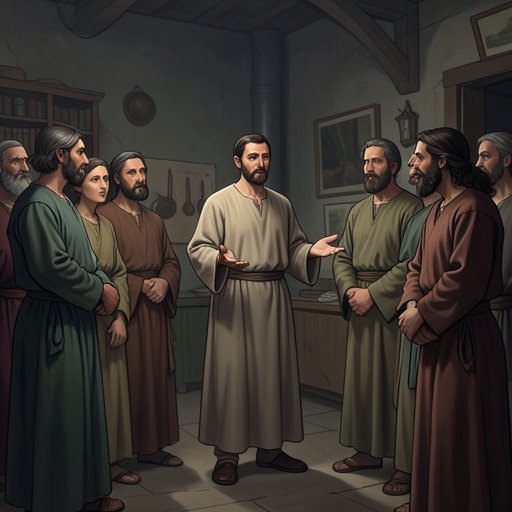
Jesus Christ
Book of EstherJesus Christ is presented as both the ruler who directs history toward the spread of the Gospel and the Saviour whose death makes salvation possible without compromising divine justice. The book connects his authority over the Church and the course of nations to a central theological claim: human actions remain accountable even when Providence makes them serve purposes their agents did not intend.
Identity and Authority
Jesus Christ appears not as a distant figure in a closed historical account but as the living ruler of the Church and of earthly events. The book insists that his rule extends on earth as well as in heaven. Consequently, the Church does not need the approval or assistance of those opposed to the Gospel in order to fulfil its mission. His authority is the ground for confidence that the Church’s work does not depend ultimately on political favor, human strategy, or the resources of its opponents.
That claim also governs the book’s reading of Esther. The deliverance of the Jews is treated as an instance of divine purpose working through human choices, including sinful ones, without making their agents innocent. The same account of Providence applies beyond that narrative: people pursue their own aims, yet their actions can be made to serve a purpose they neither recognize nor intend. Jesus Christ’s rule gives this interpretation its assurance that history is not finally controlled by the enemies of God.
Providence and the Course of History
The book reads the worldwide spread of the Gospel as the fulfilment of a prediction attributed to Jesus Christ. Its account traces a chain of circumstances across eighteen hundred years and presents their convergence as evidence that the God who governs Providence is the God of the Bible. Historical developments are not treated as alternatives to divine action merely because they have identifiable human causes. Rather, the timing and combination of those causes can themselves be understood as the means through which Providence works.
The spread of the Gospel supplies a particularly forceful example. Jesus Christ, the book observes, made fewer converts through his own preaching than the Apostles did: Peter’s address converted three thousand, while even the Saviour’s teaching could meet persistent unbelief. The contrast is used not to diminish Jesus Christ’s authority but to argue that the Gospel’s extraordinary success cannot be explained by eloquence or outward means alone. Its rapid advance in the face of obstacles points, in the author’s account, to divine power opening human hearts.
Material and intellectual developments also enter this providential history. The invention of papermaking and printing made books far less scarce, and printing was perfected in the century before the Reformation. The book interprets this timing as preparation for the wider circulation of divine truth: the technologies that multiplied books helped make the diffusion of the Gospel possible. Jesus Christ’s government of the world therefore includes the use of human skill and invention for the good of the Church, even when those involved do not understand that larger purpose.
The preservation of Scripture through the Church of Rome presents a sharper paradox. The book does not credit that church with being the only means by which the Bible survived; other churches and groups could also have preserved it. Its argument instead turns on the survival of Scripture in the keeping of an institution portrayed as hostile to its authority and interested in its destruction or corruption. That continued preservation is attributed to the power of God, who makes even an opponent an unwitting instrument in the progress of truth. The Scripture thus passes through the hands of a church that, in the author’s interpretation, it will ultimately expose and overthrow.
The Gospel and Human Understanding
Jesus Christ’s commission to preach the Gospel throughout the world is also used to argue that the Gospel carries evidence of its own truth. The book reasons that condemnation for unbelief would be unjust if the hearer had no access to evidence. It considers someone hearing the Gospel for the first and last time, without an opportunity to consult other sources, and concludes that the truth must be evident, in some measure, in the message itself. The preacher’s authority alone cannot settle the matter for such a hearer; the content of the Gospel must disclose its own significance.
At the heart of that message is the union of justice and mercy in the salvation of sinners through Jesus Christ’s death on the cross. The book describes this as a truth that human wisdom could not have devised and argues that failure to perceive its importance reflects spiritual blindness, not a deficiency in the Gospel’s evidence. Faith, in this account, is not presented as the reward for first mastering an external body of proofs. When the mind is opened to the nature of the Gospel, the truth brings conviction; later investigation of Christianity’s other evidences can deepen and strengthen that conviction.
Atonement and the Harmony of Divine Attributes
The atoning death of Jesus Christ is the decisive resolution of the book’s account of justice and mercy. Human schemes that rely on good conduct to cover wrongdoing leave the sinner still in debt to justice: good actions are duties owed, not a surplus payment for sin. Nor, the author argues, can mercy simply cancel justice without making God’s attributes appear to conflict. Salvation must therefore show mercy to sinners while fully honoring the law they have broken.
The book locates that resolution in Christ’s sacrifice. Redemption through his blood does not diminish the law or bargain away its claims; it magnifies the law and makes it honorable. The death of Jesus Christ, as the sacrifice of one of infinite worth, provides the full compensation that the sinner’s punishment could never complete. The argument presents this not merely as an escape from punishment but as the clearest practical display of divine justice, joined without contradiction to mercy.
This account gives the believer confidence grounded in more than an appeal to mercy alone. The book says that forgiveness rests also on God’s justice and truth, because Christ’s death has answered the law’s claim. The righteousness credited to the Christian is the righteousness of the Son of God; accordingly, the charge of sin cannot undo the salvation secured through him. Jesus Christ thus stands at the intersection of the book’s two central emphases: he rules the history through which the Gospel advances, and through his atonement he makes the salvation of sinners an expression of both mercy and perfect justice.