Mariner’s compass
Book of EstherMariner’s compass is the navigational instrument that, in this account, turned the open ocean from a barrier into a route between distant lands. The author gives it a significance beyond practical navigation: because it made access to the world’s scattered peoples possible, he reads its discovery and adoption as part of God’s provision for the worldwide preaching of the Gospel. Its needle is at once a human invention and, in this theological interpretation, an instrument prepared for a purpose long before navigators could use it.
The Maritime Problem
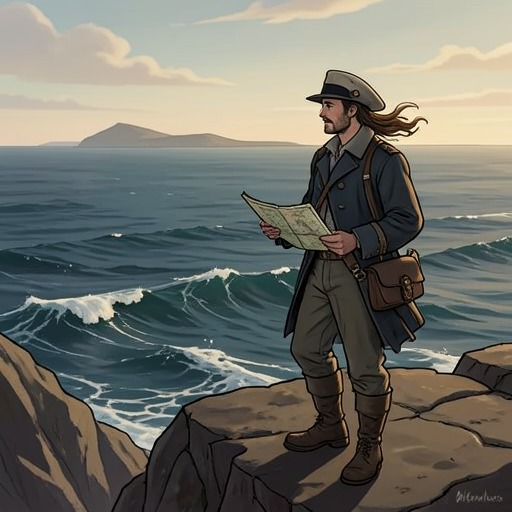
Before navigators had a dependable guide across the ocean, they relied on the sun and stars and were reluctant to travel beyond sight of land. Voyages proceeded slowly and dangerously along coastlines. That limitation had a global consequence in the author’s argument: when Jesus Christ pledged that the Gospel would be preached among all nations before the end of the world, much of the globe was unknown to Europeans, and no navigational method then available seemed capable of reaching the lands beyond it. The author compares the apparent impossibility of such a voyage to the prospect of travelling to the moon.
The compass changes the terms of that problem. Its directional guidance allows a vessel to steer through open water and find a way in darkness across what had been described as a trackless deep. The author stresses not merely that sailors could travel more efficiently, but that the scattered islands and peoples of the globe became accessible. In his account, the device supplies a practical answer to the question of how a promise concerning all nations could be fulfilled when many nations lay beyond the known routes.
The Needle and Its Historical Timing
The account describes the compass through the magnetic property that enables an iron rod to point toward the earth’s poles. It credits Flavio Gioia, a citizen of Amalsi in the kingdom of Naples, with observing the phenomenon, recognizing its usefulness, and devising the nautical needle. It also acknowledges that the mariner’s compass was reportedly in use in China from a very early period. The passage therefore does not simply present the instrument’s history as an uncontested first invention; its emphasis is on the discovery, recognition, and practical application that made ocean navigation possible in the account’s providential history.
The author places the decisive convergence in 1302. The magnetic property, the capacity to perceive its use, and the skill to turn that recognition into an instrument are treated as distinct conditions meeting at a consequential moment. Yet the compass did not immediately produce a new age of exploration. Nearly half a century passed before navigation ventured into new seas, and at the beginning of the fifteenth century it had not advanced beyond the level it had reached before the fall of the Roman Empire. Italians first gained practical skill in using the instrument; the account then turns to the Portuguese as the people destined to lead the new discoveries.
A small political circumstance begins the next stage of that sequence. John the Bastard, having secured a throne to which he had no legitimate right, planned an expedition against the Moors on the coast of Barbary to occupy his restless subjects. Ships sent ahead to sail along Africa’s Atlantic coast for purposes of discovery initiated a wider movement of exploration. In this chronology, the compass does not by itself cause every voyage: it makes open-ocean navigation possible, while practice, political decisions, and particular expeditions carry that possibility forward. The author connects this sequence to the later voyages associated with Christopher Columbus and Captain Cook, and to the discoveries that opened new seas.
An Instrument Read as Providence
The author’s central claim is that the compass was indispensable to fulfilling the prediction that the Gospel would reach all nations. He consequently interprets it as more than a useful human contrivance: it was, he argues, as truly a provision of God as if an angel had delivered it from heaven. This is an interpretation of historical purpose, not a claim that navigators understood themselves to be serving a religious design. The compass becomes evidence, for the author, that events and discoveries can serve an end beyond the intentions of the people involved.
That reading rests on a distinction the book repeatedly draws between divine appointment and human responsibility. In its discussion of the Book of Esther, the author argues that God’s purposes may be achieved through actions that remain the free and culpable acts of human beings. He applies the same broad logic to the compass: an invention may serve God’s design without its human makers or users acting with knowledge of that design. The instrument’s service to a providential purpose does not turn every human action associated with it into a virtuous one, nor does the author treat the use of the talents of God’s opponents as approval of their conduct.
The Compass in a Larger Historical Design
The compass is one element in an account of how conditions for transmitting the Bible and Gospel emerge across different periods. The author also treats the development of modern European languages as providentially useful: after centuries in which Latin dominated learning, those languages became suitable vehicles for translation. The compass performs a complementary work in space. Languages make the word communicable across linguistic boundaries; ocean navigation makes distant populations reachable. Together, these examples let the author present worldwide proclamation as dependent on a succession of material and intellectual developments rather than on preaching alone.
The chronology also gives the object a particular symbolic force. The magnetic property belongs to the created world from the beginning, but its usefulness to navigation remains undiscovered until the author’s appointed historical moment. He describes the earth’s “key” as formed at creation and placed in human hands only when it was needed to open the world to navigation. From that perspective, the compass’s significance lies both in what the needle does and in the delay before people learn to use it: creation, discovery, practical ingenuity, and later voyages form a sequence that the author reads as one providential plan. The result is a compact emblem of his larger thesis that human skill and historical change can become instruments of a purpose their agents do not themselves perceive.