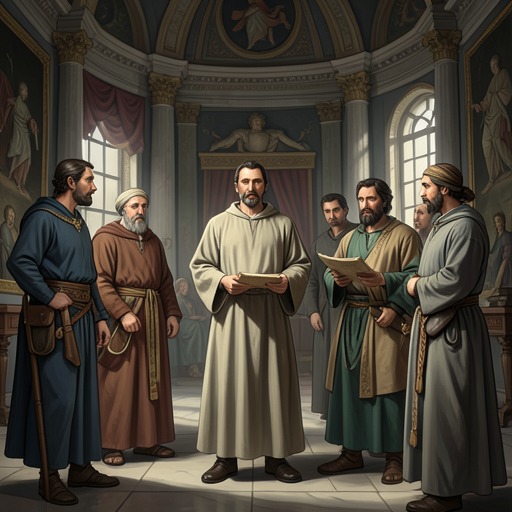
Mordecai’s Leadership and Protection of the Jews
Book of EstherMordecai’s leadership of the Jews is presented as consequential but morally complicated: his refusal to honor Haman becomes a pretext for a danger extending to the whole community, while his counsel to Esther helps turn her position at court into a means of intercession. In the account’s providential reading, the same Mordecai whose conduct contributes to the crisis later becomes a public source of protection, as his rising influence helps the Jews withstand the threat against them.
A contested beginning to his leadership
Mordecai’s refusal to bow to Haman is the point at which his individual conduct becomes entangled with the fate of the Jews. The king had ordered his servants to show Haman marked reverence, and the narrator argues that the required gesture could have been understood as civil honor. On that reading, Mordecai’s refusal was not clearly required by religious duty. Even if he acted from a desire to honor God, the account distinguishes a worthy motive from a potentially mistaken action; devotion does not, in itself, make error into duty.
The refusal also acquires collective consequences because Mordecai identifies himself as a Jew. The other servants had not previously known his descent, but their questions about his disobedience lead him to disclose it. Haman then learns which people Mordecai belongs to. The narrative emphasizes the reversal: Mordecai’s earlier caution in advising Esther to conceal her nationality had not prevented peril, and now his own disclosure helps bring the Jews into view. What begins as a dispute over courtly reverence becomes a vulnerability shared by an entire dispersed people.
Counsel to Esther in the crisis
When Haman’s request leads Ahasuerus to authorize the destruction of the Jews, Mordecai’s role shifts from refusing a royal command to urging action against the consequences of the king’s decision. He turns to Esther, whose position as queen gives her a possible route to the king, and warns her not to assume that residence in the palace will place her beyond the danger facing her people. His appeal joins personal risk to communal responsibility: if she remains silent, he says, deliverance will come to the Jews from elsewhere, while she and her family may perish.
Mordecai’s argument is also an interpretation of Esther’s rise. He understands her royal position not simply as the result of ordinary events, but as an opportunity appointed for this emergency. In the book’s account, her elevation follows Vashti’s removal and Esther’s beauty; Mordecai can recognize those worldly circumstances and still believe that God has placed her where she can plead for the Jews. His confidence in deliverance is not confidence that Esther is indispensable: he believes the people can be saved by another means, but that refusing the service available to her would carry consequences.
Esther initially resists because entering the king’s inner court without a summons could cost her life. She has not been called to him for thirty days, making the danger feel especially immediate. Mordecai does not erase that risk; his appeal helps her confront it. After the Jews in Shushan (Susa) fast for three days, Esther resolves to approach the king, accepting the possibility of death. The account therefore depicts Mordecai’s leadership not as protection that removes danger, but as counsel that calls another person to act within it.
Responsibility, law, and the community
The author does not treat Mordecai as an uncomplicated moral exemplar. His earlier refusal to honor Haman is sharply distinguished from Esther’s later submission to the king’s ceremonial authority. Esther falls at Ahasuerus’s feet when she pleads against Haman’s decree, even though Mordecai had refused to bow to Haman. This contrast supports the author’s objection to attempts to justify Mordecai by claiming that the honor demanded was necessarily religious worship. In this interpretation, the book shows both his commitment and the danger of forcing events to vindicate a favored leader.
The crisis also turns on the collision between imperial commands and religious obligation. Haman represents the Jews as a people whose laws differ from those of other nations, and Ahasuerus accepts his proposal without examining it adequately. The author argues that the Jews were bound to obey the civil laws of the land, but not to abandon the religious institutions of God in order to conform to humanly appointed rites. Mordecai’s experience thus stands within a wider conflict between the authority of the Persian court and the community’s distinctive religious duties. The Jews’ vulnerability is collective, but the narrative does not make their difference itself a fault.
Public influence and protection
After Haman’s fall, the first decree remains in force and cannot simply be revoked. The Jews still face enemies throughout the provinces of the Persian Empire, and permission to defend themselves does not by itself guarantee their safety. The account attributes their changed position in part to Mordecai’s growing standing at court. His reputation spreads through the provinces, and fear of his influence falls upon the officials and other people there.
When the Jews gather in their cities to resist those seeking their harm, provincial rulers, deputies, and royal officers assist them. The author presents this support, together with the fear surrounding Mordecai’s name, as a practical means by which the Jews escape destruction despite the unchanged decree. Mordecai’s leadership has therefore changed in character: the man whose refusal helped expose the community to danger becomes a figure whose public authority helps make its defense possible. In the author’s providential interpretation, this reversal does not cancel the question of his earlier conduct. Instead, it makes the relationship between human responsibility and divine purpose central to his history with the Jews.