Persecution of Christianity under the Roman Empire
Book of EstherThe Roman Empire’s opposition to Christianity is presented as a prolonged test of a movement without worldly power: for three hundred years, imperial authority resisted the Gospel, yet Christianity endured and spread without a rebel sword being drawn to protect it. The author makes this imbalance central to his account of providence, arguing that the movement’s progress cannot be explained by force, elite sponsorship, or human ability alone.
Opposition and an Unequal Contest
The book places the persecution within a broader gathering of resistance to Christianity. It recalls the rulers and peoples assembled against Jesus Christ, naming Herod and Pontius Pilate among those joined with Gentiles and Israel. The later conflict with the Roman Empire extends this pattern: the Gospel confronted hostility from both political authority and established learning, rather than securing protection from the powerful.
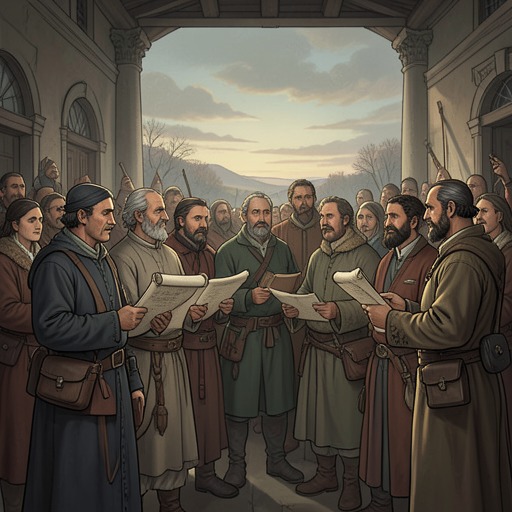
The author emphasizes the disparity between the movement’s means and its opponents. The first heralds were, in his account, illiterate fishermen, facing the learning and influence of the ancient world. Christianity had neither the favor of rulers nor an armed force at its disposal; no rebel sword was raised to shield it from imperial opposition. The duration of the struggle—three centuries—makes its eventual establishment, in the author’s reasoning, more striking, not less.
How the Gospel Advanced
The argument does not attribute the Gospel’s expansion simply to the natural persuasive power of its messengers or to miracles. The author notes that miracles accompanied the beginning of the Gospel but were occasional rather than the ordinary means of its spread. He contrasts the apostles’ rapid success with the small number of followers Jesus Christ left at his death, despite his mighty works and teaching. The raising of Lazarus also failed to compel belief: some witnesses instead reported the event to opponents who plotted to kill Lazarus. These contrasts support the author’s claim that outward evidence and human eloquence could not, by themselves, account for conversion.
Nor, in this account, did the apostles generally advance through spectacular interventions. Providence ordinarily worked through circumstances that might look like accident or human agency: the apostles were delivered, continued on their journeys, and found friends and protectors. Against the backdrop of imperial opposition, this distinction matters to the author’s explanation. Christianity’s endurance did not mean that its adherents escaped danger; rather, the movement continued by means that did not require political victory or a counter-revolution.
Survival and the Preservation of Scripture
The author extends the argument from the survival of the Christian movement to the preservation of the Bible. He argues that Scripture would not have vanished even if every copy held by the Church of Rome had been destroyed: Eastern churches and groups separated from the Western church could have preserved it. His particular point is that the text, in his view, was preserved in integrity even when transmitted through an institution whose interests and hostility should have favored its destruction or corruption. He treats this apparent contradiction as another instance of providence working through an unlikely instrument, while distinguishing the Church of Rome from the Roman Empire’s earlier persecution.
Later material conditions also enter the book’s account of how the Gospel could reach a wider public. The author links the invention of paper, which he dates to the eleventh century, to the growing possibility of producing books; before that, writing materials were scarce, books costly, and private ownership unusual. Printing, which he says arose in Germany or Flanders around 1420 and later developed through movable type, multiplied books on a scale that manuscripts could not. He describes paper as preparing the way for renewed learning and printing as preparing the way for the Reformation. These developments belong to a longer history of circulation, not to the Roman persecution itself, but they extend the same claim that the Gospel’s reach depended on providentially ordered circumstances as well as on its first preachers.
Historical and Theological Significance
The episode functions as evidence within the author’s account of divine government. The Roman Empire’s opposition was real, and the Christians’ lack of worldly protection is part of the claim, not an obstacle the narrative conceals. Yet the author interprets the movement’s survival and expansion as showing that hostile power could not finally determine its course. The persecution thus becomes a measure of the contrast between imperial strength and the Gospel’s eventual reach.
This interpretation also belongs to the book’s larger insistence that human action and divine purpose are not mutually exclusive. The Gospel’s opponents act from their own interests, while the author understands the outcome as serving a purpose beyond theirs. His account therefore treats the three centuries of resistance not as proof that Christianity succeeded by force, but as a central instance of how, in his theological reading, providence advances its ends through ordinary history and against formidable opposition.