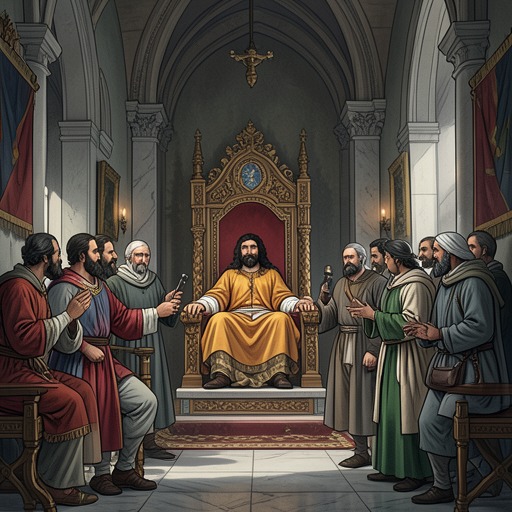
Pope Leo X’s Conflict with Martin Luther
Book of EstherThe book portrays the conflict between Leo X and Martin Luther as a struggle that gathered force through the indulgence trade and was prolonged by the pope’s misjudgments and political caution. Luther’s challenge did not begin as a fully formed plan to break with the Church of Rome: he was initially a sincere member of that church, and his understanding of its errors developed over time. The author reads the resulting delay, controversy, and protection as a providential convergence, while maintaining that human agents acted from their own motives and remained responsible for their choices.
Background and the Indulgence Controversy
The conflict took shape when the sale of indulgences reached what the author calls an extreme degree of abuse. That traffic was not merely the issue Luther happened to encounter; in the book’s account, its conspicuous excess was the circumstance that roused him against the system. When he began his attack, he had no enlarged view of reform and remained, in conscience as well as profession, within the Church of Rome. Without the abuses of the sellers of indulgences drawing his attention, the author suggests, Luther might have continued in that community, as other devout men had done before him.
The controversy also had an audience prepared to hear it. The sale of indulgences had become a serious nuisance to princes and ordinary people, who were consequently ready to listen to someone willing to question its usefulness. Luther’s objections gained force in a climate of existing dissatisfaction; his challenge was not received in a vacuum. The author therefore links the opening of the conflict both to Luther’s response and to a practice whose excess had already made it vulnerable to criticism.
A Gradual Challenge and a Misjudged Response
The book emphasizes that Luther’s opposition developed by stages. His initial work did not amount to a settled renunciation of the Church of Rome. He continued for a considerable period to profess deference to the apostolic see, and only further inquiry compelled him to recognize what he regarded as fundamental errors in the system. This gradual movement, the author argues, helped his cause by making it harder for opponents to see at once the ultimate direction of his thought.
Leo X, meanwhile, is described as attributing the disturbance to jealousy among monastic orders. He left monks of different orders to contest the matter among themselves rather than immediately treating Luther’s activity as a challenge requiring decisive action. The author presents this as a consequential mistake: the dispute was allowed to develop while the pope underestimated its character. The conflict was thus shaped not simply by opposing doctrines, but by the mismatch between the growing reach of Luther’s challenge and Leo’s interpretation of it.
Leo X and the Course of the Conflict
The author associates Leo’s personal and political characteristics with the way the conflict proceeded. His profuseness, luxury, liberality, and plans for family advancement are said to have driven him to press the Church’s financial exactions, while his easy temperament and attachment to pleasure made him less inclined to act quickly to suppress the trouble caused by Luther. This portrayal links the indulgence controversy to the conduct of the papacy: the same habits that encouraged further exaction also accompanied a failure to confront the reformer promptly.
The response from the court of Rome is characterized as unusually indecisive. It neither made a vigorous early attempt to crush Luther nor tried to win him over through a partial reform of abuses. Instead, it followed a vacillating course and lost what the author presents as a critical opportunity, when Luther might either have been stopped or reconciled to the Church. The point is not that the court lacked political skill in general: the author notes its reputation for diplomatic craft precisely to underscore how exceptional this failure appeared. In this account, institutional hesitation allowed the conflict to advance.
Political Protection and Escalation
Luther’s situation was affected by the support of Frederick, Elector of Saxony, whose protection gave him a measure of security. Leo’s political calculations made him reluctant to offend the elector on the eve of an imperial election, and this restraint further delayed a decisive response. Although Luther’s opponents were impetuous, the author dates Leo’s pronouncement of the bull of excommunication to 1520, after the controversy had already had time to grow.
The death of Emperor Maximilian in 1519 also altered the political circumstances. The administration of the part of Germany governed by Saxon law passed to Frederick, and Luther consequently enjoyed tranquility under the elector’s friendly administration. During the interregnum before Charles’s election, his opinions were able to take root in different places and acquire strength. This change did not arise from the dispute between Leo and Luther alone, but the book treats it as a decisive condition of their conflict: a powerful supporter was in a position to shelter Luther while the central authority hesitated.
Providential Interpretation and Responsibility
The author’s interpretation places the conflict within a larger account of Providence. The sale of indulgences, Leo’s personal disposition, the court’s wavering policy, Luther’s gradual movement away from allegiance to Rome, and the political protection he received are presented as circumstances that converged to advance the Reformation. The claim is not that Leo consciously intended that outcome, or that Luther’s opponents freely chose it. Rather, actions pursued for human purposes could produce consequences beyond those purposes.
That account does not erase responsibility. Across the book, divine appointment and human freedom are held together: people act according to their own intentions, and their conduct remains morally accountable, even when Providence turns its effects toward a larger end. Applied to Leo and Luther, this framework makes hesitation and excess historically consequential without declaring them innocent or necessary from the actors’ perspective. Their conflict becomes, in the author’s telling, both a struggle over indulgences and a case study in how political failure, religious controversy, and unintended consequences could serve an outcome that none of the participants fully controlled.