Portugal
Book of EstherPortugal occupies a pivotal place in the book’s account of maritime discovery: a small exploratory venture on its Atlantic-facing coast becomes the beginning of a sequence that opens routes to distant lands. The narrative treats Portugal’s rise not simply as a national achievement but as an instrument of Divine Providence, preparing a wider world for the spread of the Bible. Its early leadership is therefore both a historical turning point and a measure of the responsibilities that later fall to other powers.
The First Voyages of Discovery
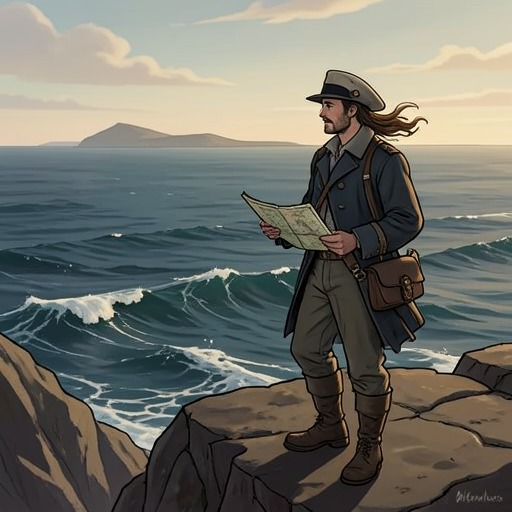
The account traces Portugal’s part in exploration to a political circumstance rather than a grand plan for worldwide navigation. John the Bastard, having established himself on a throne to which the author says he had no legitimate right, prepared an expedition against the Moors on the coasts of Barbary. While those preparations were under way, a few ships were sent ahead to sail along the western shore of Africa, bounded by the Atlantic Ocean, for purposes of discovery. The book presents this modest preliminary voyage as the opening of a new era: an expedition with limited immediate scope becomes the starting point for exploration beyond regions familiar to Europeans.
The narrative stresses the disproportion between the smallness of that beginning and the consequences it eventually carries. The ships’ voyage along Africa’s western coast did not, as described, immediately produce a complete system of oceanic exploration. Rather, it initiated a spirit of discovery that developed through later voyages and accumulated navigational practice. Portugal matters in this history as the place where a contingent undertaking first sets that process in motion.
Henry and the Portuguese Project
Prince Henry of Portugal, identified in the book as Henry the Navigator, becomes the central figure in the sustained advancement of discovery. His zeal and application are described as difficult to explain without reference to the influence of God. Obstacles met his plans, but the account emphasizes his persistence in the face of them: difficulty does not end the project but becomes the condition against which his resolution is displayed.
The book connects that persistence to several converging ambitions. The ambition of the pope, the desire to discover, and the hope of reaching the riches of India by a new passage all favored Henry’s designs. In this presentation, Portugal’s exploration is not driven by a single motive. Political and material interests combine with the larger providential purpose that the author sees unfolding through them, whether or not the individuals involved grasp that purpose.
John II inherits the zeal of his grand-uncle Henry, but with greater power to pursue it. His ardor is portrayed as so intense that the undertaking occupies his thoughts by day and keeps him from sleep at night. The book makes this sleeplessness part of its broader pattern of providential history: it recalls the sleepless night of Ahasuerus, through which events were directed toward the good of Abraham’s descendants. Portugal’s rulers thus enter a narrative in which personal ambition and political action can serve ends beyond their immediate designs.
Routes Opened and Discoveries Shared
The history of Portugal’s voyages intersects with the career of Columbus, whom the book says was brought by Providence to Portugal and enriched there with its nautical skill before Spain employed him on a voyage of discovery. Sailing west in search of India, Columbus discovered the West India Islands in 1492 and the continent of America in 1498. In that same year, Portuguese navigators reached India by way of the Cape of Good Hope. The account places these achievements alongside one another to show how the accumulated capacities of navigation opened multiple routes and enlarged European knowledge of the inhabited world.
Portugal’s part in the story is therefore both direct and enabling. Its own navigators reached India by the Cape, while the nautical knowledge Columbus acquired in Portugal contributed to a voyage undertaken for Spain. The book presents the fifteenth century as a period of extraordinary expansion in knowledge of the globe, and regards the newly accessible lands as regions that could invite the efforts of those committed to the Bible. Discovery is not treated as an end in itself: the opening of sea routes becomes preparation for religious outreach.
Portugal’s Place in a Larger Transfer of Power
The book sets Portugal’s early lead against England’s delayed entrance into commerce and discovery. Portugal, Spain, the Italian states, and the cities of the Hanseatic League all preceded England in commercial development. The author also points to England’s internal divisions and successive conflicts as circumstances that retarded its progress. Within this comparison, Portugal’s prominence is evidence that the later distribution of commercial power was not inevitable or simply the result of geographic advantage.
The passage to India by the Cape and the first influx of the riches of the East are described as having been given to Portugal, while vast provinces in South America were assigned to Spain. The author reads this division as making Providence’s role more visible: Portugal’s access to India and Spain’s American dominions appear as stages in a history whose political arrangements can change. By the time commerce and discovery advanced rapidly during the sixteenth century, England, despite its eventual importance, had not yet acquired a comparable name in either.
That contrast leads to the book’s central qualification of Portugal’s achievement. The wealth of India later passes to Great Britain, and the author interprets this transfer as carrying a duty to make the Bible available to India’s inhabitants. Portugal’s earlier success is thus part of a changing sequence of powers, not the final destination of the history. Across the account, routes, maritime skill, and imperial possessions acquire their deepest significance from the purposes the book assigns to them: they open regions to contact, and with that opening comes a religious responsibility.