The Age of Discovery
Book of EstherThe Age of Discovery marks the point at which ocean navigation began to open regions previously beyond Europeans’ practical reach. In this book, it is more than an era of geographical exploration: it is a decisive link in the author’s account of how the Bible could be carried to all nations. The mariner’s compass gave navigation a new instrument; Portuguese and Spanish voyages enlarged the known world; and the resulting sea routes made distant societies accessible to the spread of the Gospel. The author reads this sequence as providential, while emphasizing the many human decisions and incremental developments through which it unfolded.
The Compass and the Opening of the Seas
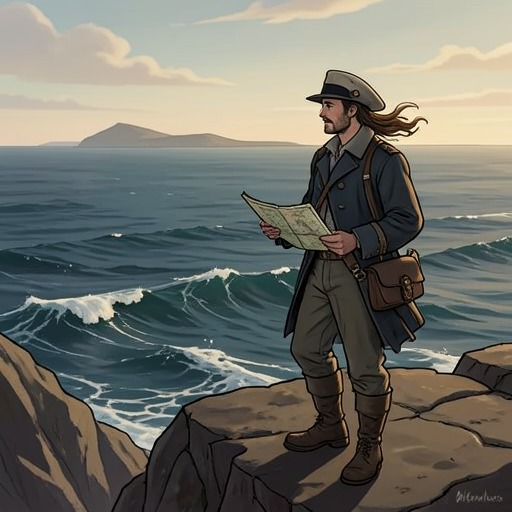
Before the compass, sailors relied on the sun and stars, and the most daring navigators hesitated to sail beyond sight of land. Long-distance voyages therefore crept along coasts and were slow and hazardous. The author treats this limitation as a practical obstacle to the worldwide proclamation of the Gospel: if distant nations were to hear it, navigators needed a way to cross open water.
The crucial discovery was the magnetic property that makes an iron rod point toward the poles. The book credits Flavio Gioia, a citizen of Amalsi in the kingdom of Naples, with recognizing the phenomenon’s usefulness and inventing the nautical needle. It dates this development to about 1302, presenting the compass as a key to the world whose usefulness emerged only when the time was ripe for it. A note acknowledges that the compass was said to have been used in China from an early period, while the main account stresses its consequences for European navigation.
The new instrument did not immediately produce a wave of exploration. Nearly half a century passed before navigators began to venture into new seas, and at the beginning of the fifteenth century navigation, the author says, had advanced little beyond the level reached before the fall of the Roman Empire. Practice among Italian sailors gradually developed skill in using the compass. In the book’s interpretation, the device mattered not as an isolated invention but as the first enabling link in a longer chain: an instrument had to be understood, mastered, and put to use before voyages could extend the reach of navigation.
Portuguese Exploration and Its Impetus
The Portuguese took the lead in the new discoveries. The account traces the beginning of their exploratory activity to a political decision by John the Bastard, who had secured a throne without a legitimate claim and sought to redirect his subjects’ restless energies toward an expedition against the Moors on the Barbary coast. While preparations were under way, a few ships were sent to sail along Africa’s Atlantic shore for purposes of discovery. The book identifies this modest preliminary effort as the start of a movement that would widen European knowledge of the globe.
Prince Henry of Portugal then advanced the project through sustained zeal and application, persisting despite obstacles. The author interprets his commitment as more than personal resolve, but also identifies worldly interests that helped the enterprise: papal ambition, the desire for discovery, and the prospect of reaching the riches of India by a new route. John II inherited Henry’s enthusiasm and had greater power to pursue the objective. His ardor became so consuming that the project occupied his thoughts by day and deprived him of sleep at night. The narrative uses this succession of motives and efforts to show how exploration could serve a purpose beyond the explorers’ own designs.
Voyages and the Enlarged World
Christopher Columbus was brought to Portugal, where he acquired nautical knowledge, and later entered Spanish service for a westward voyage in search of India. In 1492 he reached the West Indies. In 1498 he discovered the continent of America; that same year, the Portuguese reached India by sailing around the Cape of Good Hope. The book places these voyages within a rapid fifteenth-century expansion of geographical knowledge and stresses their combined effect: regions in North America and South America, as well as the vast territories of the East Indies, now lay open to the efforts of those seeking to spread the Bible.
The exploratory movement continued after these voyages. Captain Cook and other British seamen added to the territories that, in the author’s phrase and framework, were destined to be reached by the Gospel. The account says that many South Sea islands had already embraced it and were competing with Britain in their subjection to Christianity. It also names the continuing work of Captain Parry, Mungo Park, Major Laing, and Captain Franklin, whose journeys carried exploration into remote and dangerous regions. The author distinguishes the explorers’ immediate incentives from the religious outcome he attributes to their journeys: love of glory or the hope of an enduring name might spur individuals, yet their efforts could still advance a purpose they did not themselves share.
A Wider Infrastructure for the Bible
The book sets maritime access alongside changes that made the Bible more available to readers. Before papermaking, books in Europe depended on scarce and costly writing materials. The account says that after communication with Egypt was interrupted following the Saracen conquest in the seventh century, papyrus could no longer be obtained there, leaving parchment as the material for books. Manuscripts might be written over erased writing; private individuals seldom owned books, and even notable monasteries could possess only one missal. The expense could be extreme: a countess of Anjou reportedly paid two hundred sheep, grain, and millet for a collection of homilies.
Paper, which the author dates to the eleventh century, eased the material constraint but did not by itself make books affordable to the wider population. Hand-copying remained expensive: Dr. Beattie estimated that writing out a Bible would cost as much as building an ordinary country church. Even in 1471, Louis XI had to pledge substantial plate and obtain a nobleman’s guarantee to borrow the works of an Arabian physician. Printing completed what paper had begun. The book dates its invention to about 1420 in Germany or Flanders, describes early printing from engraved wooden blocks, and places the discovery of movable type about thirty years later. It argues that these developments multiplied books in time to serve the Reformation, and notes that stereotype printing further reduced the cost of the Bible.
The account also makes literacy and written communication part of this infrastructure. During the Dark Ages, few people could read or write; some clergy, it says, could scarcely read the breviary they used. An English Bible edition of only six hundred copies, translated during the reign of Henry VIII, reportedly took more than three years to sell. Alphabetical writing, the spread of reading, and the ability to communicate explanations of Scripture across great distances are presented as additional means by which the Gospel could travel. In this way, the compass and the printed book serve complementary roles: one opens routes across the seas, while the other makes the message more reproducible and communicable.
Providential Interpretation
The author’s central claim is that the Age of Discovery belongs to a divinely directed historical process, not merely a sequence of useful inventions and ambitious voyages. The compass’s magnetic property, the moment when people learned to use it, the persistence of explorers, and the opening of new routes are treated as stages that together made worldwide proclamation possible. The book describes this chain as the means by which a biblical prediction concerning the Gospel’s reach among nations could be fulfilled.
That interpretation does not depend on portraying every participant as a missionary. The account expressly says that the navigators and crews could be far from Christian conviction, and that even those whose skill and humanity it acknowledges might lack any desire to communicate their faith to the people they encountered. It nevertheless regards their preservation through dangers at sea and their construction of routes across the oceans as service to a larger religious end. The era’s significance, in this reading, lies in the contrast between limited human intentions and the far-reaching consequences of their actions: exploration enlarged the known world, while the accumulated means of navigation, printing, and literacy made that world increasingly accessible to the Bible.