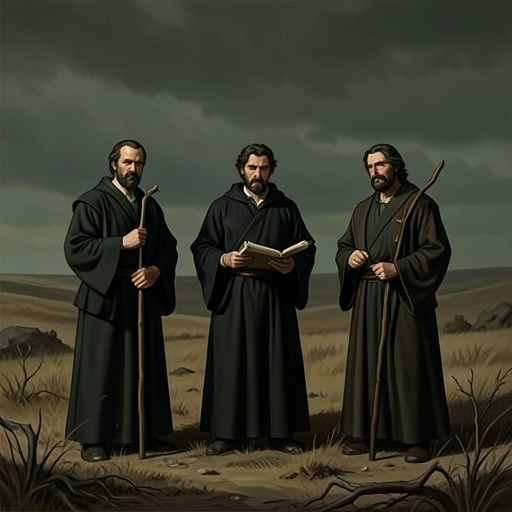
Job's Three Friends Visit and Sit in Mourning
Book of JobJob's Three Friends Visit and Sit in Mourning brings Eliphaz, Bildad, and Zophar to Job after calamity has overtaken him. Their arrival begins as an act of shared grief: they come intending to mourn and comfort him, but the enormity of his suffering leaves them without words. Their seven days and nights of silence mark the threshold between a scene of communal mourning and the anguished speech that opens Job's dispute with his friends.
The Friends Come to Mourn
When they hear of the evil that has come upon Job, each friend sets out from his own place: Eliphaz is the Temanite, Bildad the Shuhite, and Zophar the Naamathite. They have arranged to come together, joining their individual journeys in a collective effort to mourn with Job and comfort him. The account gives their visit a deliberate purpose before showing how difficult that purpose will prove to fulfill.
The friends see Job from a distance but do not recognize him. Their response is immediate: they raise their voices and weep, tear their mantles, and cast dust upon their heads toward heaven. These gestures make their grief visible and communal. Their recognition fails at first, while their knowledge of his suffering is enough to provoke lament; the contrast underscores how profoundly the man before them has been changed by what has happened.
Seven Days of Silence
The three sit with Job on the ground for seven days and seven nights, and none speaks. The silence is not a failure to notice his grief: they remain beside him because they see that it is very great. Their original wish to comfort him gives way to presence without explanation or counsel. For this first stretch of the visit, mourning is expressed not through argument but through shared time, bodily gestures, and refusal to leave him alone.
That silence also shapes what follows. When Job at last opens his mouth, he does not begin by asking his companions to explain his suffering. He curses the day of his birth, wishing that the day had perished and asking why he had not died from the womb. The movement from seven nights without speech to an elaborate lament makes the friends' quiet vigil a hinge in the narrative: it precedes, rather than relieves, Job's outcry.
From Mourning into Dispute
Job's lament establishes the emotional ground on which the subsequent exchanges unfold. His later questions continue to press against the conditions of human life and suffering; in another speech, he describes a person's days as few and full of trouble. The friends' presence therefore does not close the crisis. It brings the crisis into a shared setting where Job can speak, and where the initial work of mourning will be followed by disagreement.
The change is visible in the later movement of the dialogue. Job asks how a person can be just with God, describes his complaint as bitter, and cries that God does not hear him. His claim that he has a witness in heaven places his appeal beyond the comfort his companions can offer. At the same time, he says that his friends scorn him. The visit thus carries a tension from its beginning: the friends arrive to comfort, but their presence becomes part of a relationship strained by Job's continuing anguish and by the disputation that follows.
Narrative Significance
The scene distinguishes compassionate attendance from an answer to suffering. Eliphaz, Bildad, and Zophar do not offer an explanation during the seven-day vigil; the text instead dwells on their arrival, their visible mourning, and their decision to remain silent beside Job. That restraint gives the scene its force, while the transition to Job's curse of his birth shows that companionship cannot by itself quiet his lament.
The visit also establishes the three friends as a group before their separate voices enter the debate. Their shared journey and shared silence form a brief unity, set against the later exchanges in which Job's complaints and his friends' responses divide them. The episode's ending is not reconciliation or relief but speech: Job breaks the silence, and mourning opens into argument.