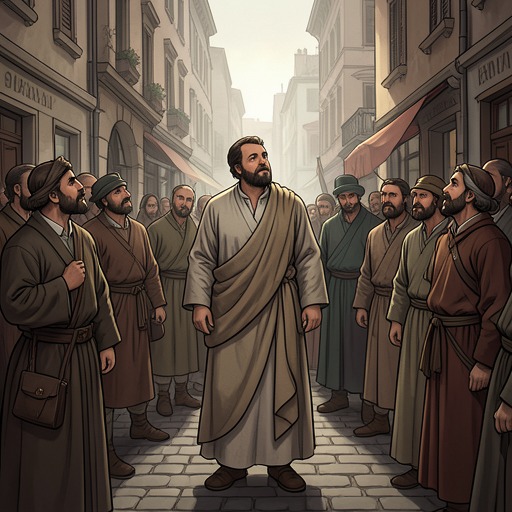
Job's Oath of Innocence
Book of JobJob's Oath of Innocence turns his defense from protest into a formally structured moral and legal challenge. Rather than merely insisting that he has suffered unfairly, Job names conduct by which his innocence can be tested: how he has treated women, servants, the poor, and his wealth. The oath culminates in a demand to be heard by God, then closes Job's speech, leaving the dispute unresolved until Elihu begins to answer.
Place in Job's Defense
The oath is the final movement of Job's extended defense, not an isolated declaration. Earlier, Job asks, "But how should man be just with God?" and recognizes the imbalance between a human complainant and a divine judge: if God contends with him, Job cannot answer even one charge in a thousand. He also says that God is not a man with whom he can simply meet in judgment, and laments that there is no mediator between them. These earlier statements make the oath's eventual demand for a hearing especially charged. Job seeks a forum in which his conduct can be examined, while acknowledging that the parties do not stand on equal terms.
Job has nevertheless appealed beyond the immediate human dispute. He declares that his witness is in heaven and his record on high, even as his friends scorn him. In the speech leading toward the oath, his complaint remains bitter and his suffering, he says, heavier than his groaning. The oath gives that continuing complaint a more ordered form: instead of leaving his claim at the level of pain, Job lays out standards of conduct against which he invites judgment.
The Conduct He Puts to the Test
Job begins with sexual self-discipline, declaring, "I made a covenant with mine eyes;" and asking why he should then think upon a maid. The covenant presents restraint as deliberate practice rather than mere absence of a proved offense. His defense proceeds through conduct toward people with less power. He asks what he would do when God rises if he had despised the cause of a manservant or maidservant who contended with him. He grounds the claim in shared creation: the same maker formed servant and master in the womb. His argument thus makes status no excuse for denying another person's case.
He next names obligations to people exposed to hardship. Job asks whether he has withheld from the poor what they desired, caused a widow's eyes to fail, or eaten his portion alone. These are posed as conditional charges against himself, not as abstract praise of generosity. Each makes the oath answerable to an observable practice: whether need was met, whether a widow was left waiting, and whether Job kept food to himself. The sequence extends his defense beyond private innocence to the treatment of vulnerable people in his care or reach.
The oath also tests his relationship to prosperity. Job asks whether he made gold his hope or told fine gold that it was his confidence, and whether he rejoiced because his wealth was great. Wealth is presented as a possible rival to trust, not as proof that Job deserves his former standing. By including this question among his tests, Job refuses to let either prosperity or its loss settle the moral case automatically.
Demand for a Hearing
The oath's ethical declarations lead to a direct procedural demand: "Oh that one would hear me!" Job wants the Almighty to answer him, and wishes that his adversary had written a book. The image of a written case gives his challenge a documentary shape. Job is not asking only for an end to pain; he wants an answer to the accusation implicit in his suffering and a record against which his conduct can be judged.
That demand carries forward the tension in his earlier appeals. Job has spoken of a witness in heaven, yet here he wants the case set down and heard. His statements do not erase the distance between human and divine authority that he has already emphasized. Instead, they sharpen the paradox: he submits a detailed account of his conduct while asking for a hearing from the one whose judgment he cannot compel. The oath's force lies in making his claim specific without pretending that the hearing is already granted.
Ending and Narrative Function
Job's closing words include a conditional invocation of ruined harvest: "Let thistles grow instead of wheat, / And cockle instead of barley." The agricultural reversal gives the close the shape of a self-imprecation: if the stated conditions are false, loss should follow. The image is severe and concrete, bringing the oath's verbal tests to a material consequence rather than ending with a general assertion of virtue.
The narrator then marks a clear boundary: "The words of Job are ended." The three friends cease answering because Job is righteous in his own eyes, while Elihu's anger rises both against Job, for justifying himself rather than God, and against the friends, for condemning Job without finding an answer. The oath therefore concludes Job's case without resolving the debate. Its detailed standards of conduct and its demand for an answer remain in view as a new speaker takes up the dispute, and its central distinction remains unsettled: Job has made a forceful claim to integrity, but the speech itself does not deliver the judgment he seeks.