The suffering of the righteous
Book of JobThe suffering of the righteous is the Book of Job’s central challenge to the belief that a person’s fortunes reliably reveal that person’s moral standing. Job is introduced as upright before disaster overtakes him, and the heavenly challenge makes his calamities a test of whether devotion can endure without reward. His losses therefore cannot be explained simply as punishment for wrongdoing: the narrative makes the gap between his character and his circumstances the problem that the book’s debates must face.
Moral standing and the test
Job lives in Uz and is described as a man who fears God and turns from evil. His prosperity is considerable: he has seven sons and three daughters, 7,000 sheep, 3,000 camels, 500 yoke of oxen, 500 female donkeys, and a large household. The account also depicts his religious care for his children. After their feasts, he rises early to offer sacrifices for them, concerned that they may have sinned inwardly. His conduct establishes both his integrity and the care with which he approaches religious duty; suffering follows this portrait rather than a confession or exposure of prior wrongdoing.
The challenge between God and Satan gives the book’s problem a second dimension. God identifies Job as exceptionally upright, while Satan argues that Job’s devotion depends on the protection and prosperity surrounding him. The question is not only why a good person suffers, but whether goodness remains genuine when its material benefits disappear. God permits Satan to test Job, first by allowing harm to his property and family while sparing Job himself, and later by permitting bodily affliction while placing a limit on the threat to his life. This framing separates the reader’s knowledge from Job’s: the reader sees a test of his integrity, while Job must make sense of calamity without access to that explanation.
Loss and steadfastness
The first disasters arrive in a sequence of reports. Raiders take the oxen and donkeys and kill servants; fire destroys the sheep and more servants; Chaldean raiders seize the camels and kill their attendants. While one messenger is still speaking, another brings news that a great wind has struck the house where Job’s children were feasting, killing them. The succession leaves little space between one loss and the next, moving from livelihood and dependents to the whole circle of Job’s children.
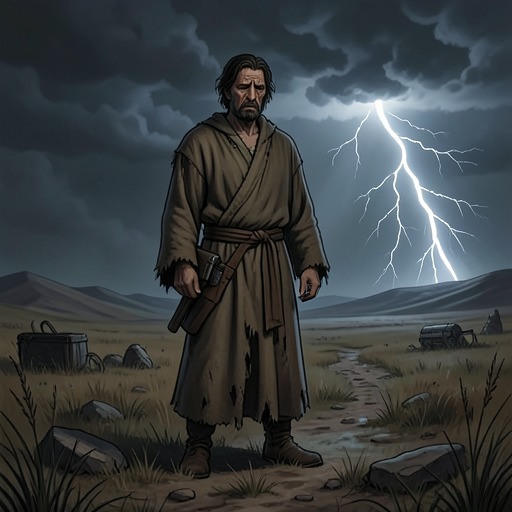
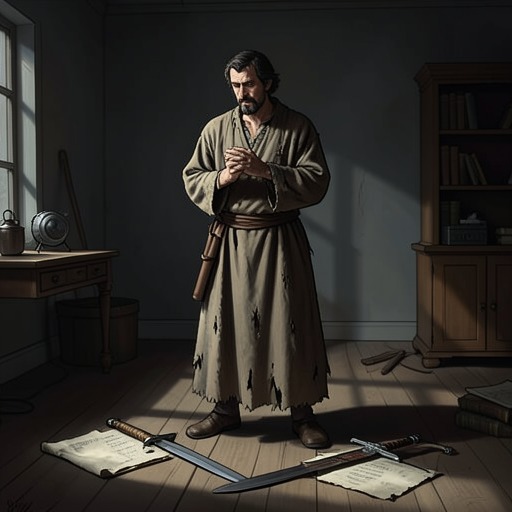
Job responds with public signs of mourning: he tears his robe, shaves his head, falls to the ground, and worships. He understands life and possessions as things received and subject to loss, and the narrator states that he does not sin by accusing God recklessly. In the second trial, Job is afflicted with painful sores and sits among ashes, scraping himself with a potsherd. His wife urges him to abandon his integrity, but he refuses her counsel and argues that receiving good from God cannot exempt a person from receiving adversity. These responses do not make his grief disappear; they establish that grief, continued worship, and moral protest can coexist.
Debate over justice
Job’s friends—Eliphaz, Bildad, and Zophar—come to mourn and comfort him. Seeing him from a distance, they weep, tear their robes, and sit with him on the ground for seven days and nights without speaking. Their silence recognizes the scale of his grief. The later debate, however, brings competing explanations into conflict, and Job challenges the adequacy of the answers offered to him.
The conventional moral account treats prosperity and suffering as evidence of how a person stands before God. Job’s situation puts that logic under pressure: the account has already established his uprightness, yet his losses are extreme. He asks how a human being can establish justice before God and observes the unequal position of the parties in any imagined hearing. He also points to a contradiction in the expected pattern of reward and punishment by asking why the wicked live long, grow powerful, and see their descendants established around them. His question is not an abstract denial of moral order; it arises from the evidence he sees and from the failure of a simple rule to account for it.
Complaint, witness, and wisdom
As the debate continues, Job’s language becomes that of a claimant seeking a hearing. He says that God has overthrown him and counts him as an enemy, and he describes his complaint as bitter. At the same time, he imagines a witness in heaven and wishes that the Almighty would answer him. His insistence on a witness and an answer gives his protest a legal shape: he wants more than an explanation supplied by his friends; he wants his case heard by the authority against whom he is speaking. The imbalance remains stark in his recognition that God is not a human opponent with whom he can simply meet in judgment.
The poem on wisdom widens the question beyond Job’s particular fate. Human beings can locate veins of silver and places where gold is refined, yet the source and place of wisdom remain hidden from the living. The contrast makes technical skill and material discovery poor substitutes for comprehensive understanding. Job’s distress thus belongs to a broader inquiry into what people can know about the order governing their lives, not merely to an argument over the motives behind a single disaster.
The limits of an answer
When God answers Job from the whirlwind, the exchange shifts from the case of one sufferer toward the scale and ordering of creation. The surviving passage begins with a challenge to Job’s understanding, and the book’s final dialogue has Job acknowledge that God can do everything. This ending places human judgment beside a power and order it cannot fully command. It does not erase the earlier losses or turn them into proof that Job deserved them. Instead, the narrative preserves the tension between Job’s demonstrated integrity, the reality of his suffering, and the limits of explanations that promise to make every fortune a transparent measure of virtue. The suffering of the righteous remains unsettling precisely because the book refuses to let Job’s calamity serve as simple evidence against him.