Atonement
Book of MormonAtonement is the Book of Mormon’s central account of how fallen humanity can be redeemed without denying divine justice. It is presented as an infinite work accomplished through Jesus Christ, the Holy Messiah and the Son of God, and as the ground of salvation, resurrection, repentance, covenant belonging, and hope for both the living and the dead. The book’s final appeal to its readers depends on this framework: they are asked to remember the Lord’s mercy, seek Christ, and endure in faith rather than treat the record as merely human history.
The Human Need for Redemption
Human beings are described as fallen and therefore cut off from the presence of the Lord. This condition is not treated as a minor moral lapse but as a rupture that affects the whole human situation: corruption cannot simply be ignored, and justice cannot be set aside without destroying the very order that makes God God. Because humanity is in the grasp of justice, redemption requires more than instruction or ordinary reform. It requires an intervention capable of answering the consequences of the Fall while opening a way back into the presence of the Lord.
The necessity of an infinite Atonement follows from the scale of that rupture. The text insists that without an infinite Atonement, corruption could not put on incorruption. The language joins moral and bodily transformation: redemption must address both the fallen condition and the mortality through which that condition is experienced. Atonement therefore stands at the meeting point of justice, corruption, death, and restoration rather than functioning as a narrow remedy for isolated wrongdoing.
Christ as the Mediator of Redemption
The decisive agent of Atonement is Jesus Christ. Redemption comes in and through the Holy Messiah, who is full of grace and truth. The formulation presents Christ neither as a distant symbol nor as one teacher among many, but as the necessary mediator through whom the impossible passage from fallenness to redemption becomes possible. Grace supplies what fallen humanity cannot supply for itself, while truth prevents redemption from becoming a denial of reality or justice.
The book’s opening declaration extends this claim beyond one community. Its abridged record is addressed to the Lamanites, as a remnant of the house of Israel, and also to Jew and Gentile. Its stated purpose is to convince Jew and Gentile that Jesus is the Christ, the Eternal God, manifesting himself unto all nations. Atonement is consequently universal in scope even when the historical record is rooted in the experiences of the Nephites, Lamanites, and the people of Jared. The record itself becomes a witness-bearing instrument through which the nations may recognize Christ and the covenants of the Lord.
That universal claim receives narrative confirmation when the resurrected Jesus Christ appears to the people at Bountiful and identifies himself as the one whom the prophets testified would come into the world. The appearance makes the Atonement inseparable from incarnation and resurrection. The Christ who fulfills prophecy is also the Christ who can be encountered after death, turning the doctrine from distant expectation into a witnessed event for the assembled people.
Justice, Mercy, and the Way Prepared
The Atonement does not abolish justice. The argument surrounding the work of justice states that justice could not be destroyed, for if it were destroyed, God would cease to be God. This creates the book’s governing tension: mercy must be real, but it cannot be purchased by pretending that wrongdoing and consequence do not exist. Atonement is the means by which that tension is resolved. It makes mercy possible while preserving the moral seriousness of divine judgment.
The same pattern appears in the book’s broader understanding of obedience. The Lord gives commandments, yet also prepares a way for people to accomplish what he commands. Atonement belongs to this prepared way. It does not turn human beings into passive objects or remove the need for response; rather, it makes faithful response possible within a condition that would otherwise end in separation and misery. The human role is therefore active but dependent: people must turn, believe, enter covenant, and endure, while the power that makes redemption effective comes through Christ.
This structure explains why the book repeatedly joins Atonement to repentance and faith. Atonement is not only a verdict pronounced over humanity; it is the foundation of a changed life. The person who receives baptism is cleansed through the power of the Holy Ghost and is received with a determination to serve Christ to the end. Such language shows redemption becoming communal and durable. It takes form in initiation, cleansing, commitment, and continued endurance rather than in a moment detached from later conduct.
Atonement in Community and Conflict
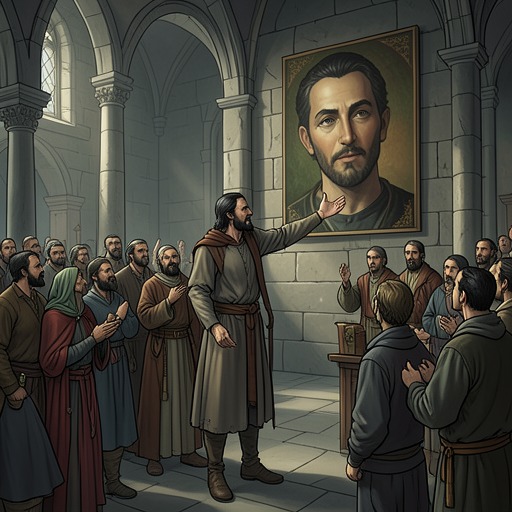
The doctrine is tested most sharply where communities have caused or inherited violence. The sons of Mosiah and their companions encounter peoples whose hatred has been intensified by Amalekites and Amulonites, and the resulting conflict threatens to turn old injury into renewed rebellion. In this setting, Atonement is not merely an abstract explanation of salvation. It supplies the moral horizon within which perpetrators can repent, victims can refuse the perpetuation of violence, and a damaged community can seek a different future.
When the king addresses his people, he interprets the arrival of their missionary brethren as an act of God’s goodness. That response shifts the community away from retaliation and toward gratitude, recognition, and reconciliation. The people’s later covenantal commitment to abandon their weapons of war gives this movement a concrete form. Their change is measured not only by professed belief but by the cessation of harm and by the costly refusal to resume the practices that once defined their hostility.
The Atonement thus has a restorative dimension. It does not make the history of violence disappear, and it does not equate reconciliation with the absence of pain. Instead, it creates conditions in which hatred can be interrupted, former enemies can be received, and communal identity can be rebuilt through covenant and service. The movement from rebellion toward repentance shows moral repair as a process involving acknowledgment, changed action, and continued communal support.
Witness, Interpretation, and Enduring Appeal
The Book of Mormon presents its testimony through layers of record, abridgment, translation, prophecy, and revelation. It is described as an abridgment of the record of the people of Nephi and the Lamanites, with an additional abridgment from the record of the people of Jared. The record was written and sealed, hidden up unto the Lord so that it might not be destroyed, and brought forth by the gift and power of God. These claims make textual preservation part of the Atonement’s witness: a record survives destruction so that a later remnant and the wider world may know what the Lord has done and may remember his covenants.
The book also acknowledges human limitation. If there are faults, they are identified as the mistakes of men, and readers are warned not to condemn the things of God because of them. This distinction preserves both humility and authority: the human recorders may err, while the divine purpose of the record remains directed toward testimony of Christ. Readers are commanded to search the words of Isaiah diligently, and they are exhorted to remember how merciful the Lord has been when they read these things. Interpretation is therefore an ethical act, not mere information gathering; the reader is asked to move from recognition of mercy to faith, repentance, and commitment.
Atonement finally gives coherence to the book’s closing posture. It supports the call to endure in faith on Christ’s name, the concern over disputations among believers, and the hope that those who have entered covenant will remain cleansed and steadfast. It also explains why the record is written to peoples separated by history and identity: the same Christ is proclaimed to Israel’s remnant, to Jew, to Gentile, and to all nations. In the Book of Mormon’s narrative and theology, Atonement is both the event through which redemption is accomplished and the interpretive center through which suffering, justice, covenant, memory, and hope are understood.