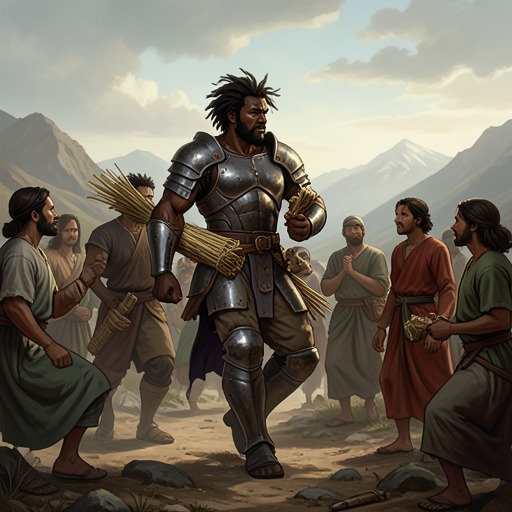
Burial of the weapons of war
Book of MormonThe Burial of the weapons of war marks the Anti-Nephi-Lehies’ decisive break with a history of violence. After their conversion and the approach of a Lamanite attack, they acknowledge the murders they have committed, credit God with removing their stains, and bury their swords and other weapons so that they will not again kill their brethren. The action turns repentance into a public covenant: weapons once used to take life are hidden away, while the people accept vulnerability, labor, and possible suffering as the price of remaining faithful.
Causes and Covenant Background
The immediate crisis is military. The Lamanites are preparing to destroy the people of God, while hostility against the Anti-Nephi-Lehies has been intensified by the Amalekites and the Amulonites. The danger becomes even more severe when the king dies in the same year that these preparations begin. Ammon, his brethren, and those who had come with him see the threat and recognize that the converted people must decide whether their new faith will survive contact with fear and retaliation.
Their decision is rooted in an unusually direct confession of collective guilt. The people describe themselves as having been among the most lost of mankind and admit the many murders they had committed. Repentance is therefore not presented as an abstract change of belief or a private emotional experience. It requires them to confront the concrete instruments and consequences of their former conduct. They understand that God has taken away their stains through the merits of his Son, but that divine cleansing also creates an obligation: they must not willingly resume the practices from which they have been delivered.
The king expresses that obligation in covenantal terms. Because their swords have become bright, they resolve not to stain them again with the blood of their brethren. The image joins moral memory to physical metal: the brightness of the weapons signifies the removal of guilt, while the possibility of staining them again represents the ever-present danger of relapse. Their vow is not merely to refrain from one particular battle; it is a renunciation of the identity and habits associated with killing.
The Burial and Its Public Form
After the king finishes speaking, the assembled people take their swords and every weapon used for violence and bury them deep in the earth. The burial is collective and deliberate. It is performed before the gathered community, making the covenant visible to those who share it and legible to those who will hear of it later. The weapons are not surrendered temporarily, hidden for tactical advantage, or placed in the hands of a stronger ruler. They are removed from immediate reach, converting the earth itself into a repository of their former violence.
This physical act gives repentance an irreversible shape. A weapon carried openly can be drawn in anger; a weapon buried in the ground cannot be used without first violating the very sign of the covenant. The people therefore create a material barrier between their new commitment and the impulses of their past. Their swords remain part of the story, but no longer as instruments of power. They become witnesses against the return of bloodshed.
The action also establishes a contrast with other forms of power in the narrative. Priestcraft seeks influence through teaching for gain, and secret combinations depend on signs, words, and concealed loyalties to organize theft and violence. The Anti-Nephi-Lehies use concealment differently: they hide weapons not to coordinate aggression but to renounce it. Their hidden objects do not create a secret advantage; they testify that the community has given up an advantage it could otherwise reclaim.
Consequences and Exposure to Violence
The covenant does not remove the external threat. The Lamanites’ preparations continue, and the converted people do not protect themselves by taking up the buried weapons. Their nonviolence consequently carries real physical stakes. They are willing to suffer rather than violate the promise that their swords will no longer be stained with the blood of their brethren. The narrative presents this willingness as evidence that their conversion has endured beyond speech and ceremony.
Their transformation is also measured against their former way of life. Once characterized by killing, they now choose restraint; once capable of spending their days in idleness, they resolve to labor abundantly with their hands. The change is therefore both negative and constructive. They stop using weapons, but they do not stop acting. Renunciation of violence is joined to disciplined work, suggesting that a repaired community must replace destructive habits with practices that sustain collective life.
The covenant’s power is tested by the hostility of people who do not share it. The Anti-Nephi-Lehies’ refusal to retaliate makes their faith visible precisely because retaliation would be understandable under the circumstances. Their vulnerability is not accidental weakness but a chosen form of obedience. In the larger history of conflict between the Nephites and Lamanites, the buried weapons stand as a counter-image to escalation: security is sought not through superior force but through a promise that the people themselves refuse to break.
Meaning for Repentance and Community
The Burial of the weapons of war converts individual moral change into communal identity. The people do not merely say that they have changed; together they remove the tools that could return them to their old lives. Their shared action makes repentance social, material, and historical. The past is neither denied nor romanticized. They remember the murders, acknowledge the stain, and answer memory with a permanent restriction on future conduct.
The event also dramatizes the relationship between forgiveness and responsibility. The people believe that God has cleansed them, yet they do not treat forgiveness as permission to resume the behavior that produced their guilt. Mercy creates a duty of preservation. Their bright swords signify both what has been taken away and what must never be restored: the stain of blood, the logic of revenge, and the old fellowship built around violence.
As a recurring model of the Anti-Nephi-Lehite covenant, the burial gives later readers a concrete image of repentance that cannot be reduced to feeling. A changed heart is represented by an altered relationship to an object, a community, and a threatened future. The earth covering the weapons becomes the boundary between two ways of life: the former life of killing and the covenant life of endurance, labor, and service to God. In that sense, the action is not an interlude within a war narrative but its moral reversal—the moment when a people answer imminent violence by refusing to become what they once were.