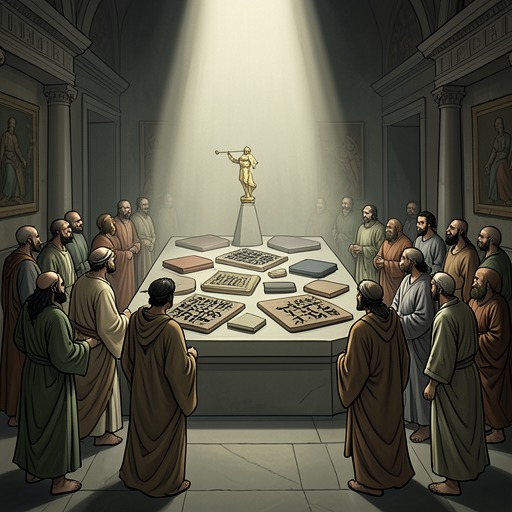
Christ’s appearance at Bountiful
Book of MormonChrist’s appearance at Bountiful is the climactic manifestation of the resurrected Jesus Christ to the Nephites. In the aftermath of catastrophe, a great multitude gathers and hears a voice from heaven identify Jesus as the Beloved Son. Jesus then descends, declares his identity and mission, and invites the people to touch the wounds of his crucifixion. The event joins revelation, prophecy, physical testimony, and covenant renewal: the Christ whom the people had been taught to expect is present among them as the slain and risen Redeemer of Israel and the whole earth.
Causes and Sacred Setting
The appearance occurs within a larger sequence of destruction and divine communication. Before the appearance, the inhabitants of the land hear a voice crying among them, establishing an atmosphere in which catastrophe has opened into direct heavenly address. The gathered multitude is therefore not encountering an isolated wonder but the next movement in a narrative of judgment, remembrance, and restoration. The setting at Bountiful becomes sacred because ordinary historical time is interrupted by a manifestation that fulfills earlier prophecy and establishes a new order of teaching and worship.
The event also belongs to the book’s stated purpose. The record is presented as an abridgment of the histories of the Nephites, Lamanites, and Jaredites, written to show the house of Israel that the Lord has not cast them off forever and to convince Jew and Gentile that Jesus is the Christ, the Eternal God manifested to all nations. Christ’s appearance at Bountiful gives that purpose its central narrative form. The claim is not left only in editorial declaration or distant prophecy; it is dramatized through a communal encounter in which the people hear, see, and touch.
The Heavenly Announcement and Descent
A great multitude is present when a voice is heard from heaven. The people do not immediately understand it. The voice comes again, and only the third time do they understand its meaning. It announces Jesus as the Beloved Son in whom the Father is well pleased and declares that the Father has glorified his name. The command is direct: the people are to hear Jesus. This repeated sound creates a threshold between confusion and recognition, while the Father’s testimony authorizes the figure who is about to appear.
After the announcement, the people look toward heaven and see a Man descending. At first they think that an angel has appeared, a reaction that shows both the strangeness of the sight and the limits of their first interpretation. The descending figure is not merely a messenger from the divine realm. He is Jesus himself, and the narrative moves from the possibility of angelic visitation to the recognition of the risen Christ. His descent makes the vertical movement of revelation visible: heaven does not remain remote, but comes into the gathered community’s field of sight.
Jesus stretches forth his hand and speaks to the people. He identifies himself as Jesus Christ, the Son of God, the Creator of heaven and earth, and the God of the whole earth. He also identifies himself through suffering, stating that he has been slain for the sins of the world. His identity therefore holds creation and sacrifice together. The one who governs the whole earth is the same one whose body bears the consequences of humanity’s sin, and his resurrection does not erase the history of his death but makes that history the ground of recognition.
Prophecy Becomes Physical Witness
When Jesus speaks, the whole multitude falls to the earth because the people remember that it had been prophesied among them that Christ would show himself after his ascension into heaven. Their physical response expresses both astonishment and recognition. The prophecy had supplied a pattern by which the event could be understood; once Jesus speaks, memory catches up with sight, and the present encounter becomes the fulfillment of a long-awaited promise.
Jesus then commands the people to arise and come forth to him so that they may thrust their hands into his side and feel the prints of the nails in his hands and feet. The invitation is unusually concrete. The truth of the appearance is not secured only through spectacle, authority, or inward conviction. Jesus directs the multitude toward the marks left by crucifixion, making wounds into instruments of knowledge. The resurrected body is continuous with the body that was slain, and the scars function as signs that connect prophecy, atoning death, and resurrection.
The multitude responds by going forward and touching his side and the prints of the nails in his hands and feet. The community’s testimony is thus formed through repeated individual contact within a collective scene. Each person’s action confirms the same identity, while the multitude as a whole becomes a body of witnesses. This emphasis on seeing and handling echoes the testimony of the Three Witnesses, who report seeing the plates and engravings through the power of God, and the Eight Witnesses, who report that they saw, handled, and hefted the plates. In both cases, sacred claims are presented through converging forms of witness; at Bountiful, however, the object of testimony is the risen Christ himself.
Consequences and Covenant Meaning
The appearance transforms an inherited expectation into direct communal knowledge. The people had received prophecies about Christ, and the heavenly voice had identified him before his descent, but the encounter adds Jesus’ own self-declaration and the physical evidence of his wounds. The sequence establishes a layered authority: prophecy prepares recognition, the Father bears record, Jesus speaks, and the multitude touches. The event’s persuasive force lies in the relation among these forms rather than in any single one alone.
Jesus’ declaration that he is the God of the whole earth also widens the significance of the manifestation beyond a local rescue. He appears to the Nephites, yet his identity is universal, and the record describes its purpose as extending to the remnant of the house of Israel, to Jew and Gentile, and ultimately to all nations. Later, the Lord declares that he will establish his people, the house of Israel. Read within that covenant horizon, the appearance at Bountiful is both fulfillment and beginning: it confirms the promises made to Israel and inaugurates renewed dealings with a surviving people after destruction.
The event also reverses the meaning of catastrophe. Destruction has not ended the history of the people or nullified the covenants. It has prepared a scene in which the wounded and resurrected Christ can be recognized by those who remember the prophecy concerning him. The movement is therefore from devastation to gathering, from an incomprehensible voice to an understood command, from mistaking the descending figure for an angel to recognizing Jesus, and from hearing about crucifixion to touching its marks. Restoration does not cancel judgment; it answers it through the presence of the Redeemer.
Narrative and Theological Significance
As a narrated event, Christ’s appearance at Bountiful is the book’s most concentrated meeting of revelation and evidence. The voice from heaven, the visible descent, the spoken identity, the remembered prophecy, and the tactile examination of wounds form a carefully staged progression from uncertainty to recognition. The narrative slows around the body of Jesus, allowing the act of touching to carry the burden of historical continuity: the risen Christ is not an abstract spiritual successor to the crucified Jesus but the same person marked by the nails and the wound in his side.
The event also establishes a model for how the record expects to be received. The book acknowledges that records contain human imperfections and asks readers not to condemn the things of God because of those imperfections. It promises that those who receive the record without condemning it will know of greater things. Against that frame, the Bountiful appearance offers the foundational pattern: divine truth is received through commanded testimony, remembered prophecy, authorized speech, and faithful attention to revealed signs. The people’s response to Jesus becomes an implicit standard for readers who encounter the record at a later time.
Finally, the appearance binds the Nephite record to the wider sacred history named in its opening frame. The book preserves accounts of the people of Nephi and the Lamanites, includes an abridgment of the Jaredite record, and presents all of these histories as witnesses to what the Lord has done for the fathers of Israel. At Bountiful, those dispersed histories converge in the person of Jesus Christ. His wounds interpret the suffering behind the record, his resurrection interprets its hope, and his presence among the multitude gives narrative shape to the claim that the covenants of the Lord continue rather than ending in abandonment.