Coming of Christ
Book of MormonComing of Christ is the book’s central horizon of expectation and fulfillment: Jesus Christ is proclaimed as the eternal God who will manifest himself to all nations, while the history surrounding his arrival is marked by prophecy, threatened destruction, miraculous confirmation, and the reestablishment of covenant identity. The subject therefore joins future promise to historical crisis, requiring readers to interpret earlier records in light of a coming event and to understand that event through the consequences it produces.
Prophetic Promise and Historical Preparation
The book frames the Coming of Christ through records preserved for a future audience. The record of the Nephites and the Lamanites is written to the remnant of the house of Israel, and also to Jew and Gentile, by commandment and through prophecy and revelation. It is sealed, hidden from destruction, and appointed to come forth in due time by the gift and power of God. Its stated purpose is not merely to preserve antiquity: it is to show the remnant of the house of Israel what the Lord has done for their fathers, assure them that the Lord’s covenants have not cast them off forever, and convince Jew and Gentile that Jesus Christ is the eternal God manifesting himself to all nations.
The record also places the Coming of Christ within a larger history of scattered peoples and interrupted civilizations. The Book of Ether preserves an abridgment of the record of the people of Jared, who were scattered when the Lord confounded the language of those building a tower to reach heaven. The Jaredite record thus becomes an earlier witness within the same providential design: peoples may be dispersed, languages may be divided, and records may pass through destruction, yet testimony and covenant purpose continue. The coming of Jesus Christ is consequently presented as the point toward which multiple histories converge rather than as an event belonging to only one lineage.
Earlier prophetic speech is acknowledged as difficult to understand. Nephi explains that Isaiah spoke many things that were hard for his people, and later Jesus Christ commands the people to search the words of Isaiah diligently because they are great. The Coming of Christ is therefore also an interpretive event: its meaning is approached through rereading prophecy, comparing records, and patiently moving between an earlier promise and a later fulfillment. The book’s repeated appeals to search, remember, and understand make the reader part of that process rather than a passive observer.
Signs, Timing, and the Crisis of Belief
The approach of Christ is associated with a threatened sign that becomes a test of communal faith. In the ninety-first year, six hundred years after Lehi left Jerusalem, Lachoneus was chief over the land. At that time, the historical setting is explicitly measured against the ancient departure from Jerusalem, making the anticipated arrival of Christ the fulfillment of a timetable embedded in the community’s founding story.
The crisis intensifies when a prophet’s warnings are treated as dangerous speech. His opponents bring him before the king and accuse him of prophesying evil concerning the people, saying that God will destroy them; they also report that he prophesies evil concerning the king’s life. The accusation shows how the Coming of Christ is entangled with judgment. A promise of divine arrival can sound like a threat to rulers and communities that refuse its implications, especially when prophecy announces destruction alongside deliverance.
At the decisive moment, the Lord tells the waiting prophet to lift his head and be of good cheer because the time is at hand and the sign will be given that night. The wording turns prolonged uncertainty into immediate fulfillment. The sign is not treated as a private reassurance only; it answers a public dispute over whether the prophecy can be trusted. The coming event therefore changes the status of the prophet’s message, transforming contested prediction into a visible confirmation of divine timing.
Fulfillment, Destruction, and Divine Voice
The Coming of Christ is presented against scenes of upheaval in which a voice is heard among all the inhabitants of the earth, across the face of the land, crying out. This voice universalizes the event’s significance. The arrival of Christ is not confined to a court, a sanctuary, or a single family’s experience; it addresses an entire population and makes the event a public rupture in the world’s order.
The same narrative horizon includes destruction associated with Christ’s death. The record points to a voice heard among all inhabitants and later preserves the Lord’s continuing revelations concerning what occurred in the land. In this structure, the Coming of Christ cannot be reduced to the first sign of his birth. His arrival inaugurates a sequence that reaches through ministry, death, revelation, and the reordering of communities. Destruction becomes the negative counterpart to covenant fulfillment: the event discloses both the reach of divine power and the seriousness of resistance to it.
Yet destruction is not the final meaning assigned to the Coming of Christ. The record also looks toward establishment. Jesus Christ declares that he will establish his people, the house of Israel. The language shifts from warning to reconstruction: scattered identity is gathered, a people is reconstituted, and the covenant is given a future beyond catastrophe. The Coming of Christ thus contains both judgment and renewal, with destruction functioning as a passage toward a restored order rather than as the whole of the event’s significance.
Records, Witnesses, and the Future Reader
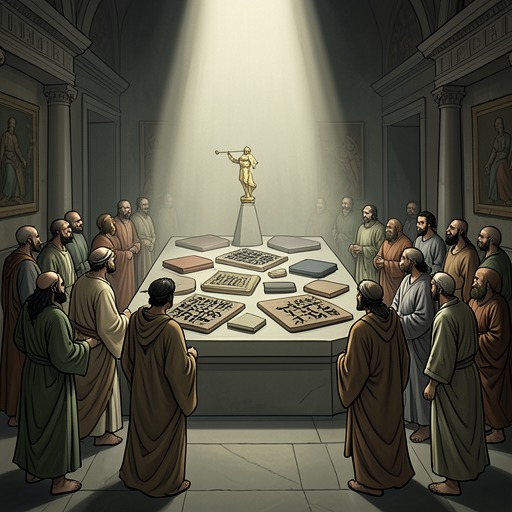
The book’s testimony about Christ is mediated through records, translation, preservation, and witnesses. The plates are described as containing the records of the people of Nephi, the Lamanites, and the people of Jared. Three witnesses testify that they saw the plates and the engravings, that an angel brought and laid them before their eyes, and that the record was translated by the gift and power of God. Their testimony presents the Coming of Christ as something affirmed through material records and divine disclosure together.
The witnesses also connect knowledge of the record with obedience and judgment. They testify that the Lord commanded them to bear record, and they state that faithfulness in Christ will allow them to be found spotless before the judgment-seat of Christ and to dwell with him eternally in the heavens. The anticipated judgment is therefore woven into the act of witnessing. To testify about Christ is to accept responsibility for how the testimony is received, while the Coming of Christ provides the ultimate setting in which that responsibility is measured.
Moroni’s role as recorder further extends the event beyond his own historical moment. He proceeds to finish his record concerning the Jaredite history, preserving a past civilization within a text directed toward readers who have not yet encountered it. At the book’s close, the reader is exhorted to remember how merciful the Lord has been to the children of men when reading these things. Memory becomes a spiritual discipline: the Coming of Christ is understood not only by waiting for it, but by recognizing mercy across the preserved histories that lead toward it.
Covenant Gathering and Eschatological Meaning
The Coming of Christ gives the book’s migrations and divisions a larger direction. The people of Zarahemla are remembered as having come out from Jerusalem when Zedekiah, king of Judah, was carried captive into Babylon. This separate migration establishes a second line of Israelite history in the promised land and reinforces the book’s concern with scattered branches of the house of Israel. The geographical division between the Nephites and the Lamanites, marked by a line running from east to west, records a political separation, but it does not erase the shared ancestral and covenant framework that the Coming of Christ will address.
The promised establishment of the house of Israel answers this history of displacement. The Lord’s future action is described as gathering and establishing a people rather than merely rescuing isolated individuals. In that sense, Coming of Christ is both personal and communal: Jesus Christ manifests himself to nations, confirms the truth of the record, judges human response, and restores a people whose histories have been marked by departure, scattering, conflict, and remembrance.
The book finally makes the reader’s response part of the eschatological pattern. Its records are brought forth by divine power, its witnesses are commanded to testify, and its closing exhortation asks readers to remember divine mercy as they read. The Coming of Christ therefore remains a temporal threshold and a continuing interpretive demand. It fulfills prophecy, explains the preservation of the record, exposes the stakes of belief, and points beyond destruction toward covenant renewal and the gathering of Israel.