Destruction at the death of Christ
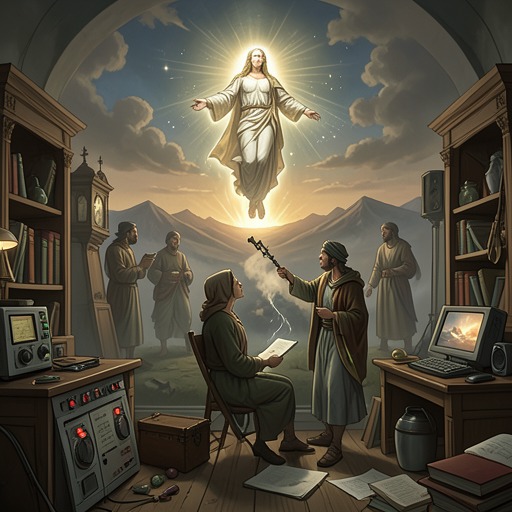
Book of MormonDestruction at the death of Christ is the great catastrophe that overtakes the Nephite lands in the thirty-fourth year, transforming inhabited space into fire, sea, mountain, ruin, and darkness. Its decisive significance lies in the way physical upheaval becomes a narrative sign: the destruction answers a long history of signs and warnings, closes one order of life, and prepares the surviving world for the voice and later appearance of Jesus Christ.
Causes and Historical Setting
The disaster occurs after a period in which the people had received many signs connected with the promised coming of Jesus Christ. The record presents the event within a larger covenant history involving the house of Israel, the people of Nephi, the Lamanites, and the ancient record of the Jaredites. Its stated purpose is to show what the Lord has done for the fathers of the house of Israel and to testify that Jesus Christ is the Eternal God manifested to all nations. The catastrophe therefore stands inside a theological history rather than outside it: it is both an event in the land and a decisive manifestation of divine power.
The timing is exact and charged with expectation. In the thirty-fourth year, during the first month and on the fourth day, a storm arose unlike any previously known in all the land. The chronology places the disaster at the death of Christ, while the preceding narrative has already established the people’s exposure to signs and their need to respond to them. The event thus reverses the anticipated stability of ordinary time. A dated day becomes an immeasurable break between the former world and the world that follows.
The Course of the Catastrophe
The first movement is atmospheric and seismic. Thunderings, lightnings, storm, tempest, and quakings of the earth continue in a combined assault rather than as separate disturbances. The record later says that these forces lasted for about three hours, giving the destruction a prolonged duration and making it a collective experience rather than a sudden private misfortune. The land is not merely shaken; its familiar physical order is repeatedly interrupted.
The cities suffer different forms of ruin. Zarahemla catches fire, turning a major center of civilization into a burning city. The city of Moroni sinks into the depths of the sea, and its inhabitants are drowned. At Moronihah, the earth is carried upward over the city until a great mountain occupies its place. These contrasting transformations matter: one city is consumed by fire, another disappears beneath water, and a third is covered and replaced by elevated earth. The catastrophe destroys both people and the spatial memory by which communities recognize their history.
The violence also reaches beyond the named cities. The combination of tempest and earthquakes alters the face of the land, while the record’s sequence of fire, drowning, burial, and geological upheaval establishes destruction as a total reordering of habitation. The inhabitants are not shown simply fleeing from a danger that will soon pass; they are caught in changes that erase roads, settlements, and landmarks. The human consequences are therefore inseparable from the transformation of the environment.
Darkness, Mourning, and the Voice
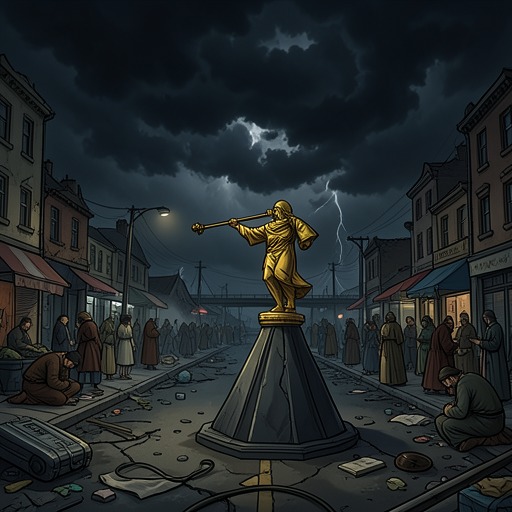
When the thunderings, lightnings, storm, tempest, and quakings cease, the crisis does not end. A mist of darkness covers the land, and for three days no light is seen. The temporal rhythm of the event changes from violent motion to suspended obscurity. The silence and darkness do not restore the world after the storm; they extend the judgment into an experience in which ordinary perception and orientation are unavailable.
The people respond with continual mourning, howling, and weeping. The narrative gives the darkness a human soundscape: grief becomes the dominant evidence of what the destruction has done. The great and terrible howlings associated with ruined cities make suffering communal, while the absence of light prevents the survivors from returning easily to ordinary social life. The event is therefore both a physical calamity and a crisis of collective meaning.
After the darkness has covered the land, a voice is heard among all the inhabitants. The voice announces itself from the midst of the disaster and leads the narrative from destruction toward interpretation. The sequence is crucial: the storm and earthquake first break the old world, the darkness suspends it, mourning registers its human cost, and the voice addresses the survivors. The catastrophe becomes a threshold through which judgment is heard rather than merely inferred from ruined cities.
Consequences and Narrative Significance
The immediate consequence is the destruction of communities, inhabitants, and the geography that sustained them. Zarahemla burns; Moroni is submerged and its people drown; Moronihah is covered by the earth and replaced by a mountain. The three days without light deepen the consequences by making survival itself an experience of grief and uncertainty. The event’s scale reaches beyond one city, one population, or one form of danger, binding fire, water, earth, storm, and darkness into a single historical rupture.
In the broader narrative, the destruction separates the period of warning from the period of divine presence. Earlier signs had created the possibility of belief, but the catastrophe demonstrates that signs do not guarantee safety for those who disregard their meaning. At the same time, the voice that follows prevents the event from ending in chaos alone. Destruction is interpreted in relation to Jesus Christ, and the ruined landscape becomes the setting from which a new covenantal order can emerge.
The event also participates in a recurring pattern across the book: peoples are scattered, cities are lost, records are preserved, and a remnant is addressed with promises of restoration. The Jaredites’ earlier scattering after the confounding of language provides a wider historical frame for understanding catastrophe as both judgment and transition. Later promises that Jesus Christ will establish his people and gather the house of Israel give the destruction an aftermath that is not limited to mourning. The old world is broken, but the narrative does not treat brokenness as the final word.
For that reason, Destruction at the death of Christ functions simultaneously as disaster, judgment, revelation, and preparation. Its value shift is stark: inhabited land becomes uninhabitable, light becomes darkness, and confidence in the continuity of history gives way to fear. Yet the catastrophe also opens the narrative toward recognition. The people’s cries are followed by a voice, and the voice prepares for the coming of Jesus Christ, so that the event’s final significance lies not only in what it destroys but in the new order it makes possible.