Helaman
Book of MormonHelaman stands at a crucial intersection of inheritance and responsibility in the history of the Nephites. He is identified as the eldest son of Alma the Younger, entrusted with sacred records, and later associated with the stripling warriors whose faith and survival become one of the period’s defining military episodes. His significance lies less in a single dramatic scene than in the continuity he represents: the transmission of scripture, authority, memory, and communal defense from one generation to the next.
Identity and Background
Helaman first appears as the eldest son of Alma the Younger. When Alma travels to teach the Zoramites, he takes Shiblon and Corianton with him but does not take Helaman, explicitly distinguishing the eldest son from the two sons who accompany him. The detail establishes Helaman as a member of a prominent religious family while also suggesting that his responsibilities differ from those of his younger brothers. His place in the family is not merely genealogical; it becomes connected with the custody of inherited revelation and the continuation of his father’s work.
The wider historical setting surrounding Helaman is defined by the overlapping histories of the Nephites, the Lamanites, the people of Jared, and the house of Israel. The Book of Mormon presents itself as an abridgment written for the Lamanites, for the Jews, and for the Gentiles, with the purpose of showing what God has done for earlier generations and affirming that the house of Israel has not been cast off forever. Helaman’s role belongs to this larger culture of remembrance. His story is framed by records that are written, abridged, preserved, sealed, and eventually brought forth through divine power rather than treated as ordinary political archives.
Stewardship of Records and Teaching
A major charge associated with Helaman is the command to take and preserve the sacred records. Alma 37 opens with Alma addressing him directly and commanding him to receive the plates. The records are not presented as inert objects. They contain the history of a people, preserve the words of prophets, and testify of God’s dealings with earlier generations. Their custody therefore makes Helaman a steward of both material history and religious interpretation.
This responsibility continues a literary pattern already established by Nephi. Nephi explains that he does not make a full account of everything his father wrote, because Lehi recorded many things seen in visions and dreams. Nephi instead selects and preserves what serves the purposes of his own record. He also writes the things of his soul and scriptures from the Plates of Brass, declaring that his soul delights in the scriptures and that his heart ponders them. Helaman inherits this model of selective preservation: record keeping is simultaneously historical labor, spiritual reflection, and an act of service to future readers.
The sacred record tradition also reaches beyond the Nephite line. Mosiah discovers that the people of Zarahemla came from Jerusalem when Zedekiah was carried captive to Babylon, revealing a second migration from the Old World and connecting separate peoples through remembered displacement. The Book of Ether likewise preserves an abridgment of the people of Jared, who were scattered when the Lord confounded the language of those building a tower. These records repeatedly transform catastrophe into testimony. Helaman’s stewardship participates in that same work, preserving evidence that destruction, exile, and division do not erase divine covenants or historical identity.
Relationship to Alma the Younger and His Brothers
Helaman’s family relationships illuminate the different forms of service expected within Alma’s household. Alma the Younger’s missionary and priestly responsibilities place him at the center of doctrinal instruction, while Helaman is marked out as the son who receives the records. Shiblon and Corianton accompany Alma during the mission to the Zoramites, but Helaman remains absent from that expedition. The narrative therefore distinguishes the brothers without reducing them to a single family role: Helaman is associated with succession and preservation, Shiblon with participation in the mission, and Corianton with the later moral and pastoral concerns addressed by Alma.
The distinction also gives Helaman’s identity a quiet gravity. He is not introduced through an act of rebellion, a public confrontation, or a spectacular conversion in the supplied material. Instead, the text positions him through trust. The eldest son is named at the moment when the family’s movements are described, and he is later addressed as the recipient of an inheritance that must be guarded. His authority begins as delegated responsibility before it becomes public leadership.
Military Leadership and the Young Warriors
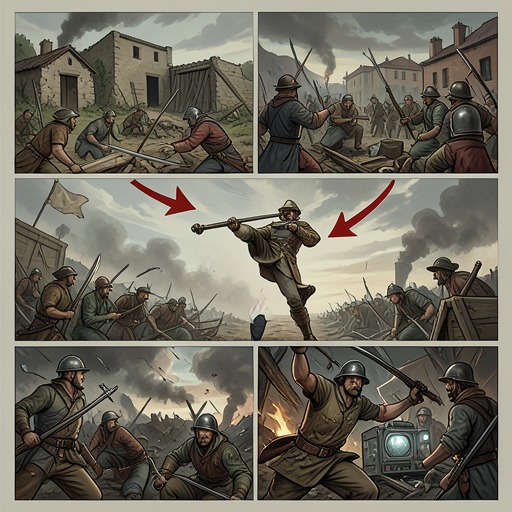
Helaman later becomes connected with the stripling warriors, a body of young soldiers serving in the Nephite defense. The surrounding military narrative is preserved through letters and campaign reports, including the account that begins a new chapter with Helaman receiving an epistle. This documentary form matters: the wars are not remembered only as heroic spectacle but as events transmitted through correspondence, command, and testimony.
The young warriors are identified with the Ammonites, whose earlier history distinguishes them from ordinary military populations. The narrative repeatedly contrasts the demands of defense with the consequences of violence, making the warriors’ service part of a larger question about covenant identity and communal survival. Helaman’s leadership places him between these pressures. He commands forces in a period when the Nephites and Lamanites are divided by territory and political conflict, yet his position is also shaped by the religious commitments of the people under his care.
The military setting is broad and unstable. The Lamanites are divided into different populations, including groups living in the wilderness and dwelling in tents, while the Nephites and Lamanites occupy opposing sides of a major geographic division. Later campaigns bring renewed peace after prolonged conflict, and Moroni eventually yields command of the armies to his son Moronihah before retiring. Against this background, Helaman’s association with the young warriors represents one phase in the effort to defend Nephite society without allowing war to become its defining moral order.
Narrative and Religious Significance
Helaman’s importance is inseparable from the Book of Mormon’s larger architecture of witness. The Three Witnesses testify that they saw the plates containing the records of the Nephites, the Lamanites, and the people of Jared, and that the plates were shown through the power of God. The Eight Witnesses add a different kind of testimony, stating that they saw, handled, and hefted the plates, which had the appearance of gold and ancient workmanship. Together these forms of witness echo Helaman’s role as custodian: sacred history must be received, preserved, transmitted, and publicly affirmed.
The record’s stated purpose is also explicitly Christological. The abridgment of Ether is said to convince Jew and Gentile that Jesus Christ is the Eternal God, manifesting himself to all nations. Later prophetic passages promise that the Lord will establish his people and address the house of Israel. Helaman’s stewardship therefore serves a future-oriented covenant narrative. Records look backward to migration, captivity, division, and destruction, but they are preserved for readers who have not yet entered the story.
That pattern culminates in the book’s treatment of catastrophe and renewal. A voice is heard among the inhabitants of the earth amid the destruction described in 3 Nephi, while later promises speak of the Lord’s establishment of his people. The Jaredite record is likewise brought to a concluding chapter in which Moroni finishes his account. Across these layers, history moves through collapse toward testimony and possible restoration. Helaman embodies the human mechanism of that movement: a son receives what earlier generations preserved, carries it through danger, and becomes part of the chain by which a threatened people remains intelligible to those who come after.