Isaiah
Book of MormonIsaiah is remembered in the Book of Mormon less through a narrated life than through the enduring force of his prophetic record. His words reach across centuries of exile, migration, destruction, covenant renewal, and promised restoration. They speak concerning Judah, address the house of Israel, and are presented as evidence that the Lord’s purposes continue through judgment and apparent abandonment. The book’s treatment of Isaiah therefore makes him both an ancient prophet and a continuing interpreter of its history: his visions give a theological pattern to calamity, survival, gathering, and the eventual establishment of the Lord’s people.
Identity and Prophetic Witness
Isaiah is identified as the son of Amoz and as the source of words concerning Judah. The record introduces his material as something he saw, not merely as political commentary or inherited tradition. His prophetic authority is grounded in vision: he beholds realities that exceed ordinary human scale, including great things on exceedingly high mountains, yet is also told that some of what he has seen should not be written. This combination of disclosure and restraint defines his place in the book. Isaiah is a witness to realities larger than the narrative can fully contain, and the limits placed on his writing become part of the meaning of his testimony.
His prophetic world includes both public history and sacred vision. One of his preserved visions is dated to the year King Uzziah died, when Isaiah saw the Lord sitting in the temple setting. The date anchors the vision in a recognizable political moment, while the vision itself opens that moment into divine presence and judgment. Isaiah thus stands at the meeting point of historical crisis and revelation: the death of a king is not isolated from the larger question of who truly reigns.
Words Preserved and Reinterpreted
The Book of Mormon preserves Isaiah’s writings within a record explicitly abridged from the records of the people of Nephi and the Lamanites and addressed to the Lamanites, to Jew and Gentile, and to the remnant of the house of Israel. Isaiah’s presence gives that address an ancient prophetic lineage. His words are not treated as detached quotations but as a body of revelation through which later peoples may recognize the Lord’s covenants and understand that the house of Israel has not been cast off forever.
Nephi introduces his own discussion by explaining that Isaiah spoke many things that were hard for many of his people to understand. The difficulty is therefore acknowledged within the text rather than concealed. Nephi’s response is not to dismiss Isaiah or reduce the visions to a single immediate meaning; he speaks concerning them and invites readers to liken the words to themselves and to all people. Isaiah’s prophecy consequently becomes an interpretive instrument. Its original setting in Judah remains important, but its language is also made available for later communities facing displacement, division, darkness, and the hope of restoration.
The book repeatedly returns to the demand that prophetic writing be actively searched. Jesus Christ later commands the people to search Isaiah’s words diligently, specifically emphasizing the greatness of those words. This command changes Isaiah’s role from a past authority into a present task for readers. His prophecy is not merely background material that confirms the status of other characters; it is a text that must be revisited, examined, and understood in relation to unfolding covenant history.
Judgment, Darkness, and Zion
Isaiah’s preserved imagery joins political catastrophe to spiritual and communal desolation. His words describe darkness and sorrow, with light darkened in the heavens. The image does more than mark an external disaster: it creates a world in which ordinary signs of orientation have failed. The Book of Mormon’s later accounts of widespread destruction and a voice heard across the land provide a narrative environment in which Isaiah’s language of darkness and judgment acquires renewed force, even when Isaiah himself is not present as an active character.
Yet judgment is not Isaiah’s final horizon. His prophecy also speaks of Zion, the Lord’s foundation of Zion, and the poor of the people trusting in it. The contrast is structural: darkness is followed not by an easy return to former stability but by the possibility of a community founded by the Lord. Trust, rather than political power or material security, marks the people who find refuge there. Isaiah’s vision therefore holds devastation and reconstruction together, making Zion the answer to a world in which human institutions and inherited securities have been shaken.
This movement from threatened identity to renewed belonging also aligns Isaiah with the book’s broader account of Israel’s scattered remnants. The Nephite record links its own people and the Lamanites to Jerusalem, recounting that the people of Zarahemla came out from Jerusalem when Zedekiah was carried captive to Babylon. It also describes the land as divided between the Nephites and the Lamanites by a wilderness running from east to west. Against this geography of separation, Isaiah’s concern with Judah and the house of Israel supplies a larger frame in which scattered peoples remain participants in covenant history rather than disconnected fragments.
Covenant, Gathering, and Fulfillment
Isaiah’s prophetic significance expands because the Book of Mormon places his words beside promises concerning the establishment and gathering of the Lord’s people. Jesus Christ declares that he will establish his people, addressing the house of Israel directly. In that setting, Isaiah’s writings become one of the principal scriptural languages for recognizing how scattered Israel can be gathered and how divine promises can move from prophecy toward fulfillment.
The record also presents the Book of Mormon itself as written and sealed, hidden up unto the Lord so that it would not be destroyed, and brought forth in due time by the way of the Gentile through the gift and power of God. Its stated purpose includes showing the remnant of the house of Israel the great things the Lord did for their fathers and convincing Jew and Gentile that Jesus Christ is the Eternal God manifesting himself to all nations. Isaiah belongs to this same economy of preservation and delayed disclosure. His visions were partly withheld, transmitted through records, difficult to understand, and later commanded to be searched. The pattern suggests that prophetic truth may remain active even when its complete meaning is postponed.
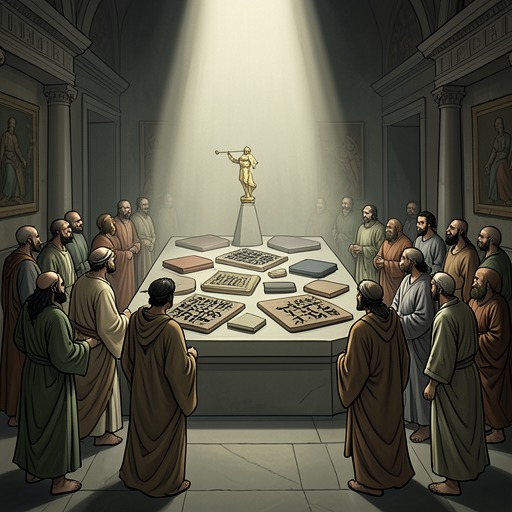
The book’s opening testimony further places its record within a chain of mediated witness. Three witnesses declare that they saw the plates containing the records of the people of Nephi, the Lamanites, and the people of Jared; they testify that an angel brought and laid the plates before their eyes and that the engravings were shown by the power of God. Isaiah’s words, preserved inside this larger record and interpreted through later prophecy, therefore participate in a layered testimony: vision becomes writing, writing becomes an abridged record, and the record becomes an object of witness and future reading.
Narrative Role and Significance
Isaiah’s narrative role is consequently architectural rather than episodic. He does not drive the book’s sequence of journeys, wars, conversions, and revelations through direct action. Instead, his visions provide a deep temporal structure beneath those events. Judah’s crisis, the scattering of Israel, the darkness accompanying destruction, the founding of Zion, and the establishment of the Lord’s people can be read as movements within a prophetic design that Isaiah helps articulate.
His importance also lies in the tension between clarity and difficulty. The text calls his words great and commands diligent searching, while Nephi admits that many find them hard to understand. That tension prevents prophecy from becoming decorative certainty. Isaiah’s authority does not eliminate the need for interpretation; it creates the need. Readers must move between the immediate historical setting, later communities’ circumstances, the promises made to Israel, and the eventual work of Jesus Christ.
Isaiah thus endures in the Book of Mormon as a prophetic mediator of memory and expectation. He looks toward Judah while speaking to a record addressed across nations; he sees realities too great to write while leaving words that later generations must search; and he announces judgment without allowing judgment to have the final word. His preserved witness helps the book understand destruction not as proof that the Lord has abandoned his people, but as one stage within a longer covenant movement toward gathering, Zion, and the recognition of Jesus Christ.