Jacob
Book of MormonJacob is the younger brother of Nephi and one of the earliest and most important prophetic voices in the Nephite record. His significance lies not in a single military or political achievement, but in the way he transforms a family’s migration history into a searching covenant theology. Born in the wilderness during the period Lehi describes as the family’s greatest sorrow, Jacob grows into a minister who must preserve the community’s spiritual identity amid separation from Jerusalem, conflict between Nephites and Lamanites, social inequality, and the uncertainty of a people living in a new land. His record joins intimate testimony, public preaching, scriptural interpretation, and historical memory.
Identity and Background
Jacob enters the record through Lehi’s final counsel to Joseph, his last-born son. Lehi recalls that Joseph was born in the wilderness during the days of his greatest sorrow, and Jacob’s own background belongs to the same formative world of affliction and displacement. He is therefore a child of the wilderness rather than a participant in the family’s former life in Jerusalem. That setting matters: his identity is formed within a community that has already lost its original homeland, carried sacred records across dangerous distances, and learned to understand survival as dependent on divine guidance.
The account of Lehi’s family names Jacob among the children connected to the founding generation of the Nephites. The family’s journey includes departure from Jerusalem, travel through the wilderness, passage to the large waters, and arrival in the promised land. Jacob’s later ministry is consequently inseparable from the question of how a migrating family becomes a people. He does not treat ancestry, land, or possession of records as sufficient guarantees of faithfulness. His preaching repeatedly places communal belonging under the judgment of covenant obligations.
Record-Keeping and Scriptural Memory
Jacob’s voice is preserved in several distinct textual settings. A chapter explicitly identifies a speech as the words of Jacob, the brother of Nephi, spoken to the people of Nephi. Another section introduces a record under the heading “The brother of Nephi” and describes Jacob’s preaching to his brethren, his opposition to a man seeking to overthrow the doctrine of Christ, and his historical remarks about the people of Nephi. These headings establish him as both a public teacher and an authoritative transmitter of communal memory.
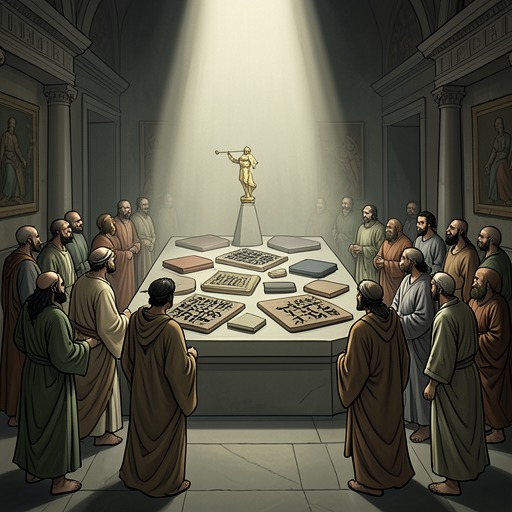
Jacob’s record is also deeply personal. He writes that upon the plates he records the things of his soul and many of the scriptures engraved upon the Plates of Brass. His relationship to scripture is not merely archival. He says that his soul delights in the scriptures and that his heart ponders them, presenting reading as an active spiritual practice in which inherited words are repeatedly interpreted in the circumstances of a new people. The Plates of Brass thus function as a portable memory of Israel, while Jacob’s writing turns that inherited memory into living instruction for the Nephites.
This work of preservation is part of the Book of Mormon’s larger layered record. The book presents itself as an abridgment of records concerning the Nephites and Lamanites, includes an abridgment from the record of the people of Jared, and states that its records were written, sealed, and hidden up unto the Lord to come forth in due time. Jacob’s contribution belongs to that chain of transmission: a local speech becomes a preserved record, a preserved record becomes part of a larger abridgment, and the larger book is directed toward the remnant of the house of Israel as well as Jew and Gentile.
Ministry Among the Nephites
Jacob’s ministry is characterized by direct address. He speaks to the people of Nephi rather than remaining a private interpreter of scripture, and his preaching carries the pressure of public responsibility. The surviving descriptions associate him with a sermon to his brethren, a confrontation with a man who seeks to overthrow the doctrine of Christ, and historical reflection on the people of Nephi. These elements show a prophet working simultaneously against doctrinal error, communal forgetfulness, and the temptation to mistake political or ethnic continuity for righteousness.
His preaching also belongs to a wider scriptural world. The Book of Mormon’s stated purpose is to show the remnant of the house of Israel what great things the Lord has done for their fathers, to teach that they are not cast off forever, and to convince Jew and Gentile that Jesus Christ is the Eternal God manifesting himself unto all nations. Jacob’s ministry anticipates and embodies this architecture. He reads Israel’s scriptures in relation to the Nephites’ displacement, teaches Christ within a record rooted in Israelite tradition, and addresses a community whose future depends on whether it will recognize covenant meaning rather than simply inherit covenant language.
The record’s historical horizon extends beyond Jacob’s own generation. It later remembers that Mosiah discovered the people of Zarahemla, who had come from Jerusalem at the time Zedekiah, king of Judah, was carried away captive into Babylon. It also describes the geographical division between the Nephites and the Lamanites, with a narrow wilderness running from east toward west. Such details clarify the world into which Jacob’s teaching enters: scattered groups trace different histories, occupy divided spaces, and carry competing claims about identity. Jacob’s prophetic task is therefore both theological and social, because scripture must speak across separation rather than merely decorate a settled community.
Relationships, Conflict, and Continuity
Jacob is defined in the record by his relationship to Nephi, whom the text repeatedly identifies as his brother. That relationship places him within the founding family’s succession of testimony and leadership, while also giving him a distinct voice. Nephi’s record includes the statement that he does not make a full account of the things his father wrote, since Lehi had written many things seen in visions and dreams. Jacob inherits this culture of selective recording and revelation, but his own emphasis falls especially on the soul, the community, and the interpretive work required to make scripture answer present conflict.
His relationship to the people of Nephi is equally central. He speaks as a brother and minister, yet the surviving summaries show that his message is not simply consoling. He confronts those who would undermine the doctrine of Christ and addresses the conduct of the society entrusted to his care. The opposition he faces is therefore not only external. The community’s own arguments, desires, and social arrangements become objects of prophetic scrutiny.
Jacob’s world is also structured by relation to the Lamanites. The Book of Mormon’s opening frame describes the Nephites and Lamanites as related peoples and addresses the record to the Lamanites as a remnant of the house of Israel. Later geography marks a division between the two groups. Jacob’s significance within this structure is that he preserves a memory of kinship even where history has hardened into opposition. The record does not erase conflict, but its framing prevents the conflict from becoming an uncomplicated story of unrelated peoples: the divided nations remain connected by ancestry, scripture, land, and the possibility of covenant restoration.
Narrative Role and Thematic Significance
Jacob serves as a bridge between generations and between narrative modes. He is a child of Lehi’s wilderness sorrow, a brother of Nephi, a preacher to the people of Nephi, an opponent of doctrinal subversion, and a writer who records the things of his soul. His presence helps the Book of Mormon move from founding-family narrative toward the durable institutions of prophetic teaching, historical remembrance, and written scripture.
His method is also a model of layered testimony. The Book of Mormon begins with records presented as translated by the gift and power of God, while the Three Witnesses testify that they saw the plates and engravings through the power of God and that an angel brought the plates before their eyes. The Eight Witnesses add a different kind of testimony: they report that Joseph Smith showed them plates with the appearance of gold, that they handled and hefted them, and that they saw engravings of ancient and curious workmanship. Jacob’s writing belongs to the earlier interior layer of this evidentiary structure. His delight in scripture and his pondering of the engraved words show how a record becomes authoritative not only through its physical preservation, but through the sustained spiritual labor of those who read, interpret, and transmit it.
The record’s later ritual language reinforces this continuity. In the sacramental text, elders and priests administer the flesh and blood of Jesus Christ through prescribed prayers, while the larger book repeatedly centers Christ’s covenant relationship with Israel and his manifestation to all nations. Jacob’s ministry stands near the beginning of that trajectory. He helps establish the pattern by which historical displacement becomes scriptural interpretation, scriptural interpretation becomes prophetic warning, and prophetic warning remains open to redemption rather than ending in permanent rejection.
Jacob’s ending is not presented here as a separate dramatic death scene or political succession. His lasting form is textual: his sermons, scriptural reflections, and personal testimony remain within the record. Through that preserved voice, the wilderness-born brother becomes a continuing presence for later readers. He teaches that a people’s survival depends not simply on reaching a promised land, possessing sacred plates, or maintaining a family name, but on remembering the covenant, searching the scriptures, recognizing Jesus Christ, and allowing inherited history to become accountable spiritual life.