Land of Promise
Book of MormonThe Land of Promise is the central destination and covenantal landscape of the Book of Mormon’s migration narratives. It receives exiles from Jerusalem, becomes an inheritance for their descendants, shelters communities fleeing violence, and is presented as a future site of Israel’s gathering. Its decisive significance lies in the tension between gift and obligation: the land is promised, but prosperity and continued possession are repeatedly connected with faithfulness to the Lord.
Definition and Covenant
The Land of Promise first appears as the destination revealed to Nephi. After the Lord commanded Lehi, father of Nephi, in a dream to take his family and depart into the wilderness, the family’s journey was given a larger meaning: they were not merely escaping Jerusalem but being directed toward a designated inheritance. The Lord told Nephi that, if he kept the commandments, he would prosper and be led to a land of promise. The location therefore functions as a covenantal future, not simply as unexplored territory; its promise is attached to conduct, guidance, and divine protection.
Lehi, father of Nephi, later taught that the family had obtained the land because the Lord had warned them to flee Jerusalem. The land’s history thus begins with flight, warning, and deliverance. It is remembered as evidence of mercy: survival in the wilderness and arrival in the new country are interpreted together, so that possession of the land becomes a testimony to the Lord’s intervention rather than an achievement explained only by human endurance.
The land also carries an explicitly national and international promise. The Lord declared that it would be a land of inheritance and that the Gentiles would be blessed upon it. This formulation extends the meaning of the Land of Promise beyond the first migrant community. It is associated with the inheritance of Lehi, father of Nephi’s posterity while also becoming a place where other peoples may receive blessing, placing ancestral claims within a wider history of divine purpose.
Migrations and Settlement
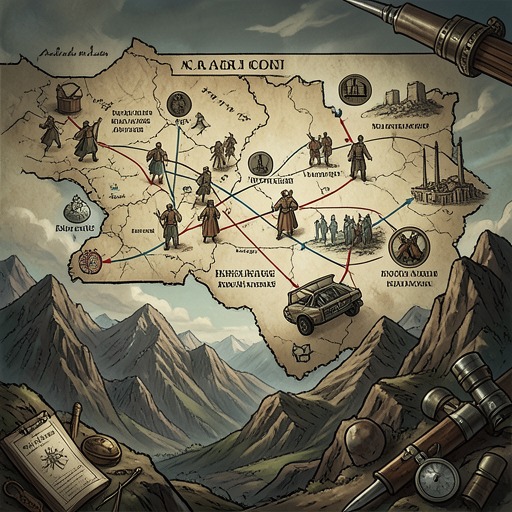
The narrative repeatedly defines the Land of Promise through movement into, across, and away from it. The Lord commanded Nephi and his brothers to return to Jerusalem to bring Ishmael and his family into the wilderness. This second expedition shows that settlement was not completed by Lehi, father of Nephi’s household alone. Families, marriages, alliances, and future population were carried into the promised region through deliberate journeys that extended the original migration.
The same pattern recurs among later peoples. Mosiah I discovered that the people of Zarahemla had come out from Jerusalem when Zedekiah, king of Judah, was carried captive into Babylon. Their presence connected the Land of Promise to another departure from the Old World and made the land a meeting place for communities whose histories had begun separately. The discovery transformed the geography into a repository of displaced Israelite memory: Jerusalem remained the point of origin, while the new land became the place where a divided past could be recognized and joined.
Migration also continues within the land. A considerable number of people took their journey again into the wilderness, showing that the promised territory does not end movement or guarantee permanent political stability. Later, when the Sons of Mosiah entered the borders of the Lamanites to preach the word of God, they separated and departed from one another, trusting in the Lord. The Land of Promise is consequently a missionary space as well as a settlement space, crossed by voluntary movement undertaken for religious purposes rather than conquest alone.
The geography is further marked by division. A line running from east to west divided the Lamanites and the Nephites, while the more idle part of the Lamanites lived in the wilderness and dwelt in tents, spread through the region. The Land of Promise therefore contains contrasting ways of inhabiting space: settled and wilderness communities, political boundaries, and populations whose identities are shaped by both ancestry and location.
Refuge, Conflict, and Collective Movement
The land’s promise does not remove danger. Its communities repeatedly face hostility, separation, and the need to relocate. When the people of the Lord gathered their families, flocks, and herds and departed from their land into the wilderness, their movement represented collective preservation rather than individual travel. Livestock and households were part of the migration, making displacement an economic and social rupture as well as a spiritual act of obedience.
That departure also reveals how the Land of Promise can become precarious even for those who regard it as sacred inheritance. A people may possess land and still be required to leave it when political or military conditions threaten their survival. The wilderness is not merely the opposite of the promise; it becomes the route through which a threatened community seeks to preserve its covenantal identity and reach a safer place within the broader promised geography.
The land is similarly shaped by the consequences of war and destruction. A voice heard among all the inhabitants of the earth, across the face of the land, announces catastrophe in the account surrounding the death of Jesus Christ. The event places the entire territory under a universal moral and historical horizon: the land is not only the stage for local rivalries but also a place affected by events of cosmic significance. Its inhabitants collectively hear the voice, and the geography becomes a shared arena of judgment.
Future Gathering and Narrative Significance
The Land of Promise ultimately points beyond the first migrations. Jesus Christ declared that the time would come when the fulness of his gospel would be preached to the house of Israel and that he would establish his people. The land is thus linked to the gathering of Israel, where earlier displacement is answered by renewed establishment. Its meaning is prospective as well as retrospective: it remembers departure from Jerusalem while anticipating the reconstitution of a covenant people.
The Book of Mormon itself is framed as an abridgment of records concerning the people of Nephi and the Lamanites, written to the Lamanites as a remnant of the house of Israel and also to Jew and Gentile. It includes an abridgment from the Book of Ether concerning the people of Jared, who were scattered when the Lord confounded the language of those building a tower to get to heaven. By placing Jaredite and Nephite-Lamanite histories within one record, the text makes the Land of Promise part of a larger pattern of scattering, preservation, and divine remembrance.
The record states that these histories are intended to show the remnant of the house of Israel what great things the Lord has done for their fathers and to assure them that they are not cast off forever. The Land of Promise therefore operates as a material anchor for a theology of survival. Peoples may be scattered, languages may be confounded, cities and societies may disappear, and records may be hidden, yet the land remains a recurring setting in which covenant, warning, migration, and restoration can be interpreted together.
Its final significance is consequently conditional and relational. The Land of Promise is inheritance, refuge, frontier, battlefield, missionary route, and future gathering place at once. It grants no automatic security: its blessings are repeatedly connected to obedience, and its history includes division, departure, and destruction. Precisely because it holds promise and peril together, the land becomes one of the book’s most powerful narrative structures, converting physical geography into a record of how communities remember their origins, negotiate belonging, and understand the consequences of their choices.