Liberty
Book of MormonLiberty is not merely escape from bondage in the Book of Mormon; it is a political and moral condition in which people can live under correct laws, share equal standing, and resist the concentration of power. Its decisive test comes when a society must choose between hereditary kingship and a system in which rulers are accountable to the people. The narrative repeatedly contrasts that ordered liberty with priestcraft, warfare, secret combinations, and political collapse, showing that freedom can be relinquished by consent or destroyed by conspiratorial power.
Definition and Constitutional Foundation
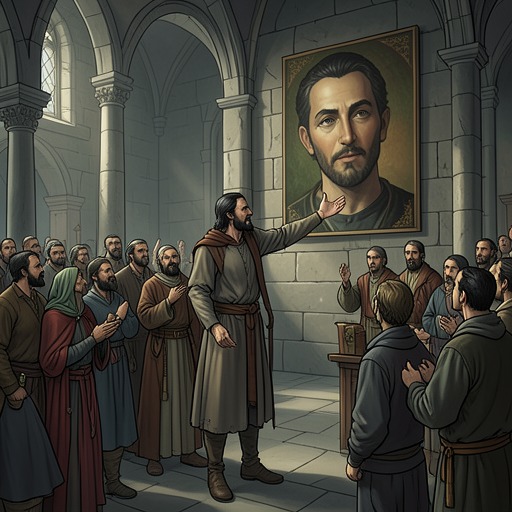
Liberty becomes an explicit public question when King Mosiah consults the people about who should succeed him. The people initially express a desire for Aaron son of Mosiah to become king, preserving the familiar system of hereditary rule. Mosiah’s response redirects the issue from personal succession to the character of government itself. Because not all people are just, he argues, it is not expedient to place a king or kings over the people. Even a good ruler cannot guarantee that a future successor will be righteous, and the consequences of a wicked king would fall upon the people as well as upon the throne.
Mosiah therefore proposes that the people choose judges by their collective voice and be judged according to the laws given by their fathers. Liberty is thus joined to law rather than opposed to it. The relevant alternative is not unrestricted individual action but a government whose authority is constrained by inherited, publicly recognized standards described as correct. The people’s voice supplies political legitimacy, while the law supplies a measure by which both citizens and officials can be judged.
The proposed reform also addresses inequality. Mosiah declares his desire that inequality should no longer prevail in the land and that the land should be a land of liberty in which every person may enjoy an equal chance. Liberty in this formulation includes distributive and civic dimensions: it concerns not only who rules, but whether ordinary people can stand before the political order without being subordinated to a privileged ruling class. The people consequently relinquish their desire for a king and become deeply concerned that every person should have an equal opportunity throughout the land.
Liberty as Accountable Rule
The transition from kingship to judges marks a major institutional transformation. Hereditary succession would have concentrated political authority in a family line, while the proposed judgeship makes authority conditional on public selection and legal judgment. The change does not eliminate conflict, ambition, or injustice, but it creates a structure in which political power is meant to be answerable rather than automatically inherited.
That principle also appears in the conduct of Pahoran. When Pahoran writes that he does not seek power, his response distinguishes office from personal domination. He has been censured, yet he is not angry; instead, he rejoices in the greatness of Moroni’s heart. His stated refusal to seek power presents liberty as a relationship sustained by restraint, patience, and recognition of a common cause rather than by rivalry among officials. Political disagreement need not become a struggle for possession of the state.
The contrast is sharp when Moroni, as chief commander of the Nephite armies, hears of political dissensions and becomes angry with Amalickiah. His anger arises in a setting where internal division threatens the political community. Liberty requires more than the existence of institutions; it requires those entrusted with them to recognize when personal ambition and factional conflict endanger the people those institutions are meant to protect. Moroni’s response frames the defense of liberty as both military and constitutional: the land’s political order must be defended against those who would replace public freedom with domination.
Threats from Priestcraft and Secret Combinations
The narrative identifies priestcraft as an early corruption of public life. Alma the Younger tells Nehor that priestcraft has been introduced among the people and charges him not only with seeking material or social advantage through religious influence but also with attempting to impose his beliefs by force. The episode places liberty at the intersection of conscience, persuasion, and coercion. Religious authority becomes politically dangerous when it is used to elevate a self-appointed teacher above the community or to compel belief rather than leave people responsible for their own response.
Secret combinations present a different but related threat. The conspirators among the people possess signs and secret words by which members recognize one another after entering the covenant of the organization. Their hidden system creates loyalty outside the ordinary public order. Because membership is concealed and identification depends on private signals, the group can coordinate theft, violence, and political subversion while evading the transparency expected of lawful civic life. Liberty is thereby threatened not only by an overt tyrant but by an invisible network that converts secrecy into power.
The collapse of government in the later history makes the danger explicit. After prophets are murdered, the regulations of government are destroyed because of the secret combination formed by the murderers’ friends and kindreds. The state does not simply lose a leader; its rules are dismantled by a kin-based conspiracy whose power overrides public institutions. The result is a movement toward kingship and subjection, demonstrating how liberty can be lost when private allegiance and organized violence replace common law.
Liberty, Discipline, and Communal Order
Liberty is also protected through disciplined communal practices. In the church, members are required to observe that there be no iniquity among them. When a person is found committing iniquity and three witnesses condemn the person before the elders, the matter is brought into an ordered process of communal judgment. This practice places moral accountability within the community rather than treating liberty as immunity from consequences. Freedom survives through procedures that distinguish accusation from judgment and locate judgment within recognized elders and witnesses.
The same tension appears in the treatment of prisoners of war. When defeated soldiers cast down their weapons and plead for mercy, Moroni takes them as prisoners and takes possession of the city rather than presenting mercy as the abandonment of public safety. The episode shows liberty operating within conditions of conflict: mercy can be granted, but political and military responsibility remains. A free community must protect itself while refusing to confuse victory with unrestricted vengeance.
The opening discussion of unbelief supplies the spiritual foundation for these political questions. Those who do not believe cannot understand the word of God, and their hearts become hardened. The passage does not define liberty as a simple legal mechanism detached from perception and character. A people whose understanding is obstructed and whose hearts are hardened may possess institutions yet fail to recognize the principles that make those institutions worth preserving. Political liberty therefore depends upon moral and spiritual capacities as well as formal arrangements.
Fragility and Narrative Significance
The history’s broad arc gives Liberty a cyclical structure. Government can move from kingship to judgeship in the hope of securing equal opportunity; it can then be weakened by dissension, ambition, priestcraft, and secret combinations; and it can finally be destroyed when conspirators seize control of the political order. Liberty is consequently neither a permanent inheritance nor a synonym for prosperity. It is a condition that must be renewed through just laws, public accountability, moral discipline, and resistance to hidden domination.
The narrative’s most sustained political lesson is that liberty requires limits on rulers and obligations upon citizens at the same time. Mosiah rejects kingship because the character of future rulers cannot be guaranteed. Pahoran refuses to define political disagreement as a personal contest for power. Moroni treats factional ambition as a threat to the commonwealth. The church’s system of witnesses and elders shows that communal freedom is compatible with judgment. Against these practices stand priestcraft and secret combinations, which convert influence, secrecy, and violence into rival forms of sovereignty.
Liberty therefore functions as both a governmental ideal and a test of communal character. It is strongest when authority is accountable, law is regarded as legitimate, every person has an equal chance, and public life is not captured by hereditary privilege or hidden alliances. It fails when people surrender judgment to rulers, when religious or political figures seek power for themselves, or when conspiracies replace the visible institutions of the community. In this sense, Liberty is not only something the people receive from a constitution; it is something they must collectively understand, choose, and defend.