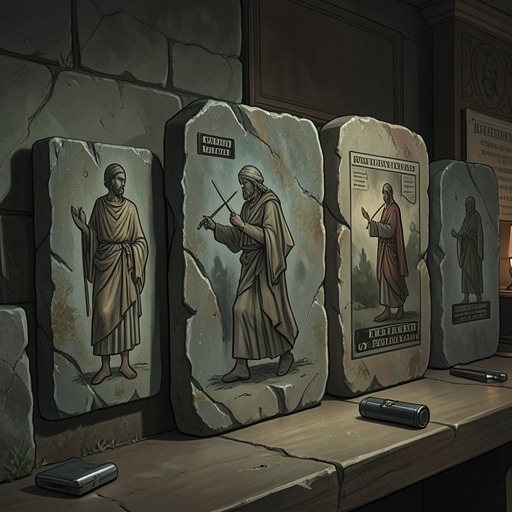
Moroni's concealment of the plates
Book of MormonMoroni's concealment of the plates is both a survival act after the destruction of the Nephites and the decisive material transition by which a defeated people's history is carried into the future. The hiding does not erase the record; it places it beyond the reach of the immediate catastrophe so that it may later come forth as a testimony of Jesus Christ, the covenants of the Lord, and the fate of the covenant peoples.
The Catastrophe That Makes Concealment Necessary
The act occurs after the great battle at Cumorah. The Nephites who escaped into the country southward are hunted by the Lamanites until they are destroyed, and Mormon himself is killed. Moroni therefore does not hide the plates from a stable society or as part of an ordinary archival procedure. He acts amid the collapse of his people, when the surviving record-keeper has become the last witness to a vanished community and does not know whether he will be killed next.
The physical setting intensifies the historical rupture. Mormon had gathered the people to the land of Cumorah, knowing that it was the last struggle of the Nephites. After that struggle, the collective world that had produced the record is gone. Moroni remains to write the sad account of its destruction, making the concealment of the plates the final material gesture of a narrative already surrounded by death, pursuit, and uncertainty.
Obedience and the Act of Hiding
Moroni identifies himself as Mormon's son and as a descendant of Nephi. His concealment is consequently shaped by both family command and inherited responsibility. He states that he fulfills the commandment of his father, then declares his intention to write and hide the records in the earth. The sequence matters: writing preserves the testimony in language, while burial protects its material form from the violence that has overtaken the land.
Moroni's personal safety is deliberately subordinated to the record's preservation. He says that it does not matter where he goes, and he does not know whether his enemies will slay him. The uncertainty gives the action its stark economy. He cannot secure a future for the Nephite people, rebuild their cities, or pass the plates to a surviving community; he can only complete the record and place it where it may outlast him.
From Destruction to Future Recovery
Moroni describes himself as the same person who hides the record unto the Lord. The plates, he says, have no worth in themselves except according to the commandment of the Lord, because no one is to obtain them for wealth. Their value is therefore defined by purpose rather than possession. They are not a treasure for private enrichment but a consecrated medium intended for the glory of God and the welfare of the ancient and long-dispersed covenant people of the Lord.
The burial also creates a deliberate movement from darkness toward revelation. Moroni blesses the person who will bring the record to light and declares that it will come forth from darkness unto light according to the word of the Lord. Concealment is thus not the end of communication but its delayed form. The record disappears from human sight so that its later recovery can be understood as an act governed by divine timing rather than by the surviving author's power.
The Record's Larger Historical Mission
The concealed plates belong to a much wider record-making enterprise. The Book of Mormon presents itself as an abridgment of the records of the people of Nephi and the Lamanites, written to the Lamanites as a remnant of the house of Israel and also to Jew and Gentile. It includes an abridgment from the Book of Ether concerning the people of Jared, whose history begins with the confounding of language at the tower built by the people seeking heaven. Moroni's burial therefore preserves not only one family's memory or one nation's final testimony, but a layered history of peoples scattered across generations.
That stated purpose gives the concealment a covenantal horizon. The record is intended to show the remnant of the house of Israel what the Lord has done for their fathers and to assure them that they are not cast off forever. It is also directed toward convincing Jew and Gentile that Jesus Christ is the Eternal God, manifesting himself to all nations. The plates survive the Nephite catastrophe so that the meaning of that catastrophe can be read within a larger history of covenant, warning, judgment, and possible restoration.
Memory, Transmission, and Narrative Significance
The concealment gathers together recurring concerns about records and remembrance. Nephi's return from speaking with the Lord to his father's tent begins another act of record-centered obedience; the brass plates are later taught as indispensable because they preserve the records of the Jews; and the history repeatedly warns against failing to hearken to the word of the Lord. Moroni's final burial gives these earlier concerns their most severe setting. When a people has been destroyed, memory must be carried by a single person and a physical object.
The act also contrasts the permanence sought by the record with the fragility of human life. Moroni's people are gone, his father is dead, and his own future is unknown, yet the plates remain available to a future audience. The record does not promise that history will prevent loss. Instead, it makes loss legible and places the testimony of the dead before readers who live after the catastrophe. In that sense, Moroni's concealment transforms a remnant into a message: the final survivor's obedience becomes the means by which a destroyed civilization can still speak, and by which its account can be brought from the earth into the light.