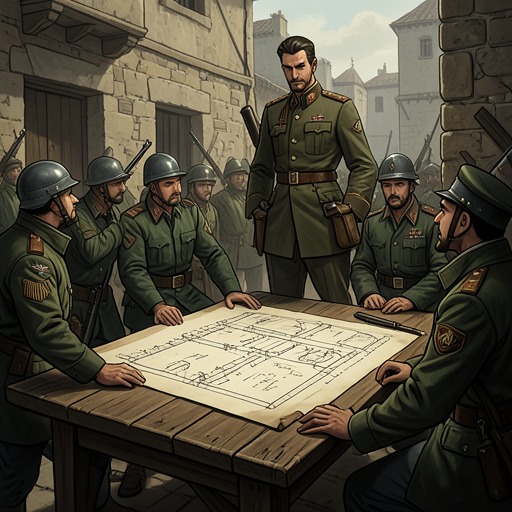
Moroni's title of liberty
Book of MormonMoroni's title of liberty is the banner raised by Moroni, chief commander of the Nephite armies, in response to internal dissension associated with Amalickiah. Made from a torn piece of Moroni's coat, it joins sacred loyalty, political freedom, domestic protection, and military mobilization in a single public emblem. Its decisive importance lies in the way it transforms a divided people into a community bound by visible symbols and covenantal action.
Causes and Political Background
Moroni acted after hearing of dissensions among the Nephites, and the account explicitly says that he was angry with Amalickiah. The danger was therefore not only an external military attack. Amalickiah represented a political ambition capable of exploiting disagreement within the land, while the people faced the possibility that their religious and civic order would be displaced by a rival power. The title of liberty answered this crisis by naming what the threatened community believed it was defending rather than by describing the enemy alone.
The banner's wording gathers several causes of resistance into one sequence: God, religion, freedom, peace, wives, and children. These concerns move from divine allegiance to public belief, political rights, social stability, and intimate family obligations. The arrangement makes the defense of the Nephite polity inseparable from the defense of worship and household life. Moroni's appeal thus frames war as a response to a threatened moral and communal order, not merely as a contest for territory.
Making and Displaying the Banner
Moroni first rent his coat and wrote the message on the torn portion. The material object was consequently marked by damage before it became a sign of unity: a piece separated from military clothing was converted into a public declaration. He then fastened the cloth to the end of a pole, producing a standard that could be carried, displayed, and recognized by people gathering across the land.
The act of display was inseparable from Moroni's own embodied authority. After preparing the banner, he put on his head-plate, breastplate, shields, and armor, girded armor around his loins, and took up the pole bearing the torn coat. The scene presents the written appeal and the armed commander together. The message identifies the ends for which resistance is undertaken, while the armor signals the means by which those ends will be defended.
The Public Covenant and Collective Response
Moroni called on anyone willing to maintain the title in the land to come forward in the strength of the Lord. The appeal required more than verbal approval: those who answered were to enter a covenant to maintain their rights and religion, with the promised blessing of the Lord. Political rights and religious commitment were therefore made mutually reinforcing through a formal act of collective promise.
The response shows the banner functioning as a mobilizing instrument. After Moroni proclaimed the words, the people came running together with armor girded about their loins. They also rent their garments as a token, repeating in their own bodies the torn condition of the original banner. The gesture made allegiance visible and communal; the people did not merely hear the proclamation but enacted their agreement through clothing, movement, and covenant.
This pattern gives the title of liberty the structure of a social movement. A crisis supplies the grievance, the written phrase supplies a shared frame, Moroni supplies leadership, the banner supplies a portable symbol, and the covenant supplies a binding commitment. The people become participants rather than spectators. Their gathered bodies convert an individual act of protest into organized resistance.
Consequences and Narrative Significance
The title of liberty establishes a recurring pattern in the wider history of the Nephites: proclamations and symbols can gather people for defense when political legitimacy is under pressure. Later accounts likewise describe leaders sending proclamations that direct people to gather their women, children, flocks, herds, and substance in the face of attack. Such mobilization extends the banner's central claim that warfare concerns the preservation of a whole society and its dependents, not only the movements of armies.
The episode also provides a sharp contrast with secret combinations, whose members use secret signs and words to distinguish those who have entered their covenant. The title of liberty is public, written, and displayed; the secret combination is concealed and restricted. Both rely on signs and covenants to organize loyalty, but they point in opposite moral directions. Moroni's sign seeks a community gathered around God, religion, freedom, peace, and family, whereas secret signs bind participants to hidden wrongdoing.
The banner's force is ultimately ritual as well as political. The torn coat, raised pole, armor, loud proclamation, running crowd, and rending of garments create a sequence through which allegiance becomes physically legible. The title of liberty does not remain an idea. It enters public space, recruits bodies, and establishes a covenantal boundary between those who will defend the community's rights and religion and those who seek power through division. Its enduring narrative role is to show how a material sign can give moral vocabulary to resistance and make collective freedom an active obligation.