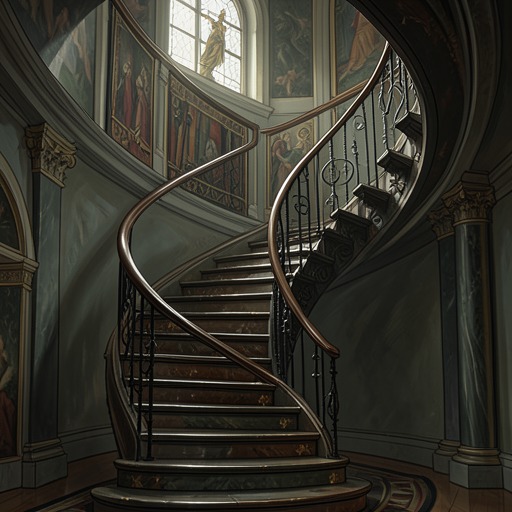
Rameumptom prayer stand
Book of MormonThe Rameumptom prayer stand is the raised platform at the center of the Zoramites’ synagogue, a purpose-built object that organizes worship around visibility, repetition, and restricted access. Known to the Zoramites as Rameumptom, interpreted as “the holy stand,” it is not merely a piece of furniture: its height, shape, and prescribed use make it the material center of a religious practice that defines who belongs and who stands outside.
Definition and Physical Form
The object stood in the middle of the Zoramites’ synagogue, where Alma the Younger and his companions found it when they entered the land to preach. The account emphasizes the strangeness of the arrangement: the stand was built high above the head, and its top was narrow enough to admit only one person. Its architecture therefore controlled both the worshipper’s body and the congregation’s attention. A person had to climb or go forward to the elevated point, occupy it alone, stretch out the hands toward heaven, and speak before the assembled community.
The Rameumptom’s name further sanctified its physical form. Calling it “the holy stand” transformed an unusual platform into an authorized sacred site. The word joined material elevation with religious status: the worshipper was literally lifted above the congregation while the object itself was treated as holy. The platform’s singular capacity also made individual performance a regular communal pattern, since each participant used the same confined space and repeated the same mode of approach.
Ritual Use and Repetition
The Zoramites required anyone who desired to worship to stand on the top of the Rameumptom, extend the hands toward heaven, and cry aloud. Worship was thus enacted through a fixed sequence of bodily gestures: separation from the group, elevation above it, an open-handed posture, and loud verbal proclamation. The ritual did not occur privately or spontaneously. It was performed in the presence of the congregation and assigned a recognizable position to every participant who followed it.
The repetition was especially important. From the stand, every person offered the selfsame prayer. The object became the mechanism through which one formula was reproduced from worshipper to worshipper, replacing individual variation with a shared declaration. At the same time, the singular platform made the repeated prayer appear as a succession of personal acts. Each worshipper occupied the stand alone, yet each reproduced the same words and the same posture, creating uniformity through controlled individuality.
The prayer expressed gratitude that the Zoramites were chosen by God and had not been led away after the traditions of their brethren. The Rameumptom therefore gave physical form to a boundary-making theology. Standing above the congregation, the worshipper announced not only devotion but also privileged identity. The stand’s height made superiority visible, while the repeated prayer gave that superiority a liturgical voice.
Social Boundaries and Conflict
Because the Rameumptom was located in a synagogue and used by the whole community, it functioned as a public institution rather than an isolated devotional object. Its ritual distinguished the Zoramites from those whom they described as having been led away. The prayer’s emphasis on being chosen and separate converted social difference into religious certainty, and the platform made that distinction observable each time a worshipper stepped onto it.
This use of sacred space helps explain why the object becomes central to Alma the Younger’s encounter with the Zoramites. Alma and his companions came to preach repentance, redemption, and faith on the Lord, but they first encountered a community whose worship had been organized around a fixed elevation and a repeated claim of election. The contrast is between a physical place that places one person above others and a message directed toward repentance and redemption. The Rameumptom concentrates the conflict in a single scene: its structure presents separation as holiness, while the missionaries’ presence challenges the religious assumptions that structure embodies.
The stand also reveals how objects can preserve doctrine through practice. The Zoramites did not need to explain their communal identity anew each time; the platform, the prescribed gesture, the loud prayer, and the repeated formula carried the teaching forward. The Rameumptom made belief durable by making it bodily and public. It trained worshippers to enact a hierarchy in which sacred approval was associated with being elevated, singled out, and set apart.
Narrative and Thematic Significance
As a narrative object, the Rameumptom compresses architecture, ritual, theology, and social division into one memorable image. Its narrow top allows only one person, yet its use belongs to the whole congregation; this tension between solitary performance and collective repetition is central to its meaning. The worshipper appears individually chosen, but the words and actions are prescribed in advance. The object therefore stages a community’s ideal self-image while exposing the rigidity beneath it.
The Rameumptom also stands in sharp contrast with other sacred practices in the record. At the waters of Mormon, Alma the Elder teaches repentance, redemption, and faith and gathers people through a covenantal community. The administration of the sacrament later depends on elders and priests, bread and wine, prayer, and the promise that participants may always have the Spirit. The Rameumptom, by contrast, is associated in the supplied account with a single elevated speaker and a repeated declaration of chosenness. These differing ritual forms show two competing ways of making religious identity visible: communal covenant and shared spiritual obligation on one side, public separation and asserted privilege on the other.
The object’s symbolic force extends beyond the immediate scene. The Book of Mormon’s testimonies and historical headings present records as witnesses meant to convince nations and preserve knowledge of God’s dealings, while Nephi writes the things of his soul and delights in scripture. Those practices treat words and records as instruments of remembrance and accountability. The Rameumptom represents a more closed use of religious form: it repeats a formula that confirms the group’s status rather than opening worship toward repentance, fellowship, or responsibility to others. Its enduring significance lies in that contrast. The stand is “holy” by name, but the narrative makes its holiness inseparable from the question of what worship produces—humility and redemption, or elevation through exclusion.