Shiz
Book of MormonShiz is the brother of Lib and the principal pursuer of Coriantumr in the closing catastrophe of the Jaredite record. He is defined less through personal background than through motion, escalation, and destruction: once he enters the narrative, pursuit becomes a force that draws cities, families, and armies into a war from which almost no one emerges. His story is therefore inseparable from the final destruction of the Jaredites, where individual rivalry expands into collective ruin.
Identity and Introduction
Shiz appears as the brother of Lib, a major opponent of Coriantumr during the last phase of the Jaredite civil war. The record gives no genealogy beyond this relationship and supplies no account of his earlier life, beliefs, or private motives. Instead, it introduces him at the moment when the conflict has already become a struggle for survival, naming him as the commander who pursues Coriantumr after Coriantumr’s army has fled.
That introduction establishes Shiz through an action rather than a description. He does not merely oppose Coriantumr politically or defend a disputed claim; he follows him across the land and overthrows cities in the course of the chase. His identity is consequently attached to the expanding reach of war. The narrative presents him as a figure whose pursuit converts a conflict between leaders into a catastrophe affecting the whole population.
Pursuit of Coriantumr
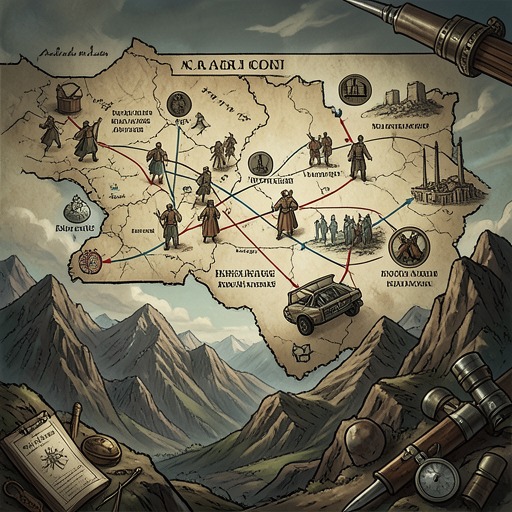
Shiz pursues Coriantumr after the army of Lib’s brother has been driven back. The chase is marked by the destruction of many cities and the killing of women and children, showing that the pursuit has lost any limited military character. Civilian life is absorbed into the logic of retaliation, and the geography of the conflict is measured by the communities Shiz’s forces overrun rather than by a stable front.
The violence surrounding the pursuit produces a grim spectacle: people begin flocking together in armies throughout the land. Shiz’s campaign thus has a recruiting and concentrating effect, whether through fear, loyalty, desperation, or the need for collective defense. The population does not remain dispersed while two leaders settle their rivalry. Instead, the pursuit gathers the inhabitants into organized masses, making the war broader and more difficult to end.
The narrative emphasizes the scale of this transformation by recording that armies form throughout the entire land. Shiz is not presented as a solitary avenger moving through an empty wilderness. He operates within, and helps intensify, a society in which nearly everyone is drawn into armed alignment. His pursuit becomes the mechanism by which private antagonism is translated into national mobilization.
Escalation into Total War
The war reaches a point at which the losses of men, women, and children on both sides are so great that Shiz orders his people not to continue pursuing Coriantumr. This command briefly reveals a limit imposed by exhaustion and mass death. Yet the pause does not produce reconciliation. It reflects the temporary inability of the combatants to continue rather than a change in the purposes that brought them into conflict.
The opposing armies repeatedly return to battle after suffering losses that would ordinarily end a campaign. In the continuing struggle, the survivors sleep upon their swords and fight again on the following day. The recurrence of combat gives Shiz’s pursuit a cyclical structure: defeat does not close the conflict, wounds do not induce surrender, and night provides only an interval before renewed killing.
By the later fighting, almost all of the combatants have fallen. One battle leaves only fifty-two people from both sides alive at nightfall, a number that makes the scale of the preceding destruction concrete. Shiz belongs to a war that no longer seeks a practical political settlement; it consumes the population required to sustain either side. The final Jaredite conflict is rendered as attrition carried beyond reason, with each surviving group continuing because the other still survives.
Wounding and Final Confrontation
In the last phase of the struggle, Coriantumr’s men regain enough strength to walk and prepare to flee for their lives. Shiz then rises as well, and the combat resumes. Earlier fighting has already left Coriantumr severely wounded, with many deep wounds and such loss of blood that he faints and is carried away as though dead. The physical condition of the leaders mirrors the condition of their societies: both are damaged almost beyond recovery, yet neither conflict nor pursuit has reached its conclusion.
Shiz’s persistence gives the closing battle its brutal momentum. Even after the armies have been reduced to remnants and the principal combatants have been gravely injured, he remains capable of rising and continuing the pursuit. The record does not offer Shiz a redemptive reversal, a moment of repentance, or a return to civil order. His final narrative function is to remain inside the war until the war has nearly erased the people who made it possible.
Narrative Role and Significance
Shiz serves as the accelerating counterpart to Coriantumr in the Jaredite destruction. Coriantumr is the pursued survivor, while Shiz is the force that keeps the pursuit alive; together they form a pattern in which leadership becomes indistinguishable from the continuation of collective death. The record’s broader purpose is to show what God has done for earlier peoples and to convince readers that Jesus Christ is the Eternal God, but the account of Shiz supplies the negative historical image against which covenant warning becomes urgent.
His story also belongs to the larger pattern of peoples scattered, divided, and destroyed when violence overwhelms covenantal memory. The Book of Mormon presents the Jaredite record as an abridgment preserved for later readers, including a remnant of the house of Israel, and the account of Shiz demonstrates why such a record must be preserved: the past is not merely an inventory of battles but a testimony of how conflict expands when its participants refuse to stop. Shiz’s pursuit begins as a movement against Coriantumr and ends as one of the engines of the Jaredite final destruction.
The character’s lasting significance lies in this conversion of pursuit into annihilation. Shiz is memorable not because the record develops his inner life, but because every supplied detail enlarges the consequences of his action: cities are overthrown, women and children are slain, inhabitants gather into armies, commanders are wounded, and the survivors repeatedly return to the sword. His arc has no true return or restoration. It terminates in exhaustion, bloodshed, and the near disappearance of the people whose history he helps bring to an end.