Sons of Mosiah
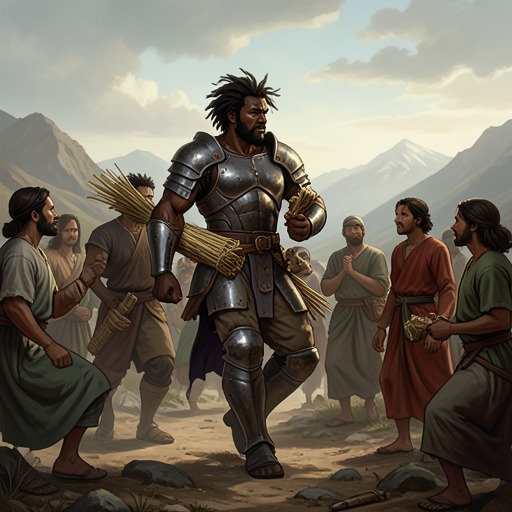
Book of MormonThe Sons of Mosiah are a group of royal sons whose defining significance lies in the conversion of privilege into service. Their story joins personal repentance to collective mission: after participating in the events surrounding the angel’s appearance to Alma the Younger, they undergo a profound spiritual reorientation, prepare through prayer and fasting, and leave familiar power behind to teach the Lamanites. Their work becomes one of the Book of Mormon’s clearest demonstrations that inward change can produce public transformation across an inherited political and religious divide.
Identity and Formation
The group is identified as the sons of Mosiah, the king of the Nephite people. Their position places them close to political authority, yet the narrative does not define them by succession or courtly status. Instead, it emphasizes what they do after conversion. Their shared history with Alma the Younger is decisive: they were with Alma when the angel first appeared to him, and Alma’s later joy at seeing them again reveals that their bond was formed through a common crisis and a common return to faith.
Their conversion stands within a wider pattern of inward renewal. The people who hear King Benjamin’s words testify together that they believe them and know their truth through the Spirit of the Lord, while Alma teaches that faith in the words spoken by Abinadi produced a mighty change in the heart. Against that background, the Sons of Mosiah represent the same movement from inherited identity to personally confirmed conviction. Their religious allegiance is not merely an extension of their fathers’ authority; it is remade through repentance, spiritual knowledge, and sustained practice.
Preparation and Mission
After completing their earlier work, the Sons of Mosiah take a small number with them and return from the land of Zarahemla with the purpose of preaching among the Lamanites. Their departure is therefore both geographical and social. They leave the center of Nephite authority and move toward a people separated from the Nephites by history, territory, and hostility. The text presents this movement as a deliberate missionary undertaking rather than an accidental journey.
Their effectiveness is attributed to preparation rather than force. They give themselves to much prayer and fasting, and as a result they possess the spirit of prophecy and the spirit of revelation. When they teach, they do so with power and authority from God. The sequence matters: discipline precedes authority, and authority serves teaching. Their mission is not presented as political conquest or as an attempt to impose Nephite rule. Its stated aim is that the Lamanites may know the word of God.
The mission also carries unusual personal cost. The sons could have remained near the Nephite political order, but they choose movement into contested territory and service among a people commonly treated as enemies. Their decision makes their former social position an ethical test. Conversion becomes credible because it alters where they go, whom they serve, and what kind of power they are willing to exercise.
Relations and Cross-Boundary Work
The Sons of Mosiah’s relationship with Alma the Younger provides the mission with an emotional and narrative center. When Alma meets them again, he rejoices exceedingly, and his joy increases because they have remained faithful and have become instruments for teaching the word of God. Their reunion links the private memory of the angelic intervention with the public consequences of conversion. The same event that changed the young men’s direction now appears in the enduring labor they undertake together and separately.
Their work crosses the boundary between Nephites and Lamanites without denying that the boundary is real. The peoples occupy distinct regions, with the Nephites and Lamanites divided by a line running from east toward west, while many Lamanites live in the wilderness and dwell in tents. The Sons of Mosiah therefore carry their message through a divided landscape, addressing communities whose political and cultural circumstances differ from those of Zarahemla. Their mission gives spiritual communication a form that can travel across territorial separation.
The consequences of this contact include changes in individuals and communities. In the conversion narratives associated with the mission, teaching is joined to acts of service, patient presence, prayer, and divine intervention. Ammon, one of the Sons of Mosiah, serves King Lamoni and is involved in the recovery of the king’s flocks; the episode becomes a gateway to religious inquiry rather than a display of domination. When King Lamoni lies apparently dead and later rises according to Ammon’s words, the event deepens the community’s recognition of God’s power. Such scenes show how the group’s mission operates through relationships: service opens attention, testimony interprets experience, and spiritual change spreads through households and peoples.
Consequences and Narrative Significance
The Sons of Mosiah embody a reversal of direction. Men associated with royal power become missionaries; those who might have defended a political inheritance instead seek the conversion and welfare of former enemies. Their story consequently enlarges the meaning of repentance. Repentance is not confined to remorse for an earlier offense or to a private declaration of faith. In their case, it generates endurance, sacrifice, disciplined teaching, and a willingness to enter another people’s world.
Their mission also contributes to the possibility of reconciliation between Nephites and Lamanites. The Book of Mormon frames its records as an abridgment concerning both peoples and as a message to the remnant of the house of Israel, intended to show what God has done for their fathers and to affirm that the Lord’s covenants have not cast them off forever. The Sons of Mosiah enact that inclusive purpose within the narrative. Their ministry treats the Lamanites not as permanently excluded opponents but as people capable of receiving the word, entering covenant relationship, and experiencing a mighty change.
The group’s importance is therefore both organizational and theological. As an organization, it is a network of companions united by shared conversion, preparation, and mission. As a narrative force, it converts inherited conflict into an arena for witness and service. Their example stands beside the later testimony of the young warriors, whose courage is described as unprecedented among the Nephites, and beside the account of the Nephite golden age, when a people no longer walk after the performances and ordinances of the law of Moses but walk after the teachings associated with Jesus Christ. Across these episodes, the text repeatedly connects durable communal change with convictions that have become inwardly embodied.
Legacy in the Book of Mormon
The Sons of Mosiah help establish the Book of Mormon’s recurring pattern of scattering, encounter, conversion, and gathering. The record preserves the histories of Nephites, Lamanites, and Jaredites, while presenting Jesus Christ as the eternal God manifested to all nations. The missionary movement of the Sons of Mosiah gives that universal claim a concrete human form: a small group crosses a social frontier so that another people may hear and know.
Their legacy is measured less by their former rank than by the communities their service reaches. They demonstrate that spiritual authority depends on prayer, fasting, revelation, and teaching with power, not on royal descent alone. They also show that the deepest answer to inherited enmity is not forgetfulness of history but a changed use of history: former transgressors become witnesses, former heirs of power become servants, and a divided people become capable of imagining one another within the Lord’s covenant purposes.