State of darkness
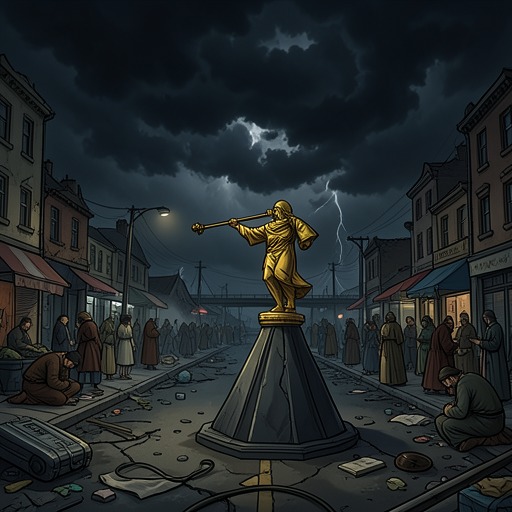
Book of MormonThe State of darkness names the spiritual condition produced when people turn away from the Word of God and thereby lose the light, knowledge, and guidance that would direct them toward repentance and salvation. In the record, darkness stands in opposition to revelation, faith, the Spirit of the Lord, and the redemptive knowledge centered on Jesus Christ. It is therefore both a condition of understanding and a condition of moral separation: the less willingly a person receives divine truth, the less light remains available to guide action.
Definition and Sources of Darkness
The contrast begins with the expectation that the words of Christ will tell people all things they should do. Revelation is presented as practical direction, not merely abstract information: those who attend to it can know how to proceed, while those who do not ask or receive it remain unable to understand. The State of darkness thus develops where divine instruction is resisted or neglected, and its defining feature is not that truth is absent but that the person has ceased to respond to the truth offered.
The record also describes a graduated loss of knowledge. When people harden their hearts, they receive only the lesser portion of the word until they know nothing concerning the mysteries of God. This progression gives darkness a cumulative character. Resistance does not simply preserve a person at an earlier level of understanding; it narrows the field of apprehension, allowing spiritual ignorance to deepen as the heart becomes less receptive. The condition is therefore linked to both will and knowledge: a hardened disposition obstructs revelation, and diminished revelation leaves the person increasingly vulnerable to error.
Causes and Spiritual Development
The decisive cause of darkness is hardening the heart against God. The text repeatedly places responsibility upon the human response to commandment, prophecy, and revelation. The Lord prepares a way for people to accomplish what he commands, so disobedience cannot be explained simply as the absence of opportunity. The contrast between divine preparation and human refusal makes the State of darkness a condition of rejected possibility: light is made available, but it is not welcomed or followed.
The same pattern appears in the record's account of spiritual transformation. Alma the Younger declares that he repented of his sins and was redeemed of the Lord, describing himself as born of the Spirit. His testimony establishes the inverse of darkness: repentance restores a person to spiritual life and renewed perception. A later appeal recalls that his father believed the words of a holy prophet and that, according to his faith, a mighty change was wrought in his heart. Faith and repentance therefore function not as external labels but as forces capable of reversing the inward condition that darkness represents.
The people who respond to King Benjamin provide another counterexample. They believe the words spoken to them and know their surety and truth because of the Spirit of the Lord. Their movement from hearing to believing to knowing shows what darkness lacks: active reception, spiritual confirmation, and a living relation to revealed truth. The State of darkness is not simply the opposite of information; it is the opposite of this whole movement toward conviction and inward change.
Consequences of Choosing Evil
The most explicit description of the condition appears in Alma's teaching about the state of the wicked. The spirits of those who are evil have no part or portion of the Spirit of the Lord because they chose evil. Darkness is therefore connected to a deliberate moral direction, not merely to intellectual uncertainty. The absence of the Spirit follows a choice, and the resulting deprivation leaves the wicked without the divine presence that would otherwise sustain, correct, and illuminate them.
This consequence gives the State of darkness an eschatological dimension. The condition reaches beyond temporary confusion and bears upon the final relation between the individual and God. The wicked do not merely lack answers during mortal life; by choosing evil, they place themselves outside the portion of spiritual influence associated with righteousness and rest. The record's language of choice, deprivation, and judgment makes darkness both an inward reality and a condition with consequences beyond the present probationary state.
Light, Memory, and Interpretation
Against darkness, the record sets searching, remembering, and receiving. Jesus Christ commands his people to search the words of Isaiah diligently, presenting scripture as a source whose meaning must be actively pursued rather than passively assumed. The record likewise exhorts future readers to remember how merciful the Lord has been to the children of men. Search and memory work together: searching opens the text, while remembering places its claims within the long history of divine mercy.
The book's own origin also opposes darkness. It is an abridgment of the records of the Nephites and the Lamanites, written to the Lamanites, to the house of Israel, and to Jew and Gentile by commandment and through prophecy and revelation. It was written and sealed, hidden up unto the Lord so that it would not be destroyed, and brought forth in due time by the way of the Gentile through the gift and power of God. Its stated purposes are to show the remnant of the house of Israel what the Lord has done for their fathers, to teach them that they are not cast off forever, and to convince Jew and Gentile that Jesus Christ is the Eternal God manifesting himself unto all nations. The book consequently treats remembrance and disclosure as acts of deliverance from spiritual obscurity.
Narrative and Theological Significance
The State of darkness is best understood as a negative boundary that clarifies the record's central movement toward restoration. The book repeatedly places hardening beside faith, diminished knowledge beside revelation, chosen evil beside repentance, and spiritual absence beside the Spirit of the Lord. These contrasts make darkness a diagnostic category: it reveals what happens when individuals or communities refuse the means by which God offers understanding and change.
At the same time, the condition is not presented as an unavoidable destiny. The Lord prepares a way for obedience; the words of Christ provide direction; faith can produce a mighty change of heart; repentance can lead to redemption and being born of the Spirit; and sincere hearers can pass from belief into knowledge through the Spirit of the Lord. The record's final appeal to remember divine mercy and search its words leaves the reader with an active alternative to darkness. Spiritual light is not treated as automatic possession, but neither is darkness an irreversible verdict wherever repentance and receptive faith remain possible.