Testimony of the Three Witnesses
Book of MormonThe Testimony of the Three Witnesses is a formal declaration by Oliver Cowdery, David Whitmer, and Martin Harris concerning the Golden Plates. They testify that the plates contained the record of the Nephites, the Lamanites, and the Jaredites, that the record had been translated by the gift and power of God, and that an angel showed them both the plates and their engravings. The event therefore functions not merely as an episode of discovery but as a public transfer of authority: an extraordinary material object and a sacred translation are presented through the shared testimony of three named observers.
Purpose and Historical Frame
The testimony appears within the front matter of The Book of Mormon, where the record is described as an abridgment of the history of the Nephites and Lamanites, together with an abridgment from the record of the Jaredites. That framing gives the witnesses' statement a wide intended audience. Their declaration is addressed to all nations, kindreds, tongues, and people, rather than to a closed circle of believers, and the record itself is directed toward the Lamanites as a remnant of the house of Israel as well as toward Jew and Gentile.
The surrounding account also defines the plates as a record preserved under divine direction. They are said to have been written, sealed, hidden up unto the Lord so that they might not be destroyed, and brought forth in due time through the gift and power of God. The witnesses' statement thus enters an already established chain of preservation, concealment, recovery, and interpretation. Their role is not to explain every stage of that chain, but to affirm that the physical record and its engravings were genuinely shown to them.
What the Witnesses Report
The three witnesses make two closely connected claims. First, they say that they saw the plates containing the record of the peoples of Nephi and the Lamanites, together with the record of the people of Jared, who came from the tower associated with the confounding of language. Second, they say that they saw the engravings upon the plates and knew that the translation had been accomplished by the gift and power of God, because the divine voice had declared this to them.
Their testimony distinguishes ordinary observation from sacred manifestation without separating the two. The plates and engravings are presented as visible objects, while the interpretation of those objects is attributed to divine power. The witnesses therefore do not claim only that a record existed; they connect its material existence with a supernatural account of how its meaning became available. Their knowledge is described as certain, yet the source of that certainty is both sensory and revelatory.
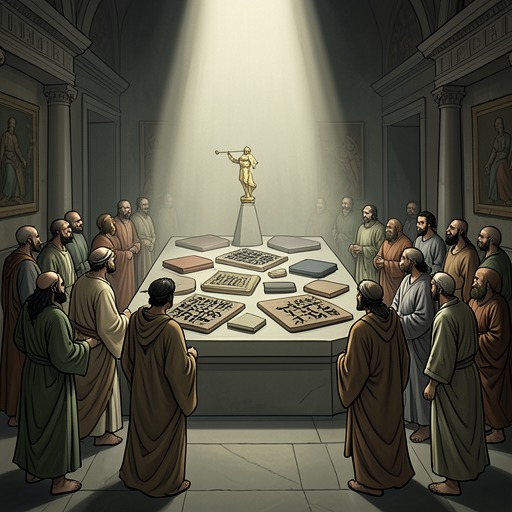
The central scene intensifies this claim. The witnesses declare that an angel of God came down from heaven, brought the plates, and laid them before their eyes, so that they beheld the plates and the engravings. The wording joins movement, placement, sight, and inscription: the angel is the heavenly intermediary, the plates are the material evidence, and the act of seeing is the witnesses' immediate encounter with both. This is not presented as a report based on rumor or on another person's description.
The Three Signatories and the Form of Witness
The declaration names Oliver Cowdery, David Whitmer, and Martin Harris. Their names appear beneath the collective statement, turning a general proclamation into an accountable document attached to identifiable human witnesses. The form matters because the testimony repeatedly emphasizes that the signatories bear record themselves and that they speak with sobriety. Their authority is consequently distributed across three persons rather than resting solely on an unnamed crowd or on an impersonal institutional voice.
The witnesses also describe obedience as part of their act. They say that the voice of the Lord commanded them to bear record, and that they do so in obedience to the commandments of God. Testimony is therefore represented as both privilege and obligation. They did not merely have an unusual experience; they were charged to make that experience public. The statement's religious force comes partly from this movement from seeing to commanded speech.
Their conclusion places the declaration within a moral and eschatological framework. They affirm that, if they are faithful in Christ, they will rid their garments of the blood of all men and be found spotless before the judgment-seat of Christ, dwelling with him eternally in the heavens. The testimony thus links the credibility of their witness to faithfulness, accountability, and final judgment. It closes by giving honor to the Father, the Son, and the Holy Ghost, identified as one God, and ends with Amen.
Relation to the Eight Witnesses
The Testimony of the Three Witnesses is paired with the Testimony of the Eight Witnesses, but the two statements establish authority through different kinds of encounter. The Three Witnesses describe an angelic visitation and divine confirmation of the translation. The Eight Witnesses, by contrast, say that Joseph Smith, Jun., showed them the plates, that they handled as many leaves as had been translated, and that they saw and hefted them. They describe the plates as having the appearance of gold, with engravings resembling ancient work and displaying curious workmanship.
This pairing creates a deliberate evidentiary contrast. The three witnesses' account emphasizes revelation, an angel, and the divine source of translation; the eight witnesses' account emphasizes bodily contact, weight, visible workmanship, and the act of being shown the plates by Joseph Smith, Jun. Together, the declarations present the record through complementary forms of testimony: a sacred manifestation and a material encounter. The Three Witnesses event is therefore strengthened in the book's front matter not by repetition alone, but by juxtaposition with another mode of seeing and touching.
Consequences and Narrative Significance
The testimony establishes a collective public witness for a record whose stated purpose is expansive and covenantal. The book is presented as evidence of what the Lord has done for the fathers of the remnant of the house of Israel and as a means by which readers may know that the Lord's covenants have not cast them off forever. It also declares that Jesus Christ is the Eternal God manifesting himself unto all nations. The witnesses' statement supports this larger mission by asserting that the record is real, its engravings were seen, and its translation came through divine power.
The event also anticipates the book's recurring concern with testimony as a means of making hidden things available. The record is sealed and hidden until the proper time, then brought forth through translation and proclamation. The three witnesses stand at the threshold between concealment and public reception. Their declaration does not erase the distance between the ancient record and later readers; instead, it marks that distance with a chain of mediators: ancient record keepers, the translator, the angel, the witnesses, and the worldwide audience addressed by the text.
Finally, the testimony includes an explicit defense against a simplistic demand for human perfection. The record's prefatory material acknowledges that faults may be mistakes of men and asks readers not to condemn the things of God because of them. In that setting, the witnesses do not claim that every human act surrounding the record is flawless. They testify specifically to what they saw, to the engravings, to the angelic manifestation, and to the divine declaration concerning translation. The event's lasting narrative power comes from this disciplined structure: personal experience becomes communal knowledge through named witnesses, solemn language, commanded publication, and a claim that the object seen belongs to a history larger than any individual observer.