The Voice from the Dust
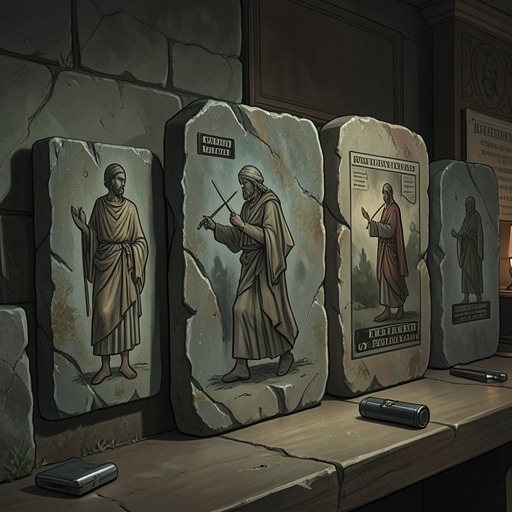
Book of MormonThe Voice from the Dust names the Book of Mormon’s central image of testimony speaking across burial, distance, and historical ruin. In its fullest formulation, Nephi addresses the house of Israel and the ends of the earth as “the voice of one crying from the dust,” bidding them farewell until the great day to come. The image joins the physical emergence of a record from the earth with the moral demand that later readers hear the words of people whose lives, communities, and memories have otherwise been swallowed by time.
Definition and Scriptural Setting
The expression appears at the close of Nephi’s record, where his address moves beyond his immediate descendants to the house of Israel and to all the ends of the earth. His voice is therefore both personal and representative. He speaks as a historical witness whose record has survived the disappearance of the world that produced it, but he also speaks for a dispersed people whose future identity depends on receiving the testimony preserved in writing. The farewell does not signify simple silence. It creates a delayed encounter in which Nephi’s words remain active until a future day when their hearers must answer them.
The dust carries several meanings at once. It is the material place from which buried plates and records are brought forth; it evokes mortality and the return of human bodies to the earth; and it marks the condition of a people remembered through remnants rather than through uninterrupted political power. The voice is not detached from historical loss. It speaks because a record has endured beneath that loss, turning destruction into an occasion for witness.
Records, Memory, and Transmission
The Voice from the Dust depends on the preservation of records. King Benjamin teaches his sons that the brass plates contain knowledge that would otherwise be lost, making the plates an instrument through which language, history, and the commandments of God remain available to later generations. In this framework, remembering is not merely private recollection. It is a communal practice supported by material objects, deliberate teaching, and the repeated transmission of ancestral knowledge.
The larger record repeatedly binds identity to movement. Lehi’s family departs from Jerusalem into the wilderness after the Lord commands Lehi in a dream to take his family and leave because their lives are threatened. Later, Nephi and his brothers return to Jerusalem to bring Ishmael and his family into the wilderness; other groups undertake further journeys; the sons of Mosiah separate in the borders of the land of the Lamanites to preach; and the people of the Lord eventually gather their flocks and herds before departing into the wilderness. These migrations make the voice from the dust a voice of displaced communities. The record preserves not only doctrine but routes, separations, dangers, and the repeated effort to carry a people’s identity through changing lands.
The surviving record also preserves emotional and generational memory. Nephi describes his people as lonesome and solemn wanderers, cast out from Jerusalem and born in tribulation, with their lives passing as though in a dream. The phrase gives collective suffering a durable form: hardship that might vanish as an unrecorded experience becomes part of the inheritance offered to later readers. At another point, a father praises his son’s faithfulness, diligence, patience, and long-suffering among the Zoramites. Such praise shows memory working at a more intimate scale, preserving not only national catastrophe but the moral endurance of particular people.
A Voice Addressed to the Future
The expression is directed toward those who come after the record’s original communities. Mormon speaks to the remnant of his people who may be spared, asking that they receive his words and learn about the things of their fathers. His appeal transforms the record from a monument to the past into an instrument of future recognition. The remnant is not asked merely to possess an ancestral document; it is asked to understand the history and obligations that the document makes present.
The later voice becomes more urgent when it describes the record’s eventual emergence from the earth. Mormon states that no one should say these things will not come, because the Lord has spoken, and that the record will come forth from the earth by the hand of the Lord. Its appearance will occur in a time when people say miracles have ceased, yet it will come as though someone were speaking from the dead. This formulation intensifies the image’s paradox: the record is materially silent, but its arrival produces speech; its authors are dead, yet their testimony confronts a living audience; and what appears to be an archaeological recovery is presented as an event of divine disclosure.
The future reader is therefore part of the expression’s meaning. The voice from the dust does not depend on the original audience’s presence. It crosses the gap created by death, exile, political collapse, and the long interval between writing and reading. Its power lies precisely in that gap, because the reader encounters testimony that has survived without the institutions, bodies, or communities that once carried it.
Historical Ruin and Narrative Significance
The image acquires force against the record’s recurrent scenes of departure and destruction. Nephi’s family leaves Jerusalem under threat; scattered groups undertake journeys into the wilderness; missionaries enter the borders of the Lamanites; and Mormon gathers his people at the land of Cumorah while knowing that the final struggle of his people is at hand and that he is growing old. At Cumorah, the record is written in the shadow of anticipated annihilation. The voice from the dust thus emerges from a narrative in which preservation is never guaranteed and writing is an act performed against the possibility of total disappearance.
That tension also explains the expression’s relation to authority. Nephi returns to the tent of his father after speaking with the Lord, presenting revelation as something carried back into family and communal life. Nephi’s challenge to his brothers asks why they have not hearkened to the word of the Lord, showing that testimony may confront resistance within the originating community before it reaches later generations. The voice is not simply a calm report of the past; it is an exhortation that remembers disobedience, warns against forgetting, and seeks a response.
The Voice from the Dust finally makes the Book of Mormon’s material form part of its theology of memory. Plates, engraved records, inherited teachings, journeys, and the ruins of peoples all converge in the idea that the past can speak when faithfully preserved. The voice does not erase suffering or restore the destroyed communities to their former condition. Instead, it gives their remnants a continuing address. Through that address, the dead become witnesses, the buried record becomes a summons, and historical memory becomes inseparable from repentance, covenant identity, and accountability before God.