Three days of darkness
Book of MormonThree days of darkness is the sacred interval that follows the death of Jesus Christ in the New World. It is not presented as ordinary night, but as a divinely announced sign accompanied by storms, earthquakes, thunder, lightning, tempest, destruction, and a voice heard throughout the land. Its end brings both physical restoration and a narrative transition toward the Lord’s renewed dealings with the house of Israel.
Prophetic Sign and Historical Meaning
The darkness is first identified prospectively as a sign of Jesus Christ’s death. Samuel the Lamanite teaches that when Christ suffers death, the sun will be darkened and will refuse to give its light. The prediction places the event within a larger covenantal and prophetic framework: Christ’s death is not merely a distant religious claim but an occurrence that will be registered in the natural world and made known to an entire people.
The Book of Mormon’s larger record frames this sign as part of a history preserved for the remnant of the house of Israel, for Jew and Gentile, and for the purpose of convincing them that Jesus is the Christ, the Eternal God manifesting himself to all nations. The darkness therefore functions simultaneously as a historical event, a covenant sign, and evidence within a record whose stated aim is recognition of Christ.
The Catastrophe Begins
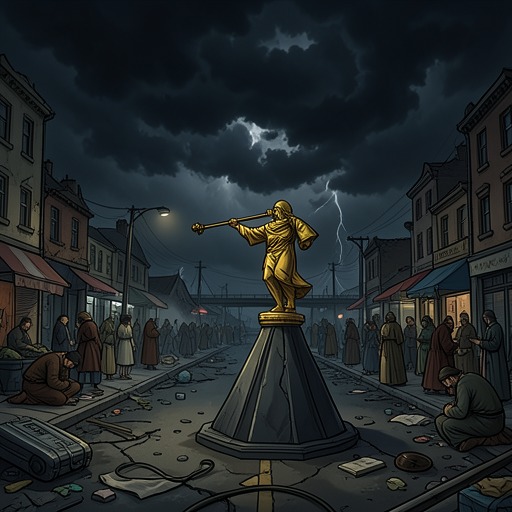
In the thirty-fourth year, during the first month and on the fourth day, a storm unlike any previously known in the land arises. The unusual date and the unprecedented character of the storm give the event a precise historical setting while also marking its rupture with ordinary experience. The catastrophe is not described as a single atmospheric disturbance: it expands into a compound assault of thunderings, lightnings, storm, tempest, and quakings of the earth.
The violence of the event makes the landscape itself unstable. The prophetic sign is realized through a natural world that appears to respond to Christ’s death, and the narrative joins cosmic darkness to terrestrial upheaval. The sequence transforms what might have been perceived as an invisible or distant tragedy into an experience shared across the land by communities that must endure the same disorientation and threat.
Darkness, Voice, and Collective Witness
After the violence, a voice is heard among all the inhabitants of the earth, across the entire land. The voice gives the darkness an interpretive center: the people are not left with unexplained ruins or terror alone, because divine speech enters the catastrophe and addresses the inhabitants collectively. The event thus moves from sign, to destruction, to revelation.
The storm, tempest, quakings, thunderings, and lightnings last for about three hours before they cease. Darkness then covers the land for three days. The contrast between the relatively concentrated period of physical violence and the sustained duration of darkness creates a distinct temporal structure: destruction is sudden and tumultuous, while darkness is prolonged, enclosing, and difficult to escape. The three-day interval becomes a measured sacred time within which the survivors remain separated from ordinary daylight.
The darkness is also a period of grief. When it passes, the people remember the loss of kindred and friends, so the event’s significance is measured not only by the scale of physical disturbance but by the human communities it damages. The shared experience produces a collective memory in which celestial sign, bodily survival, bereavement, and divine communication remain inseparable.
The Return of Light
At the end of the three days, morning comes, the darkness disperses from the face of the land, the earth ceases to tremble, and the natural order resumes. The ending is therefore more than the simple arrival of daylight. Each principal feature of the catastrophe is reversed: darkness gives way to light, trembling gives way to stillness, and the extraordinary interval closes within the ordinary rhythm of morning.
Yet restoration does not erase what has happened. The people emerge from the darkness carrying the knowledge of death, destruction, and loss. The return of light marks a threshold rather than a return to innocence. The catastrophe has prepared the narrative for further divine action, and the revealed meaning of Christ’s death continues beyond the three days.
Narrative and Theological Significance
As a unit of sacred time, the three days hold together prophecy and fulfillment, terror and interpretation, death and the possibility of renewed order. The event’s chronology is carefully staged: a predicted sign, a precisely dated storm, overwhelming physical upheaval, a voice heard throughout the land, approximately three hours of convulsion, three days of darkness, and finally the dispersal of darkness at morning. This ordered progression makes catastrophe narratively intelligible without making it less severe.
The interval also establishes a contrast between human limitation and divine purpose. The inhabitants experience an event whose scale exceeds ordinary explanation, but the record presents it within a history of covenants and prophetic witness. The darkness is consequently both an interruption of time and a form of disclosure. It conceals the land while revealing the significance of Christ’s death, and it leaves the survivors prepared to understand subsequent manifestations of the Lord and the continuing establishment of his people, the house of Israel.