Weapons of Peace
Book of MormonWeapons of Peace name a pattern of action in which a community answers violence not by abandoning moral responsibility, but by renouncing retaliation, entering binding covenants, proclaiming shared principles, and maintaining disciplined religious life. In the Book of Mormon, this pattern is most fully embodied by the Anti-Nephi-Lehies, whose buried swords make repentance visible, but it also appears in the public covenant of the Title of Liberty, in the church’s strict discipline, and in collective prayer and worship. Peace is therefore not mere passivity: it is an organized moral practice that competes with priestcraft, kingship, secret combinations, and armed domination as a way of ordering society.
Repentance and the Buried Sword
The Anti-Nephi-Lehies adopt Weapons of Peace after acknowledging the depth of their former violence. Their account of repentance describes them as having been among the most lost of mankind and as having committed many murders; their change is consequently presented not as a minor alteration of conduct but as a reversal of the identity by which they understand themselves. The memory of bloodshed remains central, yet it becomes the reason they will no longer reproduce it.
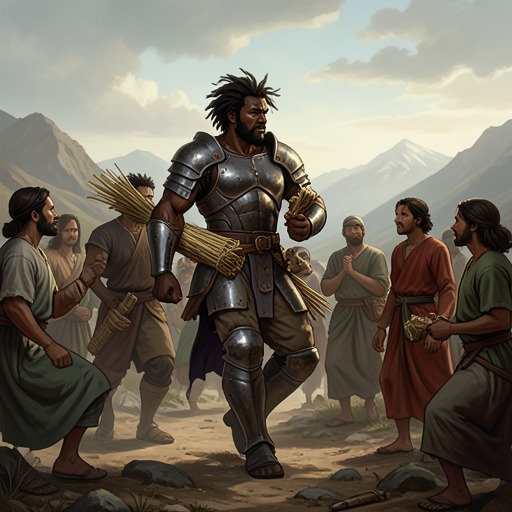
That resolve receives a material form when they bury their swords. They explain that, if their enemies seek to destroy them, they will hide their weapons and bury them rather than return to killing. The buried weapons function as both restraint and testimony: the community removes the means of revenge from immediate reach and creates a lasting sign that its covenant is stronger than fear. This is an unusually concrete form of moral commitment, because the people do not merely declare that they have changed; they surrender an instrument through which the old life could be resumed.
The covenant is tested almost immediately. When enemies attack again, the Anti-Nephi-Lehies refuse to take up arms and allow themselves to be slain according to their enemies’ desires. Their nonviolence is therefore costly, public, and collective. It does not depend on the claim that danger has disappeared. Instead, it asserts that preserving the new relationship with God and with one another matters more than securing survival through the violence that had defined their former society.
Peace as Organized Religious Practice
Weapons of Peace are sustained through institutions and repeated communal actions rather than through private feeling alone. After the king’s proclamation, Aaron and his brethren travel from city to city and from one house of worship to another, establishing the church among the people. The movement from house to house gives the new order a social infrastructure: repentance is taught, worship is organized, and a former enemy population is gathered into a recognizable religious community.
The same pattern appears in the discipline of the church. Later church members are described as strict in preventing iniquity; when wrongdoing is identified, the offender is condemned before the elders. Such discipline shows that peace in the narrative is not equivalent to moral indifference. A community seeking to end violence must also regulate conduct, name wrongdoing, and preserve standards through recognized communal procedures. The force opposing violence is thus partly devotional and partly institutional.
Collective prayer provides another form of peaceful power. When the disciples pray and fast mightily, Jesus Christ appears among them and asks what they want. The scene places the community’s appeal, rather than armed strength or political command, at the center of its encounter with divine authority. Prayer does not erase conflict by itself, but it directs communal desire toward a power that is neither secret domination nor coercive force.
Public Covenants Against Rival Powers
The contrast between Weapons of Peace and other forms of social power becomes sharp in moments of political crisis. When Moroni, the chief commander of the Nephite armies, hears of Amalickiah’s dissensions, he is angry. His response is not merely a military maneuver; he calls the people into a covenant around the Title of Liberty, inviting those who will maintain it to come forward in the strength of the Lord and pledge to preserve their rights and their religion. The public sign and the spoken covenant convert private alarm into collective commitment.
This covenant differs from the secret signs and secret words of the Gadianton robbers. Those signs distinguish members of a hidden brotherhood and enable a concealed covenant connected with power, theft, and social corruption. The Title of Liberty instead seeks visible allegiance. One order protects itself through secrecy and mutual criminal obligation; the other gathers people through an openly proclaimed standard and a publicly witnessed pledge. The contrast suggests that the legitimacy of collective power depends not only on its stated goal but also on whether its obligations are accountable to the wider community.
Weapons of Peace also stand against unstable or overly concentrated political authority. When the people call for Aaron son of Mosiah to be their king, the episode reveals the continuing attraction of hereditary rule. Yet the broader political movement away from kingship places authority in public judgment rather than in dynastic succession. In this setting, covenant, church discipline, proclamation, and the voice of the people become alternative means of preserving order without making obedience depend upon a single ruler.
Limits, Consequences, and Significance
The night without darkness associated with the birth of Jesus Christ offers the largest cosmic confirmation of a peaceful order: darkness does not come, the night remains as light as midday, and the people recognize the promised day from the sign. The episode contrasts divine assurance with the uncertainty produced by threats and violence. It does not portray peace as an ordinary political achievement alone; it connects peaceful hope to the arrival of Jesus Christ and to the recognition of a sign that a threatened people had been waiting to see.
Yet the narrative does not treat nonviolence as a simple universal solution. The Nephites gather women, children, flocks, herds, and substance into fortified places when the Gadianton robbers threaten them. The response is defensive organization, not the Anti-Nephi-Lehies’ willingness to accept slaughter. This contrast makes Weapons of Peace a particular covenantal discipline rather than a mechanically applied rule for every population and circumstance. Its meaning depends on identity, prior repentance, communal promises, and the perceived duties of protection.
Peaceful order also requires procedures for the aftermath of conflict. When prisoners of war are brought forward and cast themselves at the feet of the Nephites while pleading for mercy, Moroni takes them prisoner, seizes the city, and controls the defeated force. Mercy appears here within a framework of accountability and security rather than as an erasure of consequences. The scene helps define the wider ethic: peace may include mercy, but it does not require the community to surrender judgment or abandon protection.
Taken together, these episodes present Weapons of Peace as a rival system of power. Repentance changes the individual and the group; buried swords make renunciation tangible; worship and discipline maintain the new identity; public covenants oppose secret combinations; prayer redirects collective desire; and mercy can interrupt the cycle of revenge after victory. The enduring significance of the concept lies in this combination of inward conversion and outward structure. Peace survives only when it is embodied in objects, vows, institutions, and repeated communal choices.