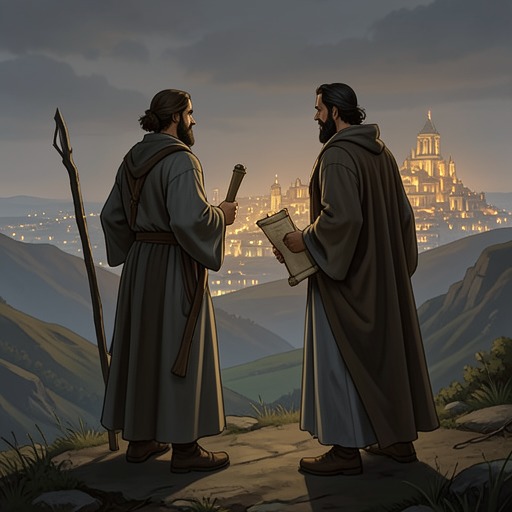
144,000 Sealed from Israel
Book of RevelationThe 144,000 Sealed from Israel are presented as servants drawn from the tribes of Israel, marked by God before harm comes upon the land, sea, and trees. Their significance in the book rests not only on this protective sealing but also on a later vision in which they stand with Jesus Christ on Mount Zion. The author treats that second scene as a chronological puzzle: its position in Revelation seems to place the meeting before Christ’s return, while his interpretation relocates it until after the battle of Armageddon.
Identity and Status
Revelation 7 identifies the group by number and collective origin: 144,000 are sealed from the tribes of Israel. The author calls them specially chosen Jews and says they were sealed for a special purpose. The passage does not give individual names or personal histories; its focus is their shared status as servants of God and the act that marks them as a distinct group.
The number is given as 12,000 from each tribe. The quoted passage names Judah, Reuben, Gad, Issachar, Zebulun, Joseph, and Benjamin among those tribal designations. The list places the group within Israel’s tribal structure rather than presenting them as an undifferentiated crowd. Their identity is therefore both collective, through the total of 144,000, and distributive, through the allocation among the tribes.
Sealed Before Harm
The sealing scene begins with four angels standing at the earth’s four corners and holding back its winds. They have power to harm the land and sea, but are told to wait until God’s servants receive a seal on their foreheads. Another angel comes from the east carrying the seal of the living God and calls for the delay. The 144,000 are counted as the seal is applied; the narrated sequence makes their marking a condition that precedes the release of harm.
The scene establishes protection through timing and designation rather than through any action by the group themselves. They do not speak or undertake a task in the passage. Instead, the angels control the pause, and the servants are identified and sealed within it. In the author’s chronological framework, this episode belongs before the judgments that harm the earth. The sealing thus gives the group a defined place in the sequence: they are marked before the destructive events proceed.
The Chronological Puzzle
The group’s later appearance in Revelation 14 prompted the author’s reconsideration of the book’s order. He recalls being confused by the image of the Lamb standing on Mount Zion with the 144,000, because he understood that Christ’s first contact back on earth would occur when his feet touched the Mount of Olives. As he read Revelation again, he concluded that this scene was not located in chronological order where it appears in the text.
That conclusion became part of his broader claim that some passages in Revelation function as angelic interruptions or overlays: supplementary visions that need to be placed alongside the main sequence rather than read as the next event in time. He distinguishes the vision’s written location from the time he believes it depicts. This distinction allows him to keep the Mount Zion meeting without treating it as a visit that precedes Christ’s return. The group’s appearance is therefore central to the book’s interpretive method, not merely an isolated detail about their identity.
The Meeting on Mount Zion
In the Mount Zion vision, the Lamb stands with the 144,000 Sealed from Israel, who bear the Father’s name on their foreheads. A sound from heaven is compared in Revelation to many waters and great thunder, accompanied by harpists. The group sings a new song before the throne, the four living creatures, and the elders; the passage says that no one else can learn it. Their scene brings together the earthly location of Mount Zion and the heavenly setting of worship before the throne.
The account further describes them as redeemed from the earth, as firstfruits to God and the Lamb, as following the Lamb wherever he goes, and as without guile and without fault before God’s throne. It also characterizes them as virgins. These descriptions present the group through consecration, fidelity, and worship rather than through individual biography or dialogue. Their distinctive song marks them as a company with a place in the heavenly assembly, while the name on their foreheads links this vision to the earlier sealing scene.
The author places this meeting after Christ’s return and the battle of Armageddon. He reads the scene as a transition: Jesus Christ meets the 144,000 on Mount Zion, after which they appear to be translated to God’s throne for a special worship service. The text of the vision supplies the Mount Zion gathering and the worship before the throne; the sequence and proposed translation are the author’s interpretation of how those images fit together.
Narrative and Interpretive Significance
The two appearances give the group a role that spans the book’s chronology. In Revelation 7 they are numbered and sealed before harm is permitted; in Revelation 14 they appear with the Lamb, sing before the throne, and are described as redeemed firstfruits. The author’s arrangement connects these scenes across a timeline, while acknowledging that their placement in Revelation can make their relation difficult to see when the book is read straight through.
This reordering also shaped the book’s reception among some readers. One correspondent praised the placement of Revelation 14, saying the chapter made sense as a picture of the church’s rapture once it was put in its proper place; another described the chronological arrangement as making Revelation intelligible after previously finding it disjointed. These responses document the appeal of the author’s reading, rather than independently establishing its chronology. Within the book, the 144,000 Sealed from Israel remain the clearest example of how a single group can connect a scene of protection before judgment with a later scene of worship after Christ’s return.