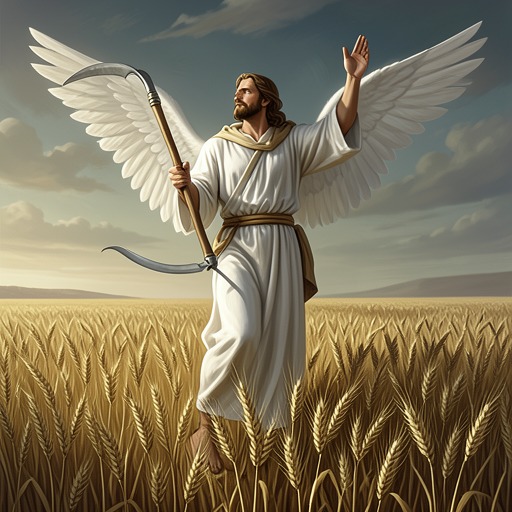
An Angel Gathers the Wicked and the Earth’s Grapes
Book of RevelationAn Angel Gathers the Wicked and the Earth’s Grapes is the harvest vision in Revelation 14:17–20, where two angels direct the gathering of the earth’s ripe vine and its destruction in The winepress of the wrath of God. The book’s author interprets the scene as divine judgment on the unrepentant and the armies gathered for The Battle of Armageddon, making it a symbolic account of the conflict whose participants and outcome are shown again in Revelation 19.
Vision and Sequence
John the Apostle sees one angel emerge from the heavenly temple carrying a sharp sickle. Another angel comes from the altar, has authority over fire, and calls to the sickle-bearing angel to harvest the earth’s vine because its grapes are ripe. The first angel thrusts the sickle into the earth, gathers the vine, and casts it into the winepress. The vision thus moves through a compact sequence of command, harvest, and judgment; its agricultural imagery turns the earth itself into the field from which the condemned are collected. The image’s force lies in the contrast between ripeness and destruction. The grapes are ready for gathering, and the angel’s action follows that readiness rather than depicting a dispute or delay. The book’s author identifies those gathered as the unrepentant and treats the harvest as an action carried out by angels serving God’s army. The passage does not name individual human targets; its collective language presents judgment at the scale of the earth and the assembled forces opposed to the returning Christ.
The Winepress and Armageddon
The vision culminates in The winepress of the wrath of God, located outside the city. Its stated scale is conveyed through the image of blood rising to the height of horses’ bridles and extending for 1,600 furlongs. The author specifically reads that measure and image as a reference to The Battle of Armageddon. In his account, the passage is not an isolated agricultural episode: the grape harvest represents the destruction of the armies assembled for the battle, while the winepress expresses the severity and reach of the judgment. The interpretation connects Revelation 14 with the later battle scene in Revelation 19. In the latter, the Beast, the kings of the earth, and their armies gather to wage war against the rider on the white horse and his army. The Beast and the False Prophet are captured and cast alive into the Lake of Fire; the remaining forces are slain by the sword proceeding from the rider’s mouth, and birds are summoned to consume the dead. These details give the earlier harvest image a military referent in the author’s reading: what Revelation 14 presents as grapes gathered and pressed, Revelation 19 narrates through the assembled opponents and the defeat of their forces.
Relation to the Book’s Chronological Reading
The commentary places this interpretation within its larger claim that Revelation is not presented wholly in chronological order. The author argues that out-of-sequence passages have contributed to competing interpretations, including disagreement about the timing of the rapture. His own reading therefore treats apparent sequence with care, looking for places where one passage supplies a vision or summary that connects with events described elsewhere. His account of Revelation 14:17–20 explicitly returns to this passage as the commentary proceeds through Revelation 19. He says the angels go into action to harvest the unrepentant and wipe out the armies assembled for Armageddon, then turns to the later scene in which the Beast and the earthly kings gather against the rider. The effect is to make the harvest a key interpretive link between symbolic vision and battle narrative, rather than simply another item in an uninterrupted list of chronological events. This is an explanation advanced by the book’s author; the passage itself gives the sickle, vine, winepress, location, and measure, while the identification with the Armageddon armies belongs to his reading of their relation.
Judgment and Aftermath
The episode’s outcome is comprehensive in scale: the earth’s vine is gathered, and the harvest is cast into the winepress. The author places that judgment alongside the destruction of the opposing armies in Revelation 19 and then points to Revelation 14:1–5, where Jesus Christ meets the 144,000 on Mount Zion. He says that meeting takes place after Christ’s return and after the battle, and suggests that the group is translated to God’s throne for a special act of worship. This juxtaposition sets the harvested wicked and defeated armies against the surviving, sealed group brought into a scene of worship. The harvest consequently serves both as an image of judgment and as a structural hinge in the author’s reading of Revelation. Its short, forceful action anticipates the fuller account of the battle, while its placement beside the Mount Zion scene helps him distinguish the fate of the unrepentant from the gathering of the 144,000. The chapter’s agricultural metaphor does not replace the conflict in Revelation 19; in this commentary, it compresses that conflict into an image of ripe fruit gathered and subjected to God’s judgment.