Armageddon
Book of RevelationArmageddon is the gathering place for the final confrontation between the beast, the kings of the earth, and their armies on one side, and Christ and the armies of heaven on the other. In the author’s chronological reading of Revelation, it is more than a name attached to a battle: it marks the end of the conflict against evil and the turning point toward Christ’s reign and the worship of God.
The Place and Its Narrative Setting
Revelation identifies Armageddon as a place called by that name in the Hebrew tongue, where the assembled forces are gathered for the great day of God Almighty. The passages considered here do not supply a fuller geographical description. Armageddon is therefore defined chiefly by its role in the prophetic sequence: it is the destination of a gathering that brings the world’s kings and their forces into the same conflict.
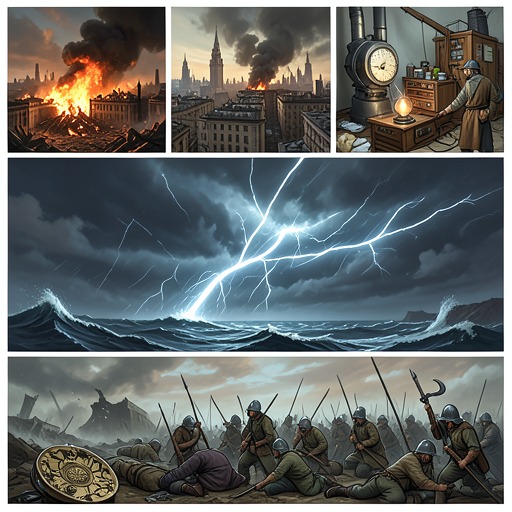
The gathering follows the appearance of three unclean spirits associated with the dragon, the beast, and the False Prophet. These spirits go out to the kings of the earth and the whole world to assemble them for battle. The text then names Armageddon as the place where they are brought together. The scene’s movement is from a worldwide summons to a single named destination, making the location a focal point for a conflict that has global participants.
The Final Battle in the Chronological Reading
The author places Armageddon after the outpouring of the bowls of God’s wrath and connects it with Christ’s return on a white horse. Christ is presented as judging and making war, while the armies of heaven follow him. The author describes the saints in white robes as part of these heavenly armies and reads the scene as Christ’s victory over Satan and the forces of evil.
The opposing forces are identified as the beast, the kings of the earth, and their armies, gathered to fight the rider and his army. The outcome is decisive: the beast and the False Prophet are captured and cast alive into the Lake of Fire, while the remaining forces are defeated. Armageddon thus signifies not an unresolved contest or a temporary reversal, but the collapse of the assembled opposition to Christ. Its narrative consequence is that the battle against evil reaches its conclusion and the sequence can move beyond the battlefield.
The Harvest and the End of Conflict
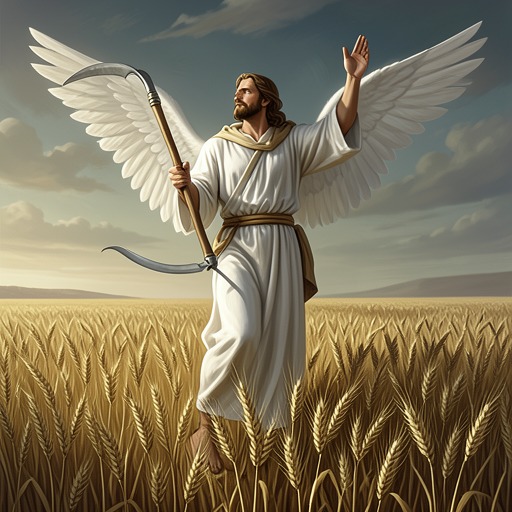
The author also places Revelation 14:17–20 in the account of the events surrounding Armageddon. In that passage, angels harvest the earth, gathering its ripe vine and casting it into the winepress of God’s wrath. The author interprets this as the gathering of the unrepentant and the destruction of the armies assembled for the battle. The harvest image therefore supplies another part of the same end-stage conflict in this reading: Armageddon’s significance extends beyond the confrontation between the mounted forces to include the judgment that accompanies the end of the war.
This connection depends on the author’s rearrangement of Revelation’s material by chronology. The book is said to contain passages that are not presented in event order, and the author treats some passages as interruptions that can be repositioned to clarify the sequence. Armageddon consequently serves as a point around which separate images—the gathering of the kings, Christ’s appearance, the angelic harvest, and the defeat of the beast’s forces—are brought into a single account of the final battle.
From the Battlefield to Mount Zion and the Throne
For the author, the end of the battle also explains the placement of the vision of Christ with the 144,000 Sealed from Israel on Mount Zion. The author argues that this meeting cannot occur before Christ’s return, because Christ’s first contact with the earth on his return is associated with the Mount of Olives. Accordingly, the meeting on Mount Zion is read as occurring after the battle of Armageddon, rather than as an earlier event in Revelation’s sequence.
The scene then leads from Mount Zion toward the throne in heaven. The 144,000 Sealed from Israel hear heavenly music and sing before the throne, the Four Living Creatures around the Throne, and the elders. The author interprets this as a special meeting of honor after their mission and as a transition from the battlefield on earth to worship in heaven. Armageddon is thus the dividing line between the final conflict and the movement toward heavenly worship and reward.
Significance in the Book’s Structure
Armageddon’s importance in this account arises from the way it organizes the ending of the conflict. The author uses it to connect the gathering of the world’s armies with Christ’s return and victory, the harvest of the earth, and the subsequent meeting on Mount Zion. The named place is not given an independent geographical history; its meaning comes from the events and transitions attached to it.
That structural role also illustrates the book’s broader argument for chronological reading. By relocating passages that the author regards as out of sequence, the account presents Armageddon as the close of the earthly war against evil and as the hinge between judgment and what follows. Its narrative arc runs from worldwide mobilization to defeat, then from the battlefield to worship before God’s throne.